A watch arrives in a drawer of inherited things, or turns up at an estate sale priced just low enough to be tempting, and the question is immediate and practical: how to tell if a watch is real before any money changes hands. You do not need a loupe collection or a trade background to make real progress. Most of what separates a convincing counterfeit from a genuine watch is visible in the hand, in the seconds hand, and in the way the case is finished.
Start with four observations: the weight and feel of the case and crystal, whether the seconds hand ticks in discrete steps or sweeps in many small beats, the crispness of the printing on the dial, and whether the serial and reference numbers engraved on the case match any paperwork. Poor printing, a hollow case, and mismatched numbers are the signals that most often mark a fake.
Here is how to run each of those checks yourself, and the one problem that passes every fake test and still costs money.
How to tell if a watch is real by weight and materials
Pick it up before you look at it. Solid stainless steel, solid gold, and a sapphire crystal all have a density and a coolness in the hand that plated brass and mineral or acrylic crystal do not. A case that feels light and slightly hollow for its size is a signal worth pursuing, as is a bracelet whose links rattle loosely and weigh almost nothing.
Then look at the edges. Plating wears first where the case meets the strap, so a warm yellow or coppery tone showing through at the lug edges, the clasp corners, or the caseback rim tells you the gold is a surface layer rather than the body of the case. Under the FTC Jewelry Guides, a gold-plated or gold-filled item has to be described accurately rather than sold as gold, so a listing that says only “gold” for a watch with wear-through at the lugs is a description problem regardless of whether the watch itself is genuine. A struck fineness mark on a solid gold case, in the pattern set out by The Assay Office, is a much stronger claim than a color.
The crystal is the other material tell. Sapphire sits at 9 on the Mohs scale, per the International Gem Society hardness ordering, which is why a sapphire crystal on a watch that has been worn for years still looks clear while a mineral or acrylic crystal of the same age is a web of fine scratches. Hold the watch under a light at an angle: a field of hairlines on a watch presented as having sapphire is worth asking about. A drop of water on sapphire also tends to bead up tightly and hold its shape rather than spreading flat, a rough indicator rather than proof.
The movement: does the seconds hand tick or sweep?
This is the fastest single check, and it costs nothing. A quartz movement advances the seconds hand once per second, in one visible step. A mechanical or automatic movement beats several times per second, so the hand appears to glide almost continuously around the dial. Watch the seconds hand for ten seconds and you will know which family the movement belongs to.
The check matters because it can contradict the seller directly. A watch sold as an automatic that steps once per second almost never is one, since the vast majority of automatic and hand-wound movements beat several times a second; the rare exception is a “dead-beat seconds” complication, built specifically to mimic a quartz tick, so treat a one-per-second automatic as a red flag to ask about rather than an automatic verdict. The reverse also happens: a smooth-looking sweep on a cheap watch is sometimes produced by a quartz movement with a multi-step motor, so look closely enough to see whether the motion is genuinely continuous or a fast series of jumps.
Two other movement observations help. An automatic winds itself from wrist motion and will typically restart when gently rocked, and you can often hear the rotor shift when you tilt the case. If the watch has a display caseback, look through it: a well-made movement shows deliberate finishing, decoration on the bridges, and visible jewels, while a cheap movement looks plain, stamped, and roughly assembled. Opening a closed caseback is a watchmaker’s job, not a check to attempt at home.
What the finishing shows under magnification
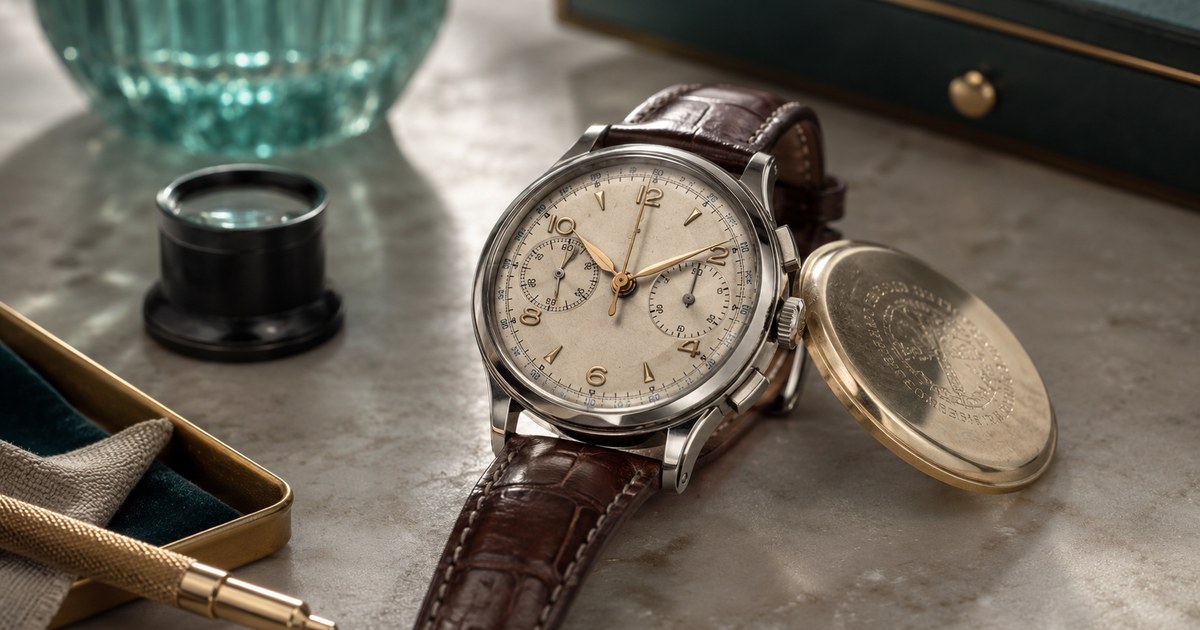
Counterfeits fail most reliably at small scale, because crisp printing and precise assembly are expensive. Put the dial under a phone camera at maximum zoom, or a cheap loupe, and look for:
- Dial text with clean, sharp letter edges and even spacing. Smudged, thick, blobby, or unevenly spaced printing is one of the strongest generic tells there is.
- Applied markers that sit flat, aligned, and evenly spaced around the dial, with no glue residue and no marker sitting at a slight angle to its neighbors.
- The date window, where the numeral should be centered in the aperture and printed in a consistent font, not sitting high, low, or off to one side.
- The hands, which should be cleanly finished, evenly colored, and mounted so they do not catch each other or scrape the dial or crystal as they pass.
- The bracelet and clasp, where end links should meet the case with even gaps on both sides, screws and pins should be neatly finished rather than rough, and the clasp should close with a precise, positive action instead of a vague snap.
- The crown, which should turn and, where it screws down, thread smoothly without grinding or cross-threading.
None of these is decisive alone. Several of them together, in the same direction, usually is.
Serial numbers, reference numbers, and the paperwork
Genuine watches generally carry engraved reference and serial numbers, most often on the caseback, between the lugs, or inside the caseback. What you are judging is the quality of the engraving and the consistency of the numbers, not the numbers themselves. Crisp, evenly cut engraving with consistent depth reads differently from shallow, grainy, acid-etched, or laser-scorched text, which is common on counterfeits.
Then compare. If a warranty card, service record, or original paperwork comes with the watch, the serial and reference on the case should match the paper exactly. A mismatch between the watch and its documents matters far more than a missing box, because a box and papers can be bought separately while a mismatch suggests the parts and the paperwork have different histories. Where a genuine watch has been serviced, service papers from an authorized centre are a stronger provenance signal than a generic receipt, and provenance is one of the value drivers we cover in what makes jewelry worth more.
A definitive authentication is a job for a watchmaker or an authorized service centre, because it means opening the case and comparing the movement against factory records. A photo-based first read cannot do that, and neither can a caseback inspection in a car park.
The genuine watch that is not original: the “franken” problem
Here is the case almost every buyer’s guide skips. A watch can be entirely genuine and still be a poor purchase, because over decades of servicing it has quietly accumulated parts that did not leave the factory with it. A replacement dial fitted at a service, a new bezel insert, a swapped crystal, replacement hands, or a bracelet borrowed from another example all produce a watch that passes every counterfeit test on this page. It is not a fake. It is a real watch that is no longer original.
That distinction matters because originality is one of the strongest value drivers in the vintage and collectible watch market. Collectors pay for a dial that has aged as a unit with the watch, for the correct hands, for the bezel and bracelet the model shipped with. A service-replaced dial or an aftermarket bezel can move a watch’s realistic resale value substantially, in a way that no amount of “but it is authentic” reasoning recovers. Confusingly, a franken watch often looks better than an honest original, because the replaced parts are newer and cleaner.
So ask the question directly, and ask it as a checklist rather than a yes-or-no: is the dial original to this watch, are the hands original, is the bezel or insert original, is the crystal original, is the bracelet original to the case. On any purchase large enough to matter, get the answer in writing. A seller who knows the watch will answer specifically. A seller who deflects to the fact that it is “100 percent genuine” has answered a different question than the one you asked.
How to photograph a watch for identification
Whether you are asking a specialist, a forum, or an app, the photographs decide how useful the answer is. Shoot the caseback straight on with light raking across it from the side so the engraving casts a shadow and becomes readable. Photograph the lugs from both sides, including any numbers between them. Open the clasp and shoot its interior, where marks and finishing quality show. Take the dial straight on, angled just enough to kill the reflection, then again at high zoom on the date window and the text at the bottom of the dial. Finally photograph any papers, cards, or service records alongside the watch.
Steady hands, diffuse light, and a plain background do more for a first read than any amount of resolution. The full method, including how to handle glare on a curved crystal, is in how to photograph jewelry for identification, and the specific marks and features to capture on a wrist piece are covered in our watch identifier guide.
The practical takeaway
Run the checks in order of cost: lift it, watch the seconds hand for ten seconds, zoom in on the dial text and date window, read the caseback engraving, then compare those numbers to whatever paperwork exists. Most counterfeits fail two or three of those before you have spent anything. If the watch clears them and the price is significant, the next two questions are originality of every visible part and a professional opinion. Weigh the cost of that opinion against the sum at stake, which is the calculation in how much does a jewelry appraisal cost, and remember that resale value, insurance replacement value, and what a dealer will hand you today are three different numbers.
For a watch you cannot place, scan it with GemPeek before you commit: it reads the likely type, the visible stamps and materials, the case condition and finish, and an estimated value range, so you walk into the conversation with a jeweler or watchmaker with a well-informed first read instead of a guess.