
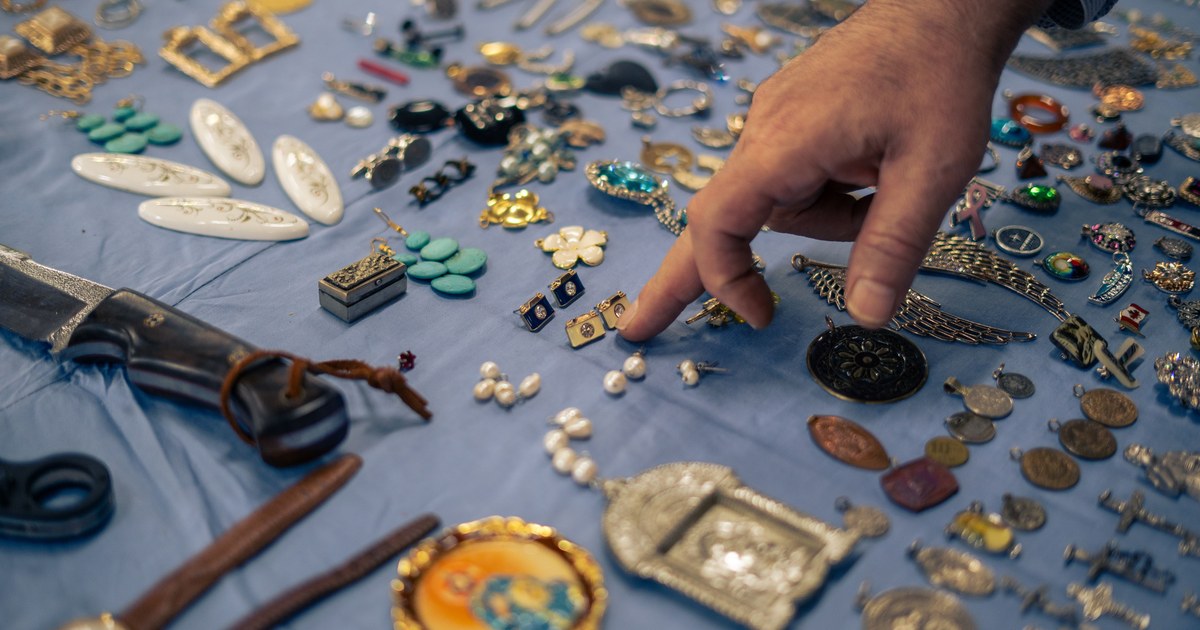
Estate sale jewelry has a reputation it only half deserves. The pieces everyone imagines, the forgotten diamond ring or the solid gold bracelet priced like costume jewelry, do turn up, but rarely in the glass case by the front door. Professional estate sales often sort the jewelry before opening and price the obvious fine pieces separately, although practices vary by company.
The realistic opportunity at an estate sale is in the mixed trays and bags: costume jewelry, broken chains, and unsorted boxes where a marked gold or silver piece can slip through. Check every clasp and inside every band for a karat or silver mark, weigh anything promising in your hand, and ask whether the fine jewelry was tested before pricing.
That is the whole strategy. The rest of this guide is how to do it quickly, on a crowded Saturday, without tools you would feel silly carrying.
How estate sale jewelry is usually priced
Most sales run by an estate company follow a similar pattern. Before opening day, staff go through the house, group the jewelry, and price it. Anything with a clear karat stamp, a signature, or a stone that looks significant tends to go into a locked case near the checkout, sometimes after a quick test. Everything that looked like costume jewelry goes into trays, bowls, or bagged lots at the other end of the price scale.
Discounts then change through the sale. EstateSales.org describes a common structure: full price on the first day, a quarter off on the second, and half off on the last. Shoppers report that the discount does not always reach the jewelry case; one writer describes Sunday sales where everything except designer items and jewelry was reduced. If you are waiting for the last day to buy a specific piece, ask the staff whether the case is included.
What this tells you about where to look:
- The case: fairly priced, sometimes above resale. Good for buying something you want to wear, less good for bargains.
- The trays and bags: where the sorting is fastest and least expert. This is where the checklist below earns its keep.
If you want the difference between “estate,” “vintage,” and “antique” pinned down before you shop, what is estate jewelry sorts out the terms.
The 5-minute estate sale jewelry checklist
You do not need a testing kit. You need good light, a small magnifier, and a little patience.
1. Read every mark
Turn each piece over. Check inside ring bands, on clasps and the small tag near them, on earring posts, and on the back of pendants and brooches. You are looking for:
- Karat marks: 10K, 14K, 18K, or the three-digit versions 417, 585, 750.
- Silver marks: 925, STERLING, or 800.
- Qualifiers that mean plated or filled: GF, RGP, GP, HGE, GE, or a fraction like 1/20. These are gold layers over base metal, not solid gold.
The FTC’s consumer guide adds one more habit worth borrowing: a karat mark should normally sit near a maker’s name or registered trademark, so a lone karat stamp with no maker mark deserves a closer look rather than automatic trust.
2. Use a loupe, not your phone camera
Marks on old jewelry are small and worn. A 10x loupe lets you read a half-polished stamp, check whether a stone is chipped, and see whether prongs are thin. How to use a jeweler’s loupe covers the technique; it takes a minute to learn and saves a lot of guessing.
3. Check the clasp with a small magnet
Gold and silver are not magnetic. A strong pull toward a small magnet usually means base metal, although a steel spring inside a real gold clasp can pull a little, so test the chain links as well as the clasp. A magnet cannot confirm gold, but it can quickly rule out a lot of costume pieces.
4. Feel the weight
Solid gold is heavy for its size. With practice, a hollow or plated chain feels noticeably light compared with a solid one of the same width. It is not a test, just a filter for what deserves a closer look.
5. Check whether sets match
Earrings, a necklace and bracelet, or a brooch and earrings that were made together are usually worth more as a complete set than apart. Look for the same metal color, stones, and maker’s mark across pieces, and ask staff to keep a set together if they have split it between trays.
6. Look at the construction
Well-made pieces tend to show it: hand-set prongs rather than glued stones, soldered jump rings, safety catches on brooches, and a clasp that closes firmly. Glue residue around stones and green discoloration on the metal point toward costume jewelry, which can still be collectible but prices differently.
For the full sequence of checks behind these shortcuts, how to tell if gold is real walks through marks, wear, and the tests a jeweler would use.
Questions to ask the estate sale staff
Staff often know more than the price tag says. A few polite questions can save you from overpaying or missing something:
- “Was the jewelry tested, or priced by eye?” Tested pieces are priced closer to value. Untested trays are where the opportunity is.
- “Is the jewelry case included in the discount days?” Policies vary between companies.
- “Are these trays from one owner or mixed in?” Some companies add consignment stock, which changes what you are looking at.
- “Can I see it under the light?” Most will let you step to a window.
Mistakes that cost estate sale buyers money
- Paying karat prices for a plated stamp. “14K GP” or “14K HGE” is a layer of gold, not solid 14K. Under the FTC’s rules, the word gold on a plated item has to be qualified, and those letters are the qualification.
- Assuming “old” means “valuable.” Age helps only when the maker, material, or design is desirable.
- Ignoring condition. Missing stones, broken clasps, and worn plating cut resale value sharply.
- Buying a whole bag for one piece without checking the rest. Often fine, but know which piece you are paying for.
The same checks work at a thrift store with less sorting and lower prices, which is why thrift store jewelry finds is worth a read if you shop both.
After the sale: sort before you sell
Once you are home, sort your finds into solid gold, sterling, gold filled or plated, and costume. Photograph each piece and its marks in good light. From there, the jewelry value guide explains how to move from a mark to a value range, and the necklace guide and bracelet guide cover the construction details that separate a keeper from a melt piece.
GemPeek can speed up that sorting: scan a piece and you get its likely type, materials, visible stones, style and era, condition, and an estimated value range, so you know which finds deserve a closer look before you list anything.