
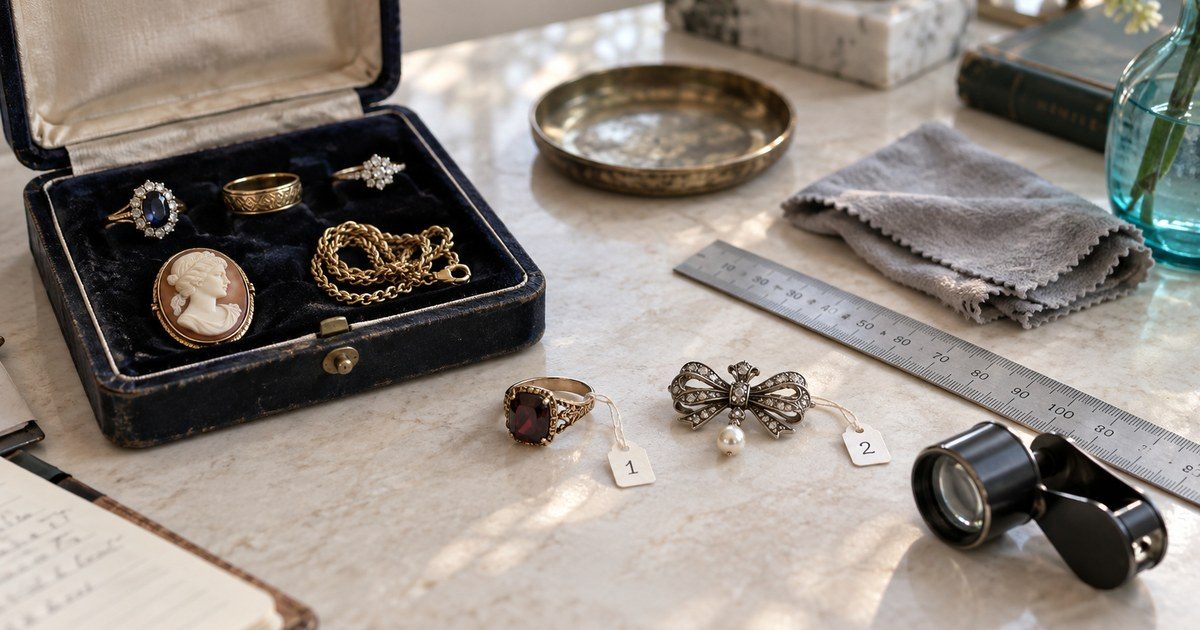
Handing an appraiser a shoebox is the most expensive way to start. Appraisers charge for their time, so a jumbled lot means paying a professional to do the sorting, photographing, and mark-reading that you could have done yourself over two evenings. Learning to inventory inherited jewelry before appraisal is the single cheapest thing you can do to control what the process costs.
An inventory is a numbered list with one row per piece, recording item type, metal mark, stone count and color, measurements, condition notes, and the file name of its photograph. Build it before you contact anyone, and you can ask for a quote on a defined lot rather than an unknown box, group the pieces that need a specialist, and prove what you had if anything goes missing.
The method below needs a spreadsheet, a phone, and two evenings.
Set up before you touch anything
Give yourself a clear table, a lamp, a soft cloth, a ruler with millimeter markings, a small digital scale that reads to a tenth of a gram, and a phone. Small resealable bags and paper tags help enormously. If you have a 10x loupe, keep it beside you for the marks.
Two ground rules before you start:
- Do not clean anything yet. Polishing can remove a patina that helps date a piece, and enthusiastic cleaning damages soft or porous stones, glued settings, and old enamel. Dirt costs you nothing; a scrubbed antique can cost real money.
- Do not sort by what looks valuable. The eye is unreliable here. Heavy gold-colored chains are often plated, and a dull, blackened chain is often sterling. Record everything and let the marks and the appraiser decide.
If the estate is still being settled, resist the urge to divide items among family before the inventory exists. A shared list is what keeps that conversation calm, and it is exactly what an estate valuation is going to need.
The columns to use
A single spreadsheet is enough. Use these columns, in this order:
- ID. A simple sequential number, 001 upward. This number goes on the bag or tag with the piece and into the photo file name.
- Item type. Ring, pendant, brooch, bracelet, chain, earrings (pair or single), watch, loose stone, cufflinks.
- Metal marks, transcribed exactly. 14K, 585, 750, 925, PLAT, and any letters that follow, such as GP, GEP, HGE, or GF. Those letters change the answer completely. The International Gem Society notes that plated pieces usually carry only a plating mark such as 14K GP rather than any indication of gold content by weight, so transcribe the suffix exactly and record “no mark found” only when there is genuinely nothing there. The FTC’s consumer guidance also points buyers to look for the maker’s name or trademark near the karat mark, so transcribe that too when it exists.
- Maker’s mark or signature. Copy it character by character even if it means nothing to you. On costume pieces this is often the most valuable line in the row.
- Stones. Count, color, approximate size in millimeters, and cut shape if you can name it. “Three colorless round stones, centre approximately 5 mm” is a genuinely useful entry. Do not guess the species; write what you see.
- Measurements and weight. Ring size or inner diameter, chain length, and gram weight. Weight matters for anything that might be sold as metal.
- Condition. Be blunt and specific: bent shank, missing stone in position three, clasp does not close, worn plating at edges, solder repair visible, discoloration. Condition is a real value driver and appraisers will note it anyway.
- Photo file name. Point to the actual files, for example
001-ring-front.jpg,001-ring-mark.jpg. - Group. Your own bucket for this piece, using the grouping below.
- Notes. Provenance, who wore it, any box, receipt, or old certificate that came with it. Paperwork is worth keeping with the piece.
Photograph each piece the same way every time: the whole piece on a plain neutral background, one close-up of the mark, and one of any damage. Consistency is what makes the set usable later, and the technique is covered in photographing jewelry for identification.
Store the spreadsheet and photos somewhere other than the phone that took them, and keep a copy off-site. An inventory that exists only on one device is also an insurance problem.
Group before you call anyone
Once every row exists, sort the list into four buckets. This is what turns a catalogue into a plan.
- Group A, precious metal with real stones. Marked gold or platinum pieces with substantial stones. These are the pieces that justify a professional appraisal, and they are where an appraiser’s time is worth paying for.
- Group B, precious metal, plain or damaged. Marked pieces with no significant stones, or broken ones. These are usually a metal-value question rather than an appraisal question.
- Group C, signed or period costume. Unmarked or plated pieces carrying a recognizable maker’s mark or a distinctive era look. These need a specialist or comparable sold listings rather than a gemological appraisal.
- Group D, the rest. Unmarked, unsigned, plated, or damaged costume pieces. Keep the list, but do not pay anyone to value them.
Most inherited boxes are heavily weighted toward groups C and D, and discovering that yourself is the saving. It is much cheaper to bring five pieces to an appraiser than fifty.
Know which appraisal you are asking for
This is where an organized owner saves the most money, because the purpose determines the method, the value type, and the fee. The American Society of Appraisers describes gems and jewelry appraisers as inspecting, identifying, and appraising precious stones and metals for sale, insurance, estate valuation, and other purposes, and those are genuinely different assignments producing different numbers for the same ring.
- Insurance replacement answers what it would cost to replace the piece today, and it is usually the highest figure of the three.
- Fair market value answers what it would sell for between a willing buyer and seller, and it is what estate, probate, and tax work needs.
- Resale or liquidation answers what you would actually be paid now, which is the number that matters if you intend to sell.
Tell the appraiser which one you need and why, and give them the inventory in advance. A defined lot with photos, marks, and weights already recorded lets a professional quote accurately instead of padding for the unknown. What those quotes look like and what drives them is covered in how much does a jewelry appraisal cost, and the parts of the process you can genuinely do yourself are in how to appraise jewelry.
Age matters here too. If several pieces turn out to be period rather than modern, a specialist in that market is worth finding, and the vocabulary for describing them is covered in what is estate jewelry.
The order of operations, start to finish
- Lay everything out, do not clean it, and bag and number each piece.
- Photograph each piece and its marks the same way.
- Fill in one row per piece, transcribing marks exactly.
- Weigh and measure anything marked as precious metal.
- Sort the rows into groups A to D.
- Decide the value question you actually need answered.
- Approach an appraiser or specialist with the shortlist and the file, not the box.
This whole process sits one step earlier than the decisions about keeping, selling, or splitting a collection, which is where inherited jewelry: what to do before you sell anything picks up.
Scanning each piece as you catalogue it makes the rows faster to fill: GemPeek reads back the likely type, the stones and materials it can see, the style, the condition, and a value bracket, which is enough to drop each piece into one of the four groups above before a professional ever sees the box.