
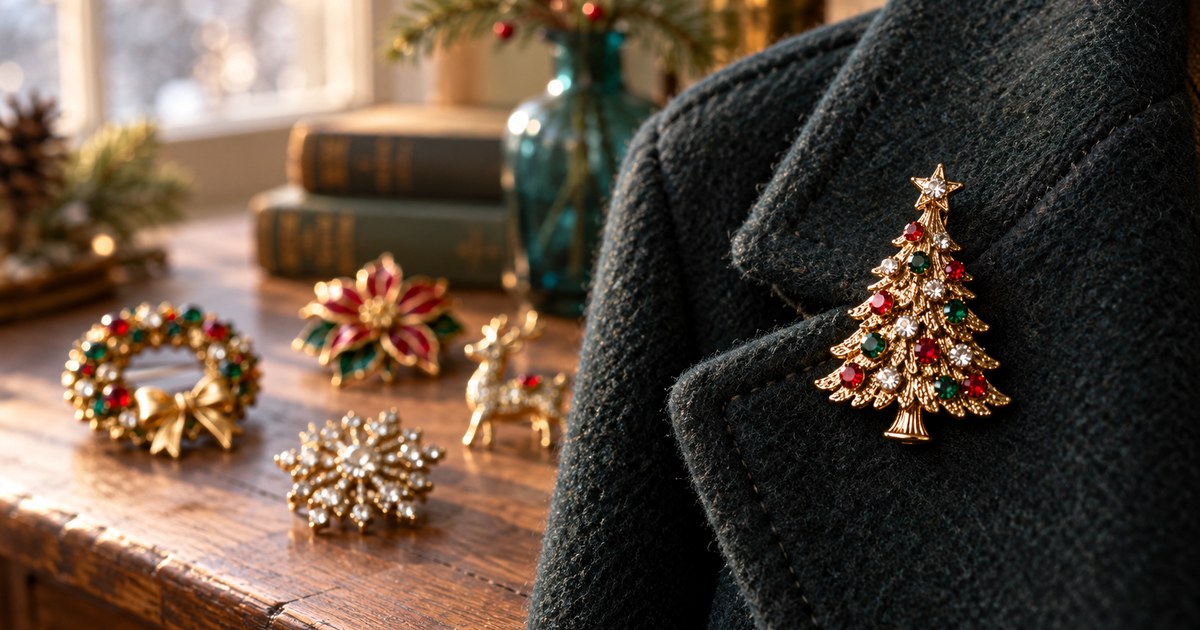
Vintage Christmas tree pins turn up in almost every inherited costume jewelry box: a little gold-tone tree studded with red, green, and clear stones, worn on a coat lapel every December for decades. Most are worth a modest amount. A few are worth considerably more, and the difference is usually visible in a few minutes if you know where to look.
Vintage Christmas tree pins are costume brooches, mostly gold-tone or silver-tone metal set with rhinestones and enamel, mass-produced from the 1940s and most popular in the 1950s and 1960s. Value depends on the maker’s mark, the design, and condition: many sell for tens of dollars, while signed or unusual designs from names like Weiss or Hollycraft can sell for more.
Here is how to work out which kind you have.
Where vintage Christmas tree pins came from
The Journal of Antiques and Collectibles dates the first mass-produced tree pins to the 1940s and puts their greatest popularity in the 1950s and 1960s. Most are cast metal, plated and often enameled, then set with stones; the same source describes the process as casting in a rubber mold, polishing and electroplating, attaching the pin back, hand-enameling, and finally setting the stones.
Antique Trader’s guide to vintage Christmas jewelry traces a similar arc: early holiday pieces were mostly dime-store novelties, many traditional costume jewelry companies joined in during the 1960s, and the trend ran into the early 1970s. Renewed collector interest arrived in the late 1990s and early 2000s.
That timeline matters because it tells you what to expect. A tree pin in an older relative’s jewelry box is most likely mid-century, made in quantity, and built the same way as other costume jewelry of the period. For the broader dating clues (clasp types, construction, and marks), see how to identify vintage jewelry.
Which makers to look for
Turn the pin over before anything else. The back carries most of the value information.
Makers named across collector sources include:
- Weiss, Hobé, and Hollycraft, which the Journal of Antiques and Collectibles names among the 1940s pioneers of the form.
- Eisenberg and Hattie Carnegie, whose rarer tree designs Antique Trader says are sought mainly by advanced collectors, and Trifari, which made only a limited number of Christmas designs.
- Mylu, ART, and J.J., which Antique Trader describes as more affordable makers.
- Later makers such as Swarovski, Kirks Folly, and Tancer II, listed by the Journal of Antiques and Collectibles among more recent tree pin producers.
A signature does not guarantee a high price, but it changes the conversation. An unsigned tree pin is priced on looks alone; a signed one can be compared against sold examples from the same maker.
How to read the marks
Marks are usually stamped on the back of the tree, on the trunk, or on a small oval plate soldered to the back. A few patterns worth knowing:
- Weiss tree pins often carry clear engraved markings, according to the Journal of Antiques and Collectibles.
- Hollycraft pieces from the 1950s are mostly dated, while 1960s pieces are typically stamped with the Hollycraft name and a copyright symbol without a date, per Antique Trader’s Hollycraft history.
- ART pins, made by Mode-Art, are marked ART in most cases.
- J.J. pins carry a mark first used in 1970, Antique Trader notes, which helps date a J.J. piece to that year or later.
Many tree pins have no mark at all. The Journal of Antiques and Collectibles points out that some makers identified their pieces only with paper tags or labels that have long since disappeared. Unsigned is common and does not mean low quality; it means the design and construction have to carry the value.
Photograph the back in sharp focus before you do anything else. A clear shot of the mark makes comparing sold listings far easier, and the technique is covered in how to photograph jewelry for identification.
Condition: what helps and what hurts
Tree pins were worn on heavy coats year after year, so condition varies widely. The Journal of Antiques and Collectibles gives the clearest rule: missing rhinestones can be replaced without hurting value, but dented, bent, rusted, or extensively paint-flaked pins have little monetary or visual appeal.
Check, in order:
- Stones. Count missing and darkened stones. A few gaps are a routine repair; widespread darkening, where the foil behind the stones has failed, is harder to fix.
- Enamel and plating. Look at the high points of the branches. Worn-through plating shows a darker base metal.
- The pin back. Make sure the pin closes and the catch holds. A broken or replaced finding is a common, fixable fault, but a buyer will notice.
- Shape. Bent branches and dents are hard to correct without further damage.
How much are vintage Christmas tree pins worth?
These are dealer and retail guide prices from named sources, not appraisals, and resale offers usually come in lower.
- The Journal of Antiques and Collectibles notes that attractive vintage pins can still be found for under twenty dollars, while some designer pieces run into the hundreds and rare ones can sell for thousands. Its captioned examples include a Weiss tree and a Hobé silver tree at $50 to $75 each and an unmarked pearl tree at $10 to $15.
- Antique Trader’s Hollycraft history suggests expecting to pay $35 to $75 for most Hollycraft tree pins, with unusual designs going over $100, and notes prices have eased since the collecting peak of the late 1990s and early 2000s.
What pushes a pin toward the top of its range: a recognized signature, an unusual or complex design, intact original stones, crisp plating, and a matching set such as earrings. What pulls it down: no mark, heavy wear, bent branches, and a design that turns up in large numbers.
If you have a whole tray of holiday pieces rather than one, the logic in is costume jewelry worth anything applies: the signature and design usually outweigh the materials, which are rarely precious.
Watch for import replicas
The Journal of Antiques and Collectibles warns that import replicas of many authentic pieces continue to appear, and points collectors to reference guides for tracking original designs. The practical defense is comparison: put a suspect pin beside verified photos of the same maker’s design, at the same angle, and check that the casting detail, the stone layout, and the mark on the back all match.
Thrift and estate sales are where most tree pins change hands, and the habits that work there apply here too; see thrift store jewelry finds and estate sale jewelry for checklists that cover marks, loupes, and clasp checks.
What to do with yours before December
Peak demand for holiday jewelry falls in the weeks before Christmas, so this is the time to sort what you have. Photograph the front and the back of each pin, note the mark exactly as it appears, record missing stones, and group matching earrings or sets together. That gives you everything you need to compare sold listings or show the pieces to a dealer.
GemPeek can speed up the first pass: scan a pin for the likely style and era, visible materials, condition, and an estimated value range, so you know which pieces deserve a closer look before you list or gift them.