
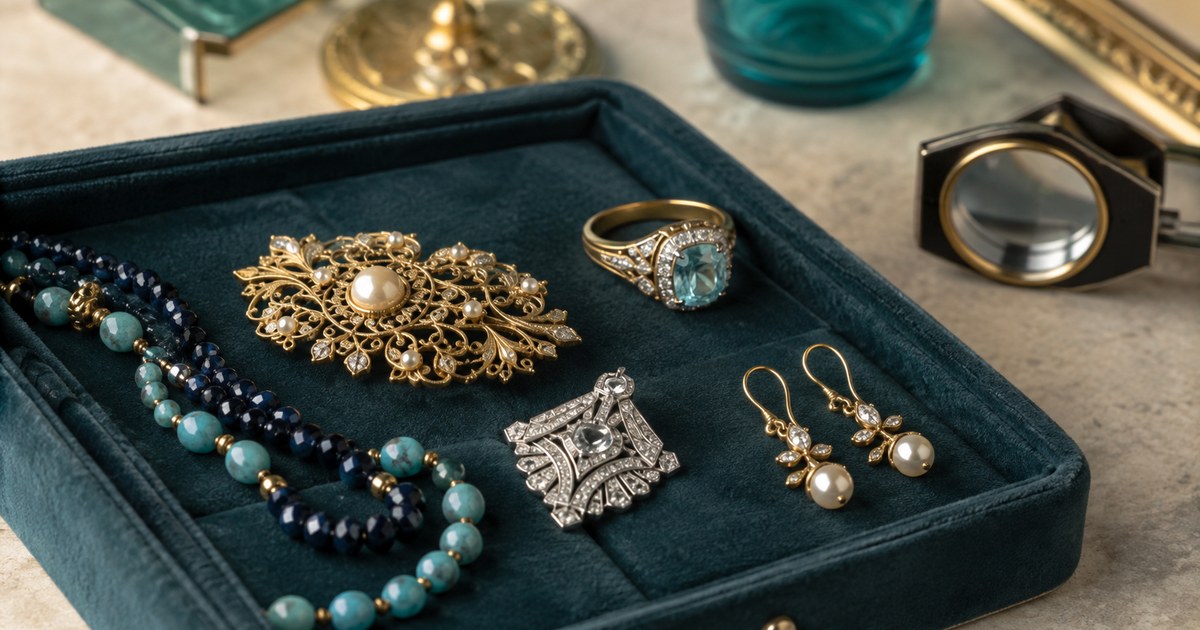
A ring comes back from a jeweler with a tag reading “estate,” an online listing advertises “fine estate jewelry,” and the word seems to carry a weight it never actually earned. People ask what is estate jewelry because the term sounds like a promise of age, provenance, or quality. It is none of those things, and understanding exactly what it does mean protects you whether you are the one buying or the one clearing out a jewelry box.
Estate jewelry simply means previously owned jewelry, at any age. A piece made last year and sold secondhand is estate jewelry. Vintage and antique are age terms layered on top: antique conventionally means about 100 years old or more, while vintage has no fixed definition and is used loosely across the trade, commonly starting somewhere around 20 to 25 years old and running all the way up to the edge of the antique threshold.
Here is how the three words overlap, where the definitions get soft, and what to actually check on a piece before that label affects what you pay or accept.
What is estate jewelry, and what does the word promise?
Estate is a sales category, not a description of the object. It tells you the piece has had a previous owner. That is the entire claim. It does not say the piece is old, that it came from a deceased person’s estate, that it was made by hand, or that it is worth more than an identical piece on the new-goods counter. Dealers use the word partly because it is accurate and partly because “estate” reads better on a tag than “used.”
Two consequences follow directly. First, a one-year-old mass-market ring taken in trade and resold by a store is legitimately estate jewelry, with no exaggeration involved. Second, and more usefully, the word is available to any seller for any secondhand item, so it carries no information you can price against. If a piece is genuinely old, genuinely signed, or genuinely well made, the seller will have specific evidence for that, and it will not be the word “estate.”
How estate, vintage, and antique actually differ
The three terms answer different questions, which is why they overlap so freely. A signed 1920s brooch on a dealer’s tray is antique, vintage in casual usage, and estate all at once.
| Term | What it claims | How firm is the definition |
|---|---|---|
| Estate | Previously owned | Firm in meaning, but says nothing about age |
| Vintage | Some meaningful age, short of antique | Loosest of the three, no agreed threshold |
| Antique | Roughly 100 years old or more | The widely used convention in the trade |
Antique is the most settled of the three. The hundred-year line is the convention the jewelry trade generally works to, and it is the same threshold United States customs practice has long used for antique goods. It is still a convention rather than a scientific fact, but when two people in the trade say antique, they usually mean the same thing.
Vintage is the term to be careful with. There is no standards body that defines it, no regulation behind it, and no single number the trade agrees on. Some sellers apply it at 20 or 25 years, others reserve it for anything not yet old enough to be antique, and plenty use it to mean nothing more than “older-looking.” When a listing says vintage, the honest reading is that the seller believes the piece has some age. If the age matters to your decision, ask for the basis rather than assuming their threshold matches yours. Dating a piece from its own evidence is a separate skill, and our guide to how to identify vintage jewelry covers the clasps, findings, and marks that place a piece in time.
Which claims about jewelry are actually regulated?
This is where the distinction becomes practical. The words describing a piece’s age and sales history are trade and marketing language. The words describing what a piece is made of are held to a much higher standard.
In the United States, the FTC Jewelry Guides set out how sellers may describe precious metals, gemstones, and treatments: what may be called gold and at what karat, when “sterling” is permitted, what qualifies as platinum, when a stone must be identified as laboratory-grown, and which gem treatments have to be disclosed. Those are the claims that give a buyer real recourse, and they are the ones worth checking on any secondhand purchase.
Treatment disclosure matters more than most buyers realize on older pieces, because a treatment can change both durability and value. GIA’s material on gem treatments explains why a clarity-enhanced or dyed stone needs different care and carries a different price than an untreated one. Nothing about the word “estate” tells you which you have.
What to check on an estate-labeled piece before buying
Ignore the label and interrogate the object. Working through this list turns a vague category into specific answers:
- Read the metal marks yourself. Find and photograph any fineness stamp (925, 375, 585, 750) and confirm it is consistent with the piece’s weight and wear.
- Look for maker or designer marks. A signature is one of the few things that reliably moves value, and it is worth far more attention than the tag wording.
- Inspect stones and settings closely. Check for chips, abraded facet edges, worn or re-tipped prongs, and stones that sit differently from their neighbors.
- Ask what has been repaired. Resizing, replaced shanks, re-soldered joints, and new clasps are all normal on secondhand pieces, but you should know about them before agreeing a price.
- Ask whether the stones are original to the piece. Replaced center stones and later substitutions are common and materially change what you are buying.
- Ask for treatment disclosure in writing. For any significant colored stone, get the seller’s statement on treatments on the receipt, not just verbally.
- Ask what the price is based on. A number anchored to a retail replacement appraisal is a different figure from realistic resale, and the two can be far apart.
If the seller cannot answer these questions, that is useful information. If they can, you now have a piece described by facts instead of by a category name.
What this means if you are the one selling
The same logic runs in reverse, and it is worth saying plainly: the word “estate” adds nothing to what you inherited. A box of secondhand jewelry is estate jewelry by definition, which is exactly why the term does not raise its value. What raises value is what is actually in the box, the maker, the materials, the craftsmanship, the condition, and the demand for the style, which is the ground covered in what makes jewelry worth more.
Sellers also get quoted the term back at them by buyers, sometimes as flattery and sometimes as leverage. Neither is meaningful. If a piece deserves a premium, it will be because of a signature, a stone, or a period design, and a qualified appraiser can say which. The National Association of Jewelry Appraisers is a reasonable starting point for finding someone credentialed when a piece looks like it warrants a formal opinion. Before anything leaves the house, what to do with inherited jewelry walks through the sequence.
The practical takeaway
Treat “estate” as shelf labeling. It confirms one fact, that the piece has been owned before, and it is not evidence of age, rarity, quality, or value. Antique has a usable convention behind it at roughly a century old, vintage has no agreed line at all, and neither term is regulated the way material claims are. Buy on the marks, the maker, the stones, and the condition; sell on the same. And be clear which number you are working with before you negotiate, because melt, realistic resale, and insurance replacement are three different figures, as the jewelry value guide explains.
If a piece has arrived with a vague label and no story, scan it with GemPeek for a structured first read: the likely type, the visible marks and materials, the style period, the condition, and an estimated value range. It gives you concrete details to ask about, or to verify with an appraiser, instead of a word on a tag.