
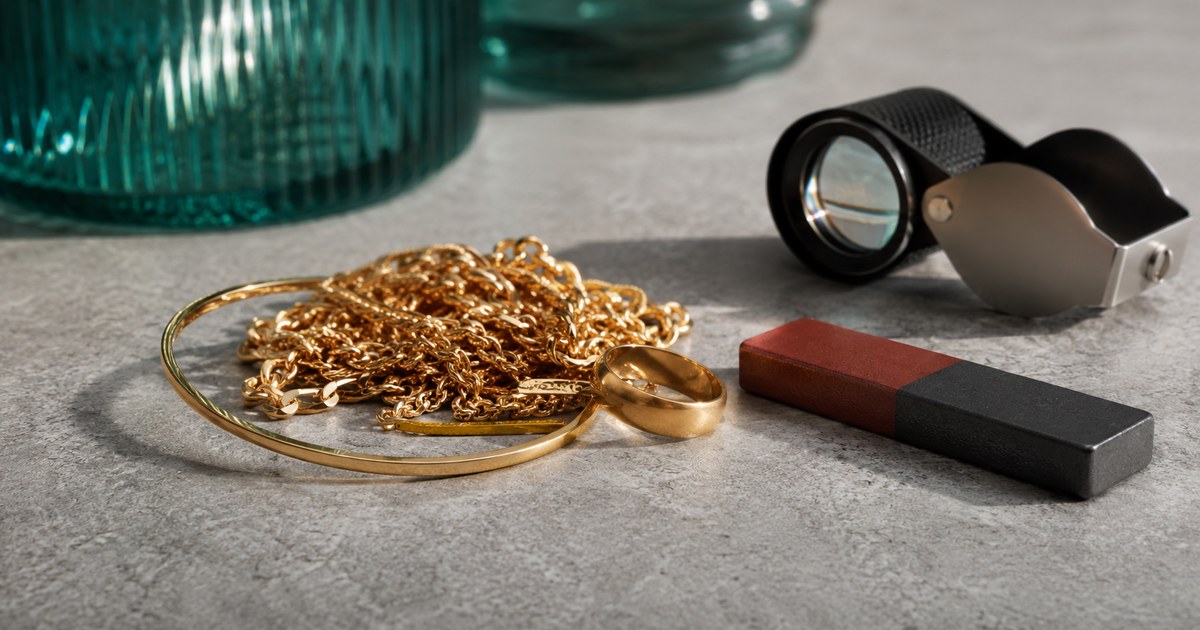
A chain from a thrift store, a ring from a relative, a bracelet bought on vacation: sooner or later everyone holds a piece and wonders whether the metal is what it claims to be. Knowing how to tell if gold is real starts with reading what the piece already says about itself, then layering quick physical checks on top, and knowing when to stop and let a professional finish the job.
To tell if gold is real, check for a karat or fineness mark first (10K, 14K, 18K, 24K, or 417, 585, 750, 999), then test with a strong magnet: real gold is not magnetic. Neither check is proof on its own, since fake stamps exist and many fakes are also non-magnetic, so confirm important pieces with professional testing.
Start with the marks: karat stamps and fineness numbers
Flip the piece over, check the clasp, look inside the band, and examine the back of pendants. Legitimately sold gold jewelry in the US is generally marked with its purity, and the FTC Jewelry Guides set out how those quality claims must be used honestly. You will see one of two systems, and they translate directly into each other:
- 10K = 417 fineness (41.7 percent gold, the lowest karat commonly used in American jewelry; the FTC dropped its old 10K floor in 2018, so lower karats can be sold as gold when the fineness is disclosed)
- 14K = 585 fineness (58.3 to 58.5 percent gold, the most common in American jewelry)
- 18K = 750 fineness (75 percent gold)
- 24K = 999 fineness (pure gold, soft and rarely used for everyday jewelry)
A karat number tells you the piece claims to be solid gold alloy throughout. Watch for qualifier letters, because they change the claim entirely: GF (gold filled), GP or HGE (gold plated), and GEP (gold electroplate) all mean a base metal core with gold only on the surface. The differences matter enormously for value, and our guide to gold filled vs gold plated vs solid gold breaks down how to spot each. If the mark says 925, you are holding sterling silver, possibly with gold plating over it (vermeil); see what 925 means on jewelry for that path.
Use a loupe or your phone camera zoomed in, because these stamps are tiny and often worn. On necklaces and bracelets the mark usually hides on or near the clasp; our necklace identification guide shows where to look on each clasp style.
What the magnet test actually proves (less than you think)
Grab the strongest magnet you can find, ideally a small neodymium magnet, and hold it to the piece.
- If the piece snaps to the magnet, it contains a ferromagnetic metal like iron, nickel, or steel. Solid gold is not magnetic, so a strong pull means the piece is not solid gold. That is a useful, fast rejection.
- If the piece does not react, you have learned very little. Brass, copper, bronze, aluminum, lead, and most silver alloys are also non-magnetic, and those are exactly the metals most fakes are made from.
So the magnet test only works in one direction: it can catch some fakes, but it cannot confirm gold. Passing the magnet test is a reason to keep checking, not a reason to celebrate. Also note that some genuine gold jewelry reacts anyway: steel springs inside clasps will pull, and nickel-alloyed white gold can show a faint tug against a strong neodymium magnet. Test the body of the piece rather than the hardware, and treat a faint tug differently from a snap.
Why no single test settles it
Two facts make gold testing genuinely tricky, and they are worth understanding before you trust any one result:
Fake stamps exist. A counterfeiter who fakes the metal will not hesitate to fake the mark. A crisp 18K stamp on a brass chain costs nothing to apply, which is why a mark is a claim to verify, not a verdict.
Gold filled pieces contain real gold, just not much of it. A gold filled bracelet has a genuine gold layer mechanically bonded over base metal. It will show real gold at the surface on a touchstone test, carry a legitimate GF mark, and still be worth a small fraction of a solid gold piece. Every surface-reading test is honestly fooled here, XRF included, because the surface really is gold. Only a method that reaches past the layer settles it: a deep file notch at an inconspicuous spot before the acid, a density measurement on a stone-free piece, or a refiner’s assay. This is the one case where a gold-buyer’s quick counter test and the truth can disagree without anyone lying, so read the mark before you accept the offer.
This is why single tests disagree by design. The marks, the magnet, the weight in your hand, and the wear points where plating rubs through are each one piece of evidence. Conclusions come from the pattern, not from any one check. This is also exactly the kind of pattern-reading a scan is good at: photograph the piece and its marks and GemPeek reads the visible evidence together, suggesting likely materials and an estimated value range as a first answer, which you should confirm professionally before a high-stakes sale.
The escalation path: density, acid, and electronic testing
When a piece passes the first checks and the stakes justify it, testing gets more rigorous:
- Density testing. Gold is remarkably dense: pure gold is about 19.3 g/cm³, roughly twice the density of brass or copper. A jeweler can weigh a piece in air and in water to estimate density. It works best on solid, stone-free pieces; hollow chains and set stones throw it off.
- Acid testing. The traditional touchstone method scratches a tiny sample onto a stone and applies calibrated acids that react differently by karat. It is reliable in trained hands, but doing it at home risks permanently marking or damaging your jewelry, and it still only samples one spot. This one is better left to professionals.
- Electronic and XRF testing. Electronic gold testers read conductivity, and X-ray fluorescence (XRF) machines read the actual elemental composition of the surface without damage. XRF is what serious bullion and jewelry buyers use, and a quick scan at a jeweler or refiner is the closest thing to a definitive answer for surface composition.
For an heirloom or a potential sale of any size, the practical move is simple: do the free checks yourself, then pay for an XRF or professional acid test only on pieces that survive them.
If it is real, what is it actually worth?
Real gold has three very different prices, and mixing them up causes most seller disappointment. Melt value is the raw metal content times the current gold price, and it is the floor a refiner works from. If your piece is stamped 14K, how much is 14k gold worth per gram walks through that exact melt-value formula with a worked example. Retail value is what a comparable piece costs new in a store, and it includes manufacturing and markup you cannot recover. Resale value is what a buyer will actually pay you, typically above melt for desirable pieces and near melt for generic ones. A 14K chain is about 58.5 percent gold by weight, so even its melt value is well below the same weight of pure gold. When you want the realistic number rather than the flattering one, start with our guide to what your jewelry is worth.
A sensible order of operations
Check the marks with magnification first, and note any qualifier letters. Run the magnet test to catch cheap fakes early. Weigh the evidence together rather than trusting any single check. Escalate real candidates to professional XRF or acid testing, and skip home acid kits. And before you sell, know whether the number you have in mind is melt, retail, or resale, because the piece in your hand carries all three at once.