
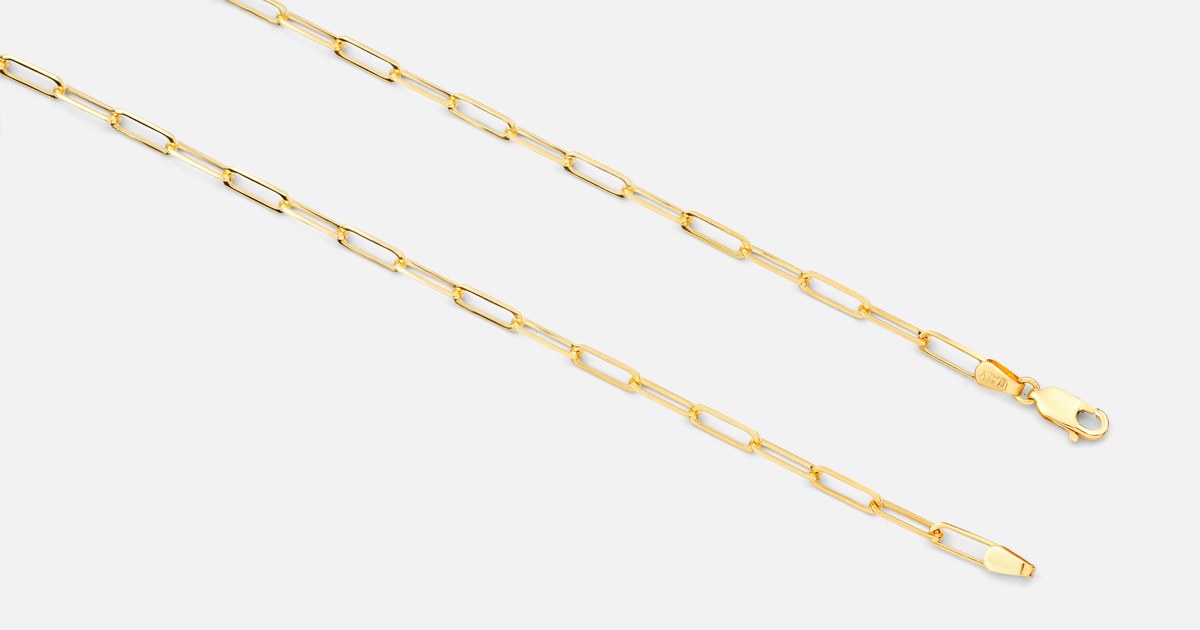
What does 14k Italy mean? You will see it most often on chains and bracelets, stamped on the clasp or on a tiny tag beside it. It reads like a brand, but it is two separate pieces of information: a gold purity mark and a country of origin.
“14K Italy” means the piece is stamped as 14 karat gold, which is 14 parts gold out of 24 (about 58.3% pure gold, stamped as 585 in the parts-per-thousand system), and that it was made in Italy. The stamp is a claim, not a certificate. Real Italian gold usually also carries a star-number-province mark identifying the maker, and a plated piece stamped “Italy” is still plated.
The sections below explain how to read each part, what the Italian marks look like, and how to spot a stamp that is telling you less than it seems.
”14K”: the purity mark
The karat mark tells you the gold content. The FTC’s consumer guidance explains the system: pure gold is 24 karat, and a piece marked 14K is 14 parts gold mixed with 10 parts other metals. That works out to 58.3%, conventionally stamped as 585 in the parts-per-thousand system. The UK Assay Office, for example, lists 585 as its 14 carat standard.
So “14K” and “585” mean the same purity. The three-digit version is explained in detail in what does 585 mean on jewelry, and how 14K compares with 10K and 18K for value and wear is covered in 10k vs 14k vs 18k gold.
”Italy”: the country of origin
“Italy” says where the piece was made, nothing more. The word does not say anything about quality, weight, or authenticity on its own.
Why Italian gold is usually stamped 585 or 750, not 14K
This is the detail most guides miss, and it helps you read a piece more accurately.
Under Italian law (Legislative Decree 251 of 1999), precious metal objects made and sold in Italy must be of a legal standard and stamped with that standard in parts per thousand, along with an identification mark. The Chamber of Commerce of Vicenza lists the legal standards:
- Gold: 750, 585, and 375
- Silver: 925 and 800
- Platinum: 950, 900, and 850
- Palladium: 950 and 500
The same decree allows production at other standards for export outside the European Economic Area. So a piece made for the Italian or European market is normally stamped 750 or 585, while a karat-style stamp such as “14K Italy” usually indicates a piece made for export, often to the US, where karat marks are the norm. Neither is more “real” than the other; they are written for different markets.
The star mark: Italy’s maker identification
Genuine Italian precious metal jewelry made under this system carries an identification mark: a five-pointed star, followed by a number, and then the abbreviation of the province, all inside a lozenge-shaped outline. The number is assigned by the local Chamber of Commerce to the registered maker, and the province letters show where that maker is based. You may see examples such as a star, a number, and “AR” for the province of Arezzo or “VI” for Vicenza.
What the star mark tells you:
- The piece was made by a registered Italian producer, identifiable by number and province.
- It sits next to the fineness stamp, such as 750 or 585.
The marks are tiny, often on the clasp or the tongue of a box clasp, and usually need a loupe. If a piece says “Italy” but has no star mark and no fineness, the stamp is telling you very little.
”925 Italy” and “750 Italy”
The same logic applies to other stamps:
- 925 Italy: sterling silver, 92.5% silver, made in Italy. The FTC notes that “silver,” “sterling,” and “sterling silver” describe products containing 92.5% silver. More in what does 925 mean on jewelry.
- 750 Italy: 18 karat gold, 75% gold, made in Italy.
- 375 Italy: 9 karat gold, 37.5% gold.
A gold-colored chain stamped “925 Italy” is gold-plated sterling silver or vermeil, not gold.
When an “Italy” stamp can mislead
A stamp is a claim, and there are three common ways it can mislead:
- Plated pieces: under the FTC Jewelry Guides, describing a plated item as gold requires qualification showing it is only surface-plated. A proper plated piece should carry GP, GEP, HGE, or similar alongside any karat. A piece stamped “14K Italy” with a plating mark is plated, not solid.
- Fake stamps: karat stamps can be struck on base metal. The FTC’s consumer guidance advises looking for a maker’s name or registered trademark near the karat mark, and treating a karat mark with no trademark alongside it with caution.
- Replaced clasps: a solid gold chain may have a replacement clasp, and a plated chain may have been fitted with a clasp from a real one. Check the chain links as well as the clasp.
If a stamp and the piece disagree, trust the tests. How to tell if gold is real walks through the checks, from wear patterns and magnets to acid and electronic testing.
What is 14K Italy gold worth?
A solid 14K Italian chain is valued like any 14K gold: its gold content sets the floor, and its design and condition can add to it. Melt value follows the formula grams x 0.585 x the spot price per gram. Italian manufacture does not change the gold content, although well-made chains in popular styles can sell above melt as jewelry.
The necklace guide and bracelet guide cover clasp and link construction, and the jewelry value guide explains how to move from a mark to a realistic value range.
For a first read on a chain with worn or tiny marks, GemPeek can scan it and give you the likely metal and karat, the style, condition, and an estimated value range, so you know whether it is worth weighing and testing properly.
Sources
- Camera di Commercio di Vicenza: Registro assegnatari marchio identificazione metalli preziosi (legal titles and the identification mark)
- D.Lgs. 22 maggio 1999, n. 251: Disciplina dei titoli e dei marchi di identificazione dei metalli preziosi
- FTC Consumer Advice: Buying Platinum, Gold, and Silver Jewelry
- eCFR / Cornell LII: 16 CFR 23.3, Misrepresentation as to gold content
- The Assay Office (UK gold fineness and hallmarking)