
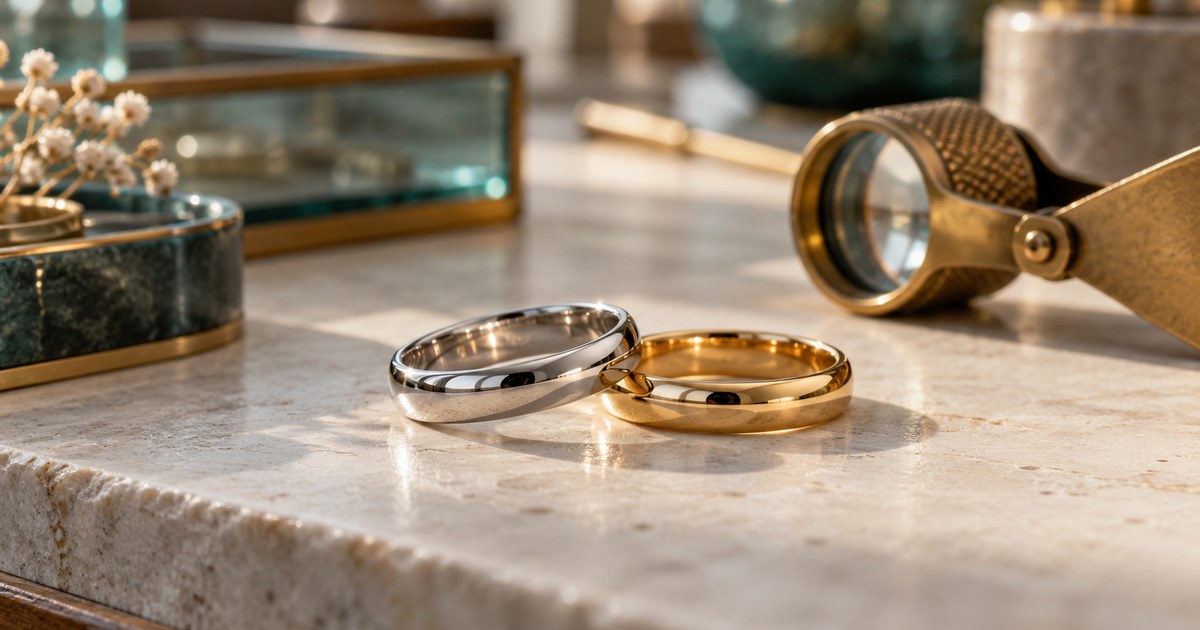
Is white gold real gold? It is a fair question when a ring that was sold as gold looks silver, or when an old white band starts turning faintly yellow at the bottom. The color makes people suspicious, and the suspicion is usually misplaced.
Yes, white gold is real gold. It is gold alloyed with white metals such as palladium, nickel, or silver, so a 14K white gold ring contains the same share of pure gold as a 14K yellow one: 14 parts in 24, about 58.3%, usually stamped 14K or 585. The bright white surface is normally a thin rhodium plating over that alloy.
The rest of this guide shows how to confirm that your particular piece is solid white gold, and how to spot the two things it is most often confused with: white-gold-plated base metal and sterling silver.
What white gold actually is
All gold jewelry is an alloy. Pure gold is too soft to hold a stone securely, so jewelers mix it with other metals, and the mix decides both the strength and the color. Yellow gold uses mostly silver and copper. White gold swaps in white metals. Wikipedia’s entry on colored gold describes white gold as an alloy of gold and at least one white metal, usually nickel, silver, platinum, or palladium, and the International Gem Society describes the same effect: paired with nickel, silver, palladium, and others, gold takes on a white color.
The gold content is set by the karat, not the color. The common karats work out like this:
- 10K: 10 parts in 24, about 41.7% gold, often stamped 417.
- 14K: 14 parts in 24, about 58.3% gold, usually stamped 585 (the European standard is 58.5%).
- 18K: 18 parts in 24, 75% gold, stamped 750.
The UK Assay Office lists 585 (14ct) and 750 (18ct) among its gold fineness standards, and those numbers mean the same thing whether the alloy is white, yellow, or rose. For the full table of stamps, see what 585 means on jewelry.
Why white gold looks whiter than it is
Here is the detail that makes people doubt their jewelry. The white alloy on its own is usually not bright, mirror white; unplated, it can look slightly warmer or greyer than plated metal. To get the showroom look, white gold is commonly finished with a thin layer of rhodium, a hard white metal from the platinum family. The International Gem Society notes the coat is added to enhance brightness and shine and may need reapplying with wear.
So when a white gold ring starts to look slightly yellow or grey on the underside of the band, that is not the “real” metal being exposed as fake. It is the rhodium wearing through to the gold alloy underneath. That warm tint is, if anything, evidence of gold. Replating restores the color without changing the gold content, and white gold vs yellow gold covers that upkeep in detail.
How to check that your white gold is solid gold
Work through these in order. Most pieces are settled by the first two.
1. Find the stamp. Look inside the ring shank, on the clasp tongue of a necklace or bracelet, or on the post or back of an earring. A plain karat or fineness mark (10K, 14K, 18K, 417, 585, 750) claims solid gold alloy all the way through. A maker’s mark or trademark next to it is a good sign; the FTC’s consumer guidance advises looking for one alongside the quality mark.
2. Read what comes after the karat. This is where most “fake white gold” turns up. Under the FTC’s Jewelry Guides on gold claims (16 CFR 23.3), an item that only has a gold surface layer has to be described with a qualifying term such as gold plated or gold filled. On jewelry, that qualification usually shows up as trade abbreviations after the number: 14K GP, 14K HGE, 14K GEP, or 14K GF. A white piece stamped “14K GP” is white base metal or plated metal with a gold layer, not solid white gold.
3. Check for a silver mark instead. A bright white ring stamped 925 or STERLING is sterling silver, not white gold, even if a seller called it “white.” Silver is a perfectly good jewelry metal, but it is valued as silver. Silver also tarnishes to a grey or black film over time, which white gold does not develop in normal wear.
4. Look at the wear points. On plated base metal, worn high spots show a different color entirely: a coppery, brassy, or dark grey core showing through. On solid white gold, wear shows the same soft warm white-grey alloy all the way down, just without the rhodium shine.
5. Notice any skin reaction. Some white gold alloys contain nickel, and MedlinePlus lists nickel in jewelry among common causes of allergic contact dermatitis. A rash under a white ring does not mean it is fake, but it can mean a nickel-containing alloy whose plating has worn thin.
If the stamp is missing, worn away, or unclear, the physical checks in how to tell if gold is real (weight, wear, and a professional acid or XRF test) take over.
White gold vs platinum vs silver: the three white metals
Owners often mix up the three white metals that show up in jewelry boxes, and the difference matters for value:
- White gold is real gold with white alloy metals, usually rhodium plated, stamped with a karat or fineness number.
- Platinum is a different precious metal, naturally white throughout, much heavier in the hand, and commonly stamped with marks such as PLAT, PT, or 950. Comparisons on cost, weight, and upkeep are in platinum vs white gold.
- Sterling silver is 92.5% silver, stamped 925 or STERLING, lighter than gold of the same size, and prone to tarnish.
A quick weight comparison helps when two pieces are similar in size. Platinum feels noticeably dense, gold sits in the middle, and silver feels light. It is not a test on its own, but it makes a mislabeled piece stand out.
Is white gold worth as much as yellow gold?
As metal, yes, at the same karat and weight. The gold content is identical, so melt value is identical; the alloy metals that make it white add little or nothing a buyer pays for. Scrap and refining offers are based on the gold content, which is why a dull, unplated 14K white ring is worth exactly as much as metal as a freshly plated one.
As a finished piece, design, maker, condition, and any stones matter more than color. For a fuller picture of what a ring or necklace might fetch, the ring guide and the jewelry value guide walk through the factors beyond metal.
The short version
White gold is real gold in a white alloy, usually with a rhodium finish. Confirm it by the stamp: a plain 10K, 14K, 18K, 417, 585, or 750 claims solid gold, letters such as GP, HGE, or GF after it mean a surface layer only, and 925 means silver. A yellowish tint on an old white gold ring is worn rhodium, not a sign the gold is fake.
GemPeek can give you a fast first read: scan the ring or chain for the likely metal, visible stones, style, condition, and an estimated value range, then confirm the metal with a jeweler before you sell or insure it.
Sources
- Wikipedia: Colored gold (white gold alloys and karat percentages)
- International Gem Society: White Gold vs Yellow Gold
- The Assay Office (UK gold fineness and hallmarking)
- eCFR / Cornell LII: 16 CFR 23.3, Misrepresentation as to gold content
- FTC Consumer Advice: Buying Platinum, Gold, and Silver Jewelry
- MedlinePlus: Contact dermatitis