
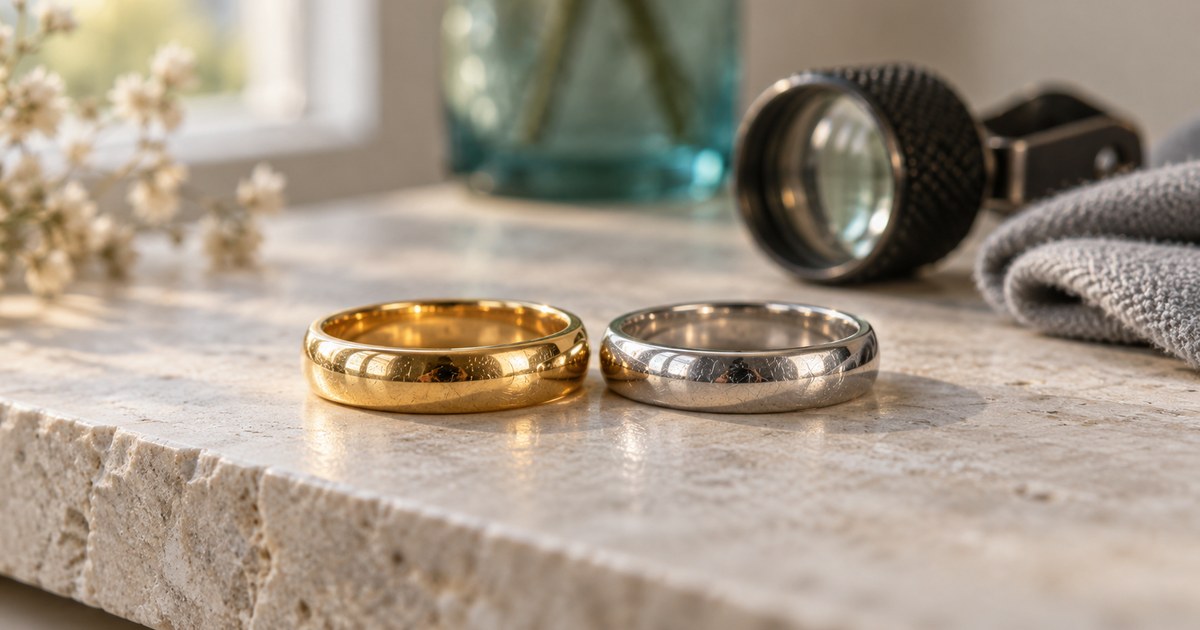
Most comparisons of white gold vs yellow gold stop at “same karat, same value” and leave you exactly where you started. That part is true, and it is also the least useful thing to know when you are choosing a ring you will wear for twenty years, or working out what an inherited one is going to cost you to keep looking right.
At equal karat, white gold and yellow gold contain the same amount of pure gold, so their gold-content scrap value is effectively the same and the alloy metals make no practical difference to it. The real differences are practical: white gold is usually finished with a rhodium plating that wears off and needs periodic reapplication, and many white gold alloys contain nickel, which is one of the most common contact allergens in jewelry.
What follows is what each metal actually is, the one recurring cost only white gold carries, and how to choose between them.
Is white gold worth less than yellow gold?
No. Gold content is set by the karat number and nothing else. A 14K white ring and a 14K yellow ring both contain 14 parts gold in 24, so their melt value is identical, and the color comes entirely from the non-gold metals in the alloy. The same logic applies across the warm colors, which is why rose gold and yellow gold also share a melt value at equal karat.
What differs is the alloy recipe. Yellow gold mixes gold with silver and copper in roughly balanced proportions, keeping a color close to natural gold. White gold replaces those warm metals with white ones. The International Gem Society describes white gold as gold paired with nickel, silver, palladium, and others, and that substitution is what pulls the color toward grey rather than yellow.
There is one nuance worth understanding: even a good white gold alloy is not the bright silvery white you see in a jewelry case. Untreated, it tends to read as a faint warm grey. The showroom white comes from a plating step, which is where white gold’s only real ongoing cost begins. That warm tint showing through on a worn ring is also why people start to wonder whether their white gold is genuine, which is answered in is white gold real gold.
What rhodium plating is, and why it is a recurring cost
Nearly all white gold jewelry is finished with a thin layer of rhodium, a bright, hard, tarnish-resistant metal from the platinum group. It is applied electrically as a surface coating, and the International Gem Society is direct about what happens next: the coat enhances brightness and shine, and with wear it may need to be reapplied.
That is the sentence to sit with. Rhodium plating is a finish, not a structural part of the piece, and finishes wear. On a ring worn daily, the plating thins first at the high-contact points, the underside of the band and the edges of the setting, and the warmer grey of the underlying alloy starts to show through. On earrings or a pendant worn occasionally, the same plating can look new for years. Wear pattern, not calendar time, is what decides the interval.
Replating is a routine bench service rather than a repair, and jewelers price it per piece. We are deliberately not quoting a national figure here, because bench rates vary widely by region and by how much cleaning, polishing, and stone protection the piece needs first. Ask a local jeweler for a quote on your specific piece, and ask how often they would expect to redo it given how you wear it.
Two things follow from this that matter for money:
- Replating never changes the gold content. Rhodium is a surface micron layer, so it adds nothing to melt value. A freshly plated white gold ring and a dull one of the same karat and weight are worth the same as metal. What plating buys is appearance.
- It is a cost yellow gold simply does not have. Yellow gold is polished, not plated, so its color is the metal itself all the way through. Scratches get buffed out; the color never needs restoring. If you want a low-maintenance piece for daily wear and you like the warm color anyway, that is a real point in yellow gold’s favor.
If you like the white look but not the upkeep, the honest alternative is a naturally white metal, which is the whole argument in platinum vs white gold. Platinum costs more up front and is heavier, but its color is intrinsic, so there is no plating to renew.
Does white gold cause allergic reactions?
Sometimes, and it is worth checking before you buy. MedlinePlus lists nickel found in jewelry among the common causes of allergic contact dermatitis, alongside watch straps, zips, and buttons. Nickel is used in some white gold alloys precisely because it is an effective, inexpensive whitener.
The practical reading for an owner:
- A reaction usually shows up as itching, redness, or a rash confined to where the metal sits. A green or dark mark on the skin alone is normally a harmless reaction between skin and copper in the alloy, not an allergy.
- Fresh rhodium plating can mask the problem. The nickel sits under the coating, so a newly plated ring may feel fine and only start bothering you months later as the plating wears through. If a piece you have worn happily suddenly starts irritating your skin, worn plating is a likely explanation and a good reason to have it looked at.
- Palladium white gold alloys exist and are the usual answer. They are typically more expensive than nickel white golds, and any jeweler selling white gold should be able to tell you which alloy family a piece uses.
None of this makes white gold a bad metal. It makes the alloy a question worth asking, particularly for earrings and for anything you will wear every day.
Do the two colors differ in durability?
Barely, and not in the direction most people assume. The International Gem Society is explicit that 18K white gold and 18K yellow gold have the same durability, and that the same holds for 14K alloys. Hardness is driven mainly by karat rather than color: lower-karat gold has more alloy metal in it and is harder, which is why 14K stands up to daily knocks slightly better than 18K in either color. The specific alloy recipe matters at the margins too, so two 14K white golds from different makers need not behave identically.
Where the colors do behave differently is in how they age visually. Yellow gold picks up a fine web of surface scratches that many owners come to like as a patina, and a polish resets it. White gold does not age so much as it fades back toward its own grey, which reads as tarnish to a lot of people even though the metal is not tarnishing at all.
Which one should you buy?
Match the metal to the piece and to the wear it will get:
- Choose yellow gold for a piece you will wear daily and want to forget about, for anything vintage or antique where the warm color is part of the design, and if nickel sensitivity is a known issue for you.
- Choose white gold if you want a bright white setting at a lower price than platinum, and you are comfortable treating replating as periodic maintenance. It is also the conventional choice for showing off a very white diamond, since a warm setting can lend a faint warm cast to the stone next to it.
- Choose platinum if you want white that stays white and are willing to pay more up front for it.
For a piece you already own rather than one you are buying, the order of operations is different: confirm what the metal actually is before you plan anything around it. A worn white gold ring, a rhodium-plated silver ring, and a plated base-metal ring can look nearly identical across a room, and the stamp is where that gets settled, which is the method in how to tell if gold is real. Once the metal is confirmed, the things that move a piece above melt, maker, design, era, and condition, are covered in what makes jewelry worth more, and the difference between melt, resale, and insurance figures is laid out in the jewelry value guide.
The short version
Color is a style and maintenance decision, not a value one. At the same karat and weight, white and yellow gold are worth the same as metal, they are equally durable, and neither one is more “real” gold than the other. White gold asks you to keep up a rhodium finish and to check the alloy if your skin is sensitive to nickel; yellow gold asks nothing beyond an occasional polish. Decide on the upkeep you want to sign up for, then let the stamp confirm the karat.
If you are holding a piece and are not certain which metal you are even looking at, scan it with GemPeek. It flags the likely type, visible stamps and materials, the finish and condition, and an estimated value range, which gives you a structured starting point to confirm with a jeweler before you insure, sell, or plan any work on it.