You are looking at a small paper tag or an old appraisal that reads something like “14K, 1.00 ctw,” and both numbers sound like they might be the same kind of measurement. They are not, and the karat vs carat mix-up is one of the most consequential misreadings in jewelry because it can make a modest cluster ring sound like a serious solitaire.
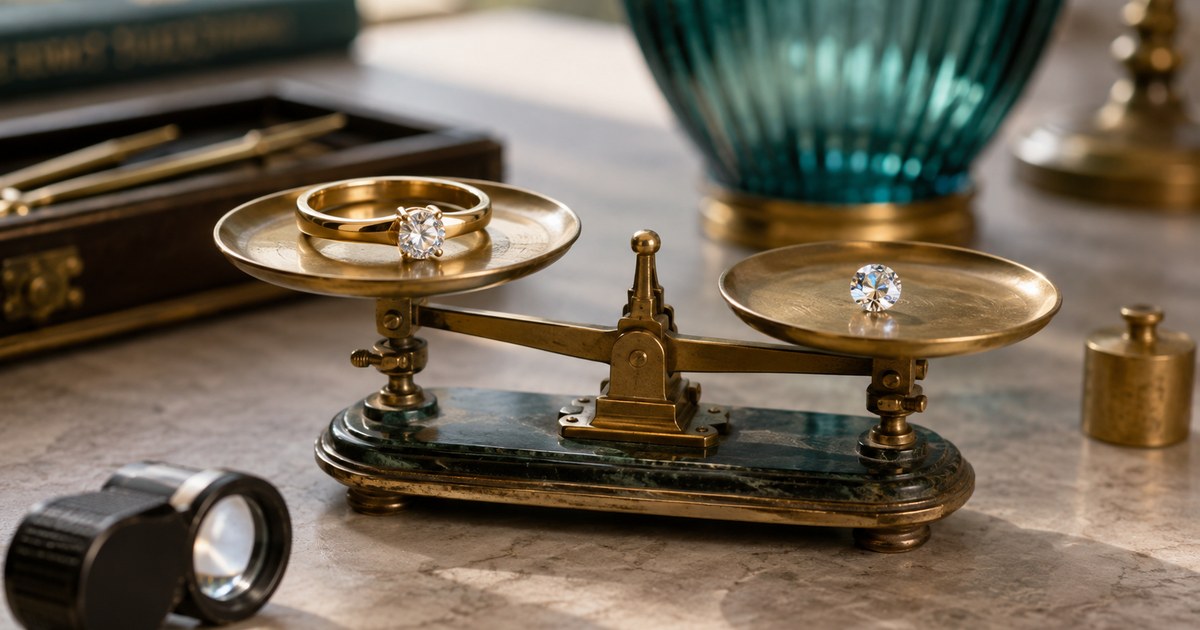
Karat measures gold purity in twenty-fourths, so 24K is pure gold and 14K is 14 parts gold out of 24. Carat measures the weight of a gemstone and equals exactly 0.2 grams, or 200 milligrams. One describes the metal, the other describes the stone. They are unrelated scales that happen to sound identical.
Here is what each number covers, why the spelling causes so much trouble, and how to read a real tag line end to end.
Karat vs carat: what each word actually measures
Karat, abbreviated K or kt, is a fineness scale for gold alloy. Because it works in twenty-fourths, the karat number tells you the fraction of the piece that is pure gold, with the balance made up of alloy metals such as copper, silver, nickel, or palladium. Most jewelry carries the parts-per-thousand version of the same figure stamped beside or instead of the karat mark.
| Karat mark | Pure gold content | Decimal stamp |
|---|---|---|
| 24K | 100 percent | 999 |
| 22K | 91.67 percent | 916 |
| 18K | 75 percent | 750 |
| 14K | 58.3 percent | 585 |
| 10K | 41.7 percent | 417 |
If you have only ever seen the three-digit version on your piece, what does 585 mean on jewelry walks through the most common one in detail. Silver uses its own separate fineness system rather than karats, which is why sterling is stamped 925 and never given a karat number, explained in what does 925 mean on jewelry.
Carat, abbreviated ct, is a unit of mass used for gemstones. The metric carat has been fixed at exactly 200 milligrams since its international adoption in the early twentieth century, which is why gem weights are quoted so precisely. A carat divides into 100 points, so a 0.25 ct stone is called a 25-pointer and a 0.10 ct stone is a 10-pointer. Carat weight is one of the four factors the GIA 4Cs framework uses to describe a diamond, alongside color, clarity, and cut.
Why the two words get mixed up so often
The confusion is not a mistake readers invented. It is baked into the language. In British and Commonwealth usage, “carat” spelled with a c is used for both gold fineness and gem weight. A UK jeweler or auction catalogue writing “18 carat gold” means purity, exactly what an American source would spell 18 karat. British hallmarking practice, described by The Assay Office, records gold fineness by these carat figures and their millesimal equivalents.
So the practical rules are:
- US usage separates the words. Karat for gold purity, carat for gem weight.
- UK and Commonwealth usage does not. Carat covers both, and context tells you which.
- The abbreviations are more reliable than the spelling. K or kt next to a number almost always means gold purity. Ct next to a decimal almost always means stone weight.
- A number under about 30 is probably karat. A number with two decimal places, such as 0.75 or 1.25, is almost certainly carat weight.
What ctw, cttw, and TCW actually mean
This is the abbreviation that costs people money. Ctw, cttw, and TCW all mean total carat weight: the combined weight of every stone in the piece added together, not the weight of any single stone. A ring described as 1.00 ctw might hold one full carat stone, or it might hold dozens of tiny ones that happen to sum to a carat.
The FTC Jewelry Guides set out the FTC’s current thinking on how fineness and weight claims should be presented to US buyers: quality and weight representations should be accurate and not misleading, and the FTC can act against a seller under general unfair-or-deceptive-practices law when they are not. A seller using ctw correctly is disclosing a total, not describing a center stone. The abbreviation is doing honest work; the misreading happens on the buyer’s side.
How to decode a tag line like “14K WG, 1.00 ctw, 32 stones”
Take that line apart piece by piece, because every element is answering a different question.
- 14K is the metal. The piece is 14 karat gold, 58.3 percent pure, and would typically also carry a 585 stamp somewhere on the shank or clasp.
- WG is white gold, the color of that 14K alloy. It says nothing about purity, only about which metals were mixed in and whether the surface is rhodium plated.
- 1.00 ctw is the total weight of all stones combined, equal to 200 milligrams of gem material spread across the whole piece.
- 32 stones is the number those 200 milligrams are divided among. Do the arithmetic and the average stone is a hair over 0.03 ct, roughly a 3-pointer, which is a very small accent stone.
That final line is the whole point. A 1.00 ctw cluster of 32 melee stones is not remotely the same object as a single 1.00 ct stone, even though both descriptions contain the number one carat. Large single stones are far scarcer than small ones, and price per carat climbs steeply with size, so one stone of a given weight is generally worth considerably more than the same total weight split across many tiny ones. How much more depends on quality and the market at the time, which is exactly why the honest framing is direction, not a multiplier. If a listing leads with a carat figure and only mentions ctw in small print, read the stone count before you read anything else.
Carat is a weight, not a size
Two stones of identical carat weight can look noticeably different across the top. Cut proportions are one reason: a shallow-cut stone spreads its weight outward and faces up larger, while a deep-cut stone hides weight in the pavilion and looks smaller than its number suggests. Material density is the other. Denser gem materials pack more mass into less volume, so a one-carat stone of a dense material is physically smaller than a one-carat diamond. When you are comparing pieces, millimeter measurements tell you what you will actually see on the hand.
Where each number appears on an appraisal
On a formal appraisal document, karat and carat sit in different rows and carry different levels of certainty. Metal fineness is usually stated plainly because it can be read from the hallmark and confirmed by testing. Stone weight is more nuanced: a loose stone can be placed on a scale and weighed exactly, but a stone already mounted in a setting normally cannot be removed, so the appraiser estimates its weight from measured dimensions and a formula. That is why appraisals so often say “approximately 0.95 ct” or “est. 1.10 ctw” for mounted goods. The word approximately is a signal of method, not of sloppiness.
Appraisals also state which value they are reporting, and the difference matters more than the carat figure. Retail replacement value, the number insurers want, sits well above fair market or resale value for the same piece. Before you anchor on any single number, decide whether you need melt, realistic resale, or insurance replacement, which the jewelry value guide breaks down.
The practical takeaway
Read the letters, not just the digits. K or kt means gold purity in twenty-fourths, ct means gem weight at 0.2 grams each, and ctw means every stone in the piece added together. When a description gives a carat total, look immediately for the stone count, because a one-carat total spread across dozens of accents is a different piece and a different value from a single one-carat stone. If your piece came from a British source, remember that “18 carat” there is a purity claim. And once you know which numbers you have, what actually moves the price is the combination of maker, materials, design, and condition covered in what makes jewelry worth more.
If you are holding a piece and cannot tell whether the number on the tag describes the metal or the stones, scan it with GemPeek: it reads the likely type, the visible stamps and materials, the stones it can see, and the condition, then gives you an estimated value range and a clear starting point to take to a jeweler or appraiser.