
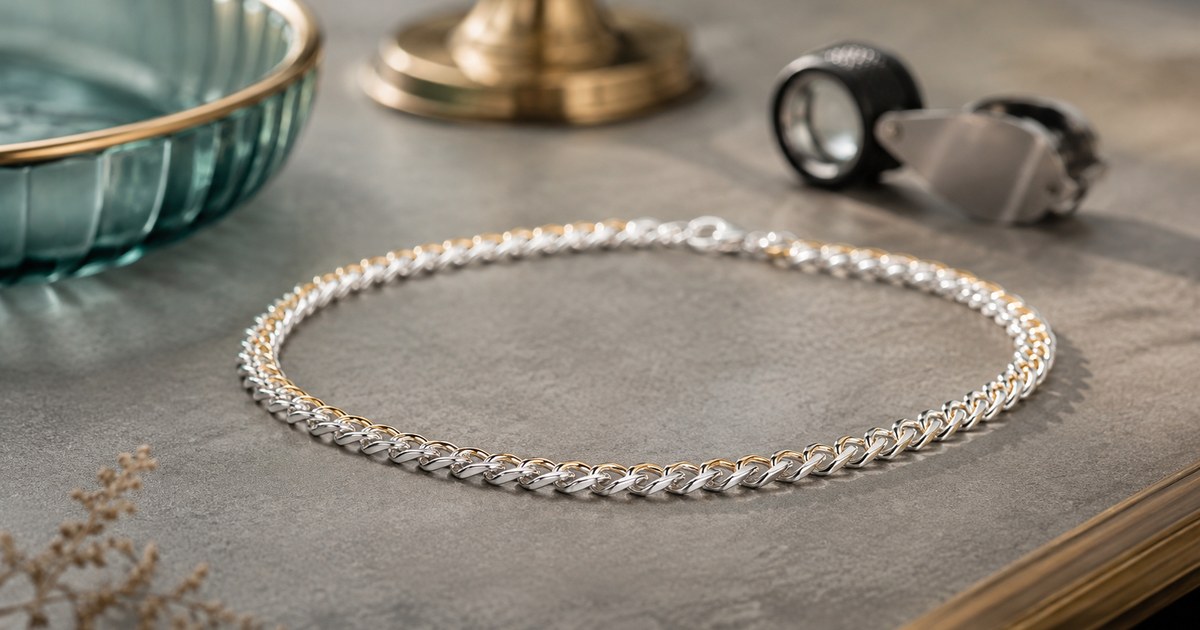
A gold-colored chain arrives in a drawer of inherited pieces, the tag or the listing says “vermeil,” and turning it over reveals a 925 stamp that seems to contradict the color. That combination confuses a lot of owners, and it is actually the clearest signal on the piece. Understanding what is gold vermeil starts with the one thing that separates it from every other gold-toned finish: what sits underneath.
Gold vermeil is gold plating over a sterling silver base. Under the FTC Jewelry Guides, the coating must be gold of at least 10 karat fineness and at least 2.5 microns thick throughout. That sterling core is what separates vermeil from ordinary gold plating, which is usually applied over brass or another cheap base metal with no precious content at all.
Here is what the definition guarantees, how to recognize vermeil on a piece you already own, and what the silver underneath is actually worth.
What does the vermeil definition actually require?
Vermeil (pronounced ver-may) is not a marketing adjective in the United States. It is a defined term. The FTC Jewelry Guides set out what a seller may and may not call an item, and for vermeil three conditions all have to be met at once:
- The base metal is sterling silver. Not brass, not copper, not stainless steel. Sterling means 92.5 percent fine silver, the standard the UK Assay Office and most national hallmarking systems recognize as 925.
- The plating is real gold of at least 10 karat. That 10K floor is specific to the vermeil definition itself under 16 CFR 23.4, separate from the general rules for labeling something “gold”: the FTC’s 2018 Jewelry Guides revision removed the old blanket karat floor for the word “gold,” so lower-karat pieces can still be sold as gold elsewhere as long as the karat fineness is disclosed just as prominently. Vermeil is stricter than that general rule, not an example of it.
- The gold layer is at least 2.5 microns thick throughout, measured as fine-gold equivalent. A micron is a thousandth of a millimeter, so this is still a coating rather than a solid metal, but it is a substantial one by plating standards. Because the rule is stated in terms of pure (24K) gold content rather than raw coating depth, a lower-karat alloy layer needs to be physically thicker than a higher-karat one to deliver the same 2.5-micron equivalent.
The word “throughout” carries weight. A piece that is thickly plated on the visible face and barely coated inside the band does not qualify. If a seller calls something vermeil, they are making a claim about the whole surface.
Vermeil vs gold plated vs gold filled
These three terms describe three genuinely different constructions, and the differences matter more for value than most listings admit.
| Term | What is underneath | Gold layer | What it means for value |
|---|---|---|---|
| Gold plated | Any base metal, commonly brass or copper | Thin, often a small fraction of a micron | Essentially no intrinsic metal value |
| Gold vermeil | Sterling silver only | At least 2.5 microns, 10K or finer | Small but real value from the silver base |
| Gold filled | A base metal core | A thicker bonded layer, a defined fraction of total weight (commonly one twentieth) | More gold by weight than plating, still not solid |
Ordinary gold electroplate is the thinnest of the three, which is why costume chains lose their color at the clasp within a season. Gold filled sits at the other end: the gold is mechanically bonded rather than electroplated, and the standard requires the gold to make up a set share of the item’s total weight, which is why you see stamps like 1/20 12K GF. Vermeil is the odd one out because its defining feature is not the gold at all. It is the silver. Our full breakdown of the bonded finishes is in gold filled vs gold plated.
How do you tell if a piece is vermeil?
You are looking for evidence of silver hiding under a gold surface. Three checks cover most cases:
- Read the stamp. A gold-colored piece marked 925, STER, or STERLING is the classic vermeil signature. Solid gold is stamped by karat or by fineness (14K, 585, 750), never 925. If the color says gold and the mark says silver, the mark is describing the base and the color is describing the coating. What each silver mark means is covered in what does 925 mean on jewelry.
- Look at the wear points. Check the inside of a ring shank, the back of a pendant bail, and the clasp, where skin contact and friction thin the plating first. On vermeil, the metal showing through is white or grey. On brass-based plating, it is a distinctly warmer yellow-pink that darkens as it tarnishes.
- Feel the weight and the tarnish pattern. Sterling has a denser, more substantial feel than plated brass at the same size, and any exposed silver tarnishes to a dark grey or black film rather than the greenish residue brass leaves on skin.
Some vermeil is stamped with both marks, for example 925 alongside a note of the plating karat. Some older or imported pieces carry no mark at all, in which case the wear-point color is the best evidence you can gather at home.
Does vermeil have any real value?
This is where vermeil separates itself from the rest of the plated category, and it is the part most retailer pages skip.
The gold layer contributes almost nothing to intrinsic value. At a few microns, the coating weighs a tiny fraction of a gram even on a substantial piece, so no refiner is paying for it in a meaningful way. But the base is sterling silver, and sterling is a precious metal with a live market price. That gives a vermeil piece a small but genuine melt floor, which brass-based plated jewelry simply does not have.
To work out that floor yourself, you need three things and no guesswork:
- The weight of the piece in grams, on a kitchen or jewelry scale, with any stones, glued elements, or non-metal parts accounted for separately.
- The sterling fraction, which is 0.925 for a piece stamped 925.
- The current silver price per gram, which moves daily. Look it up on the day you are asking; any figure written into an article is out of date the week it is published.
Multiply weight by 0.925 by the current price per gram and you have a theoretical melt value. Two honest adjustments follow: a buyer or refiner pays below that theoretical number to cover their processing and margin, and on small, light pieces the result may be modest enough that melting is not worth doing. That is not a reason to dismiss the piece. It is a reason to check whether the object is worth more than its metal, which depends on the maker, the design, the era, and the condition. The clues that push a piece above its metal value are laid out in what makes jewelry worth more, and the difference between melt, resale, and insurance replacement figures is explained in the jewelry value guide.
Does worn gold vermeil mean the piece is fake?
No, and this is worth saying plainly because worn plating sends a lot of people to the conclusion that they were sold something false. A gold layer measured in microns is designed to be a finish, not a structural metal. It wears with time, skin chemistry, perfume, cleaning products, and simple friction. Rings and bracelets go first because they take the most contact; earrings and pendants often keep their color for years.
Replating is routine work. Most jewelers either offer it or send it out, and because the piece only needs a new surface layer, it is usually inexpensive relative to the value of the item, particularly on a piece with sentimental or design value. A vermeil piece showing silver at the high points is a piece that has been worn, not a piece that was misrepresented. The mark underneath is still the truth about the base metal, and that has not changed.
The practical takeaway
Treat vermeil as sterling silver jewelry wearing a gold coat, because legally and physically that is exactly what it is. Verify the base by finding the 925 or sterling mark and by checking what color shows through at the wear points, then value the piece off the silver rather than the gold, using the current silver price on the day you ask. Do not expect a vermeil chain to melt like a gold one, and do not write it off the way you would write off plated brass. It sits between the two, with a small real floor from the silver and whatever the design, maker, and condition add on top.
If you are holding a gold-toned piece and cannot make sense of the mark inside it, scan it with GemPeek: it reads the likely type, the visible stamps and materials, the finish and its condition, and an estimated value range, so you walk into a jeweler or a resale conversation knowing what you are actually holding.