
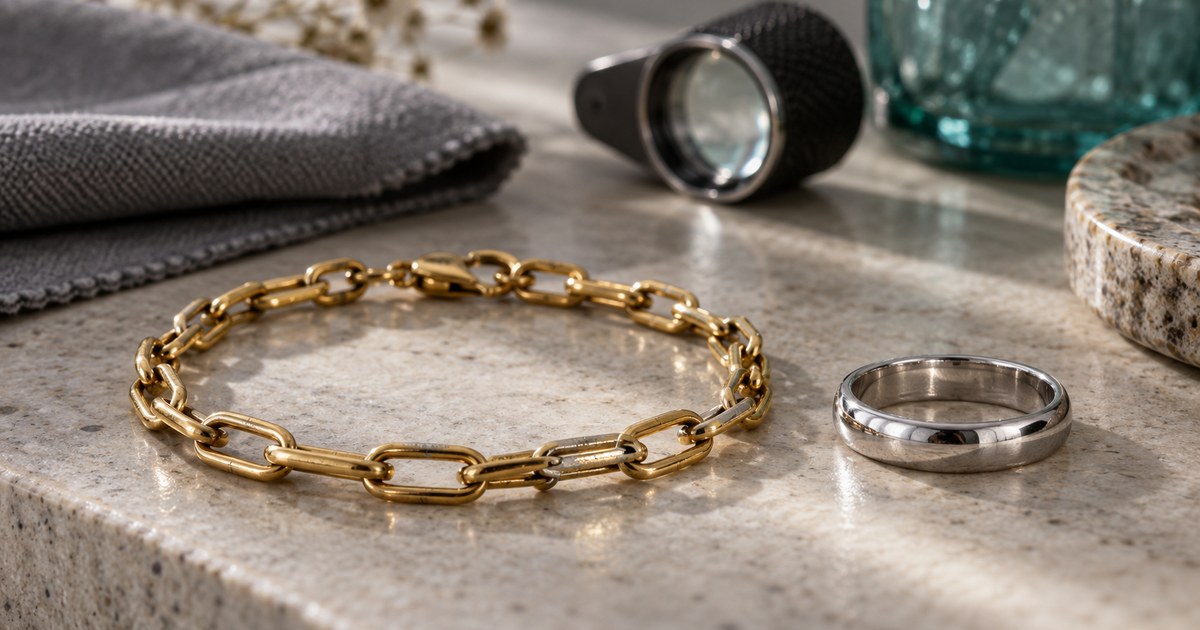
Shop for affordable gold jewelry and you will meet two labels used almost interchangeably in product listings, at wildly different prices. The difference between gold vermeil vs gold plated is not marketing language. In the United States both terms are defined in the Federal Trade Commission’s jewelry guides, and the definitions set out exactly what a seller has to deliver before using each word.
Vermeil requires two things a plain plating does not: a base of sterling silver, and a gold layer at least 2.5 microns thick. Ordinary gold electroplate needs only 0.175 microns, roughly fourteen times thinner, over any base metal at all. Both terms require gold of at least 10 karat fineness, so purity is not what separates them. Thickness and base are.
What each label legally means, why it changes how long a piece lasts, and what it does to resale, in that order.
What the FTC rules actually require
Two sections of 16 CFR Part 23 do the work.
Vermeil (section 23.4). A product may be described as vermeil when it consists of a base of sterling silver, coated or plated on all significant surfaces with gold or a gold alloy of not less than 10 karat fineness, to a minimum thickness throughout equivalent to two and a half microns (roughly 100 millionths of an inch) of fine gold, with reasonable durability. The section adds a disclosure point worth knowing: if the sterling is covered with a base metal such as nickel before the gold goes on, that undercoat has to be disclosed.
Gold electroplate (section 23.3). A product electroplated on all significant surfaces with gold, or a gold alloy of not less than 10 karat fineness, with a minimum thickness throughout equivalent to 0.175 microns (roughly 7 millionths of an inch), may be marked “Gold Plate,” “Gold Plated,” “Gold Electroplate,” or an accepted abbreviation, with the karat fineness stated just as conspicuously. There is a step above it: at the same fineness and a minimum of 2.5 microns, the piece may be called “Heavy Gold Electroplate.”
Read side by side, three requirements separate vermeil from a standard plate:
- The base metal is specified. Vermeil must sit on sterling silver. A plain electroplate can sit on brass, copper, steel, or any other base metal, and the label tells you nothing about which.
- The gold layer is far thicker. 2.5 microns against a 0.175 micron floor, about fourteen times the minimum.
- Both set a karat floor. Neither term permits anything under 10 karat gold, so “vermeil” does not automatically mean higher-purity gold than a plate. It means more of it, on a known base.
One quirk trips up a lot of shoppers. “Gold Plated” is a permitted description in two different places: for an electroplate at the 0.175 micron minimum, and, under section 23.3(c)(2), for a layer applied by soldering, brazing, welding, or other mechanical means that makes up at least one fortieth of the article’s metal weight. When that mechanically bonded layer reaches one twentieth of the weight, the term “Gold Filled” may be used. So “gold plated” alone can describe two quite different constructions, which is precisely why gold filled versus gold plated versus solid gold is worth understanding as its own comparison.
Why the thickness gap changes how the piece wears
Gold is soft, and every one of these layers is a surface. What differs is how much surface there is to lose.
At the electroplate minimum, the gold is thinner than a human hair by a wide margin, and normal contact wears it. Rings and bracelets go first, because they rub against skin, desks, keys, and each other. Earrings and pendants last far longer simply because nothing abrades them. The layer thins at the high points first, so a plated ring tends to show its base metal at the band edges and around the setting before anywhere else.
Vermeil’s 2.5 micron minimum does not make a piece permanent. It buys years rather than months on a piece that gets daily contact, and it means a careful owner can often keep vermeil looking right for a long time. The honest framing is that both wear out; vermeil starts with substantially more to wear through.
Two practical notes follow:
- Minimums are floors, not typical values. A seller can exceed either standard, and better makers do. If a listing states an actual micron figure above the minimum, that is a real quality signal.
- What shows through matters. When plating wears on a brass or copper base, you get a visibly different metal and often skin discoloration. When vermeil wears, what shows through is sterling silver, which is a far less jarring result and is itself a precious metal.
What each one is worth when you resell
This is where the base metal earns its keep, and where most comparisons stop short.
A plain gold electroplate over base metal has essentially no recoverable metal value. The gold layer is too thin to be worth separating, and the brass or steel underneath is not worth anything meaningful. Whatever such a piece sells for comes from the design, the brand, and the condition, never the materials, which is the same dynamic that governs costume jewelry in general.
Vermeil is different in one specific way: underneath the gold sits sterling silver, a genuine precious metal with its own melt value by weight. That value is modest, and it is a floor rather than a target, but it exists, and it does not wear off with the gold. It is also why vermeil pieces are stamped the way they are, which brings up the most useful physical check available to an owner.
How to tell which one you are holding
Neither label is stamped on the metal as such. What you can read is the base metal mark:
- Look for a silver mark. Genuine vermeil sits on sterling, so the piece is normally stamped 925, sometimes with the maker’s mark alongside. The meaning of that stamp is covered in what 925 means on jewelry.
- No silver mark points away from vermeil. An unmarked gold-colored piece is more likely a plate over base metal. Absence of a mark is not proof, since marks wear off and some imported pieces were never marked, but it shifts the odds.
- Check the wear points. Look at the inside of a ring band, the back of a pendant bail, and clasp edges under good light. Silvery white showing through suggests a sterling base. Yellow-pink or grey base metal showing through suggests brass or steel.
- Confirm the silver rather than assuming it. A 925 stamp is a claim, and the checks that settle it are in how to tell if silver is real.
If the stamp and the wear points both point to sterling under gold, you are almost certainly looking at vermeil, and what gold vermeil is goes deeper into how those pieces are made and cared for.
Which should you buy?
For anything worn daily, vermeil is the better buy at a higher price, because the thicker layer and the sterling base both work in your favor over time. For occasional-wear earrings or a fashion piece you expect to enjoy for a season, a well-made plate is a reasonable choice and there is no need to pay for more.
What is not reasonable is paying vermeil prices for a piece the seller describes only as “gold plated” or “18k gold over brass.” The terms are defined, sellers are expected to use them accurately, and the FTC’s own consumer guidance encourages buyers to ask what the marking means. If a listing avoids saying vermeil while charging as if it were, the wording is doing something deliberate.
For a piece already in your possession, the sequence is stamp first, wear points second, then decide whether the metals or the design carry the value. If you need a number rather than a category, the jewelry value guide explains which figure to ask for.
If the stamp is worn or missing and the wear points are not telling you enough, scan the piece with GemPeek. It reads back the likely construction, the visible stamps and materials, the condition, and the value range to expect, which is the sort of starting point a jeweler can confirm quickly.