
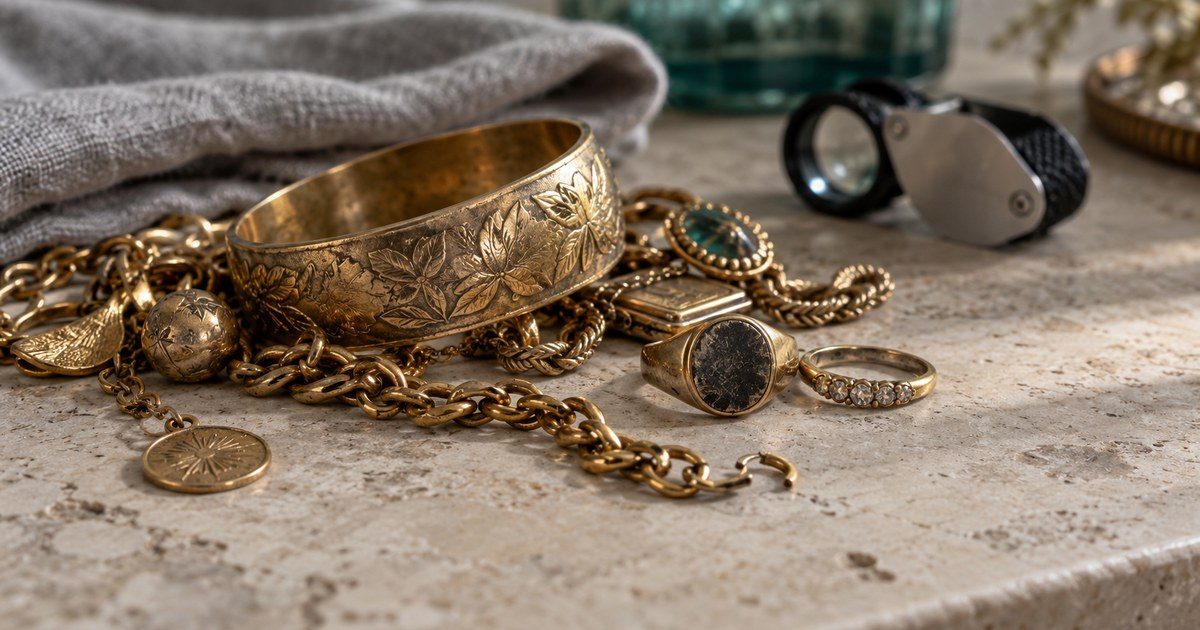
When a box of jewelry turns out to be mostly gold plated, the next question is always the same, and most answers online swing between “it is worthless” and “you never know.” Neither is useful. Is gold plated jewelry worth anything depends entirely on whether you are asking about the metal or about the object, and those two questions have very different answers.
As metal, plated jewelry has essentially no melt value: the legal minimum for a gold electroplate is 0.175 microns, and recovering a film that thin is not economic, so scrap buyers will not quote on it. As an object it can still carry real resale value, when the maker, design, or era is what the buyer wants.
Working out which of those you are holding takes about ten minutes and a good light.
Why the metal itself is worth so little
The regulated minimum explains the whole situation. Under 16 CFR 23.3, an electroplated piece may be marked “Gold Plate,” “Gold Plated,” or “Gold Electroplate” when the layer is at least 10 karat fineness and at least 0.175 microns thick. The thickness tiers and the sterling-based vermeil standard are compared in gold vermeil vs gold plated; what matters here is what that number means in grams.
Work it through. Gold has a density of about 19.3 grams per cubic centimeter. A piece with roughly 20 square centimeters of plated surface, which is generous for a ring or a pair of earrings, carries about 0.00035 cubic centimeters of gold at the 0.175 micron minimum, or roughly 0.007 grams. On a 10 gram piece that is under a tenth of one percent of its weight. Put the other way round, it would take about 3,000 square centimeters of plated surface, close to a third of a square meter, to hold a single gram of gold. Real pieces are often plated thicker than the legal floor, but not by orders of magnitude.
That arithmetic leads to three consequences worth knowing before you carry a bag of chains to a buyer:
- Scrap buyers will usually decline it. Separating a micron-scale coating from a base metal body, typically brass, copper, or steel, costs more in chemistry and labor than the recovered gold is worth, so most gold buyers will not quote on plated material at all.
- Weight is not a clue here. A heavy plated chain feels substantial because of the base metal, not the gold. Weighing a plated piece tells you nothing about its gold content.
- Testing acid or electronic testers reads the surface. A plated piece can give a gold reading on its skin while being brass a few microns down, which is why a stamp and a surface test together still are not proof of solid gold.
None of this makes plated jewelry fake. It is accurately described gold-covered jewelry, sold honestly at a fair price for what it is. It simply is not a metal asset.
The constructions that do carry metal value
Before you write off a whole box, check whether any of it is one of these three, all of which are commonly mistaken for plating:
- Gold filled. Under the same FTC section, a mechanically bonded gold layer that makes up at least one twentieth of the article’s metal weight may be marked “Gold Filled.” That is a real, measurable fraction of gold rather than a micron film, and it is why gold filled scrap has genuine, if modest, value in quantity. The full comparison is in gold filled vs gold plated vs solid gold.
- Vermeil. Section 23.4 requires vermeil to sit on a base of sterling silver, under a gold layer of at least 10 karat fineness and at least 2.5 microns thick. The gold is still a coating, but the body of the piece is a precious metal with its own melt value by weight. The distinction is set out in gold vermeil vs gold plated.
- Solid gold that looks plated. Worn, dirty, or unmarked solid gold gets mistaken for plating all the time, especially in older jewelry where the stamp has rubbed away. Anything unmarked but suspiciously heavy and evenly colored deserves a proper check before it goes in the discard pile.
The marks are the fastest sorting tool. Look for a karat mark on its own (10K, 14K, 585, 750) for solid gold, a karat mark followed by GP, GEP, HGE, or GF for coatings, and 925 for a sterling base that may be vermeil.
When a plated piece is worth real money anyway
This is the part that gets lost in “plated means worthless.” Plenty of plated jewelry sells for far more than any metal in it, because buyers are paying for the object rather than the material. Watch for:
- A signature. Designer and fashion-house costume jewelry is collected on the strength of the name, and a signed plated piece from a well-known maker can be worth many times an unsigned equivalent. The whole dynamic is covered in is costume jewelry worth anything.
- Period design. Distinctive mid-century, Art Deco revival, and 1980s statement pieces have their own collector markets that pay for the look and the era rather than the metal.
- Condition and completeness. Plated pieces are graded harshly on wear, because wear is the one thing that cannot be fixed without replating. Crisp, unworn plating with an intact clasp and original box or tag sits in a different price bracket from a piece that is brassing at every edge.
- Wearability. A plated chain that still looks new has straightforward resale value as a wearable item, priced against what a similar new piece costs rather than against gold.
The reliable way to price any of these is comparable sold listings, not asking prices, for the same maker and pattern in similar condition. Asking prices tell you what sellers hope for; sold prices tell you what buyers paid.
What to do with a box of plated jewelry
A practical sorting order that avoids wasting a trip to a buyer:
- Read every mark under good light. Sort into solid gold, gold filled, vermeil or sterling, marked plated, and unmarked.
- Set the marked plated pieces aside as objects, not metal. Their value question is maker and condition, so photograph the signature or maker’s mark rather than weighing them.
- Check the unmarked pieces carefully before assuming they are plated. Unmarked does not mean base metal, particularly for older or imported jewelry.
- Group by maker for research. One recognizable signature across several pieces is often worth more sold as a group to a collector than piece by piece.
- Only take genuinely precious-metal pieces to a gold buyer. Bringing plated jewelry to a scrap counter wastes everyone’s time and can drag down the impression of the lot.
For anything that survives this sort as potentially valuable, the factors that decide the final number are the same ones covered in what makes jewelry worth more, and choosing between melt, resale, and insurance figures is the subject of the jewelry value guide.
The honest summary
Gold plated jewelry has resale value when the object is desirable and none worth chasing when it is not, and its melt value is negligible either way, so the gold has very little to do with the outcome. Judging it by weight or by the color of the surface leads you astray in both directions: it writes off signed pieces that collectors want, and it raises hopes for heavy chains with a few microns of gold on brass. Sort by mark, then price by maker and condition.
If you are working through a mixed box and cannot tell plated from filled from solid, scan the pieces with GemPeek. It reads back the likely construction, the marks it can see, the condition, and the range a comparable piece sells for, which is how you find the two or three pieces in a box that are worth a jeweler’s time.