
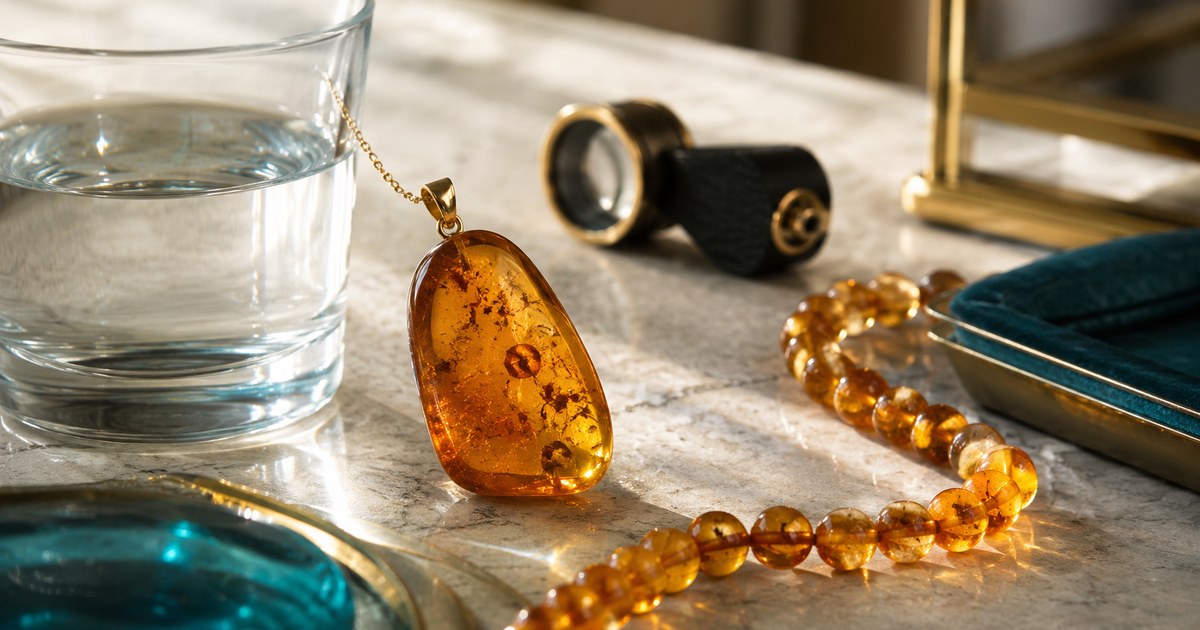
A honey-colored bead strand from a relative’s jewelry box feels oddly light in the hand, warms up fast against your skin, and you want to know whether it is amber or a bag of plastic beads before you decide what to do with it. Learning how to tell if amber is real starts with the fact that amber is not a mineral at all: it is fossilised tree resin, an organic gem, and its unusual lightness is the single most testable thing about it.
Real amber is barely denser than water, with a specific gravity of roughly 1.05 to 1.10, so it floats or hovers in a strong saltwater brine while plastic, glass, and stone sink. Rubbed briskly on wool it builds a static charge strong enough to lift a scrap of tissue paper, and it gives off a resinous, pine-like smell from the friction alone.
Those two checks cost nothing and damage nothing. Here is how to run them properly, what UV light adds, and why copal, not plastic, is the imitation most owners are actually holding.
How to tell if amber is real with a saltwater float test
This is the most useful home test because it targets the property that makes amber unusual. Amber sits so close to the density of water that a saturated salt solution will float it while denser materials drop.
- Dissolve a large quantity of salt in warm water until no more will dissolve. A commonly cited starting recipe is on the order of two tablespoons of salt per cup of water, but keep adding and stirring until the water is genuinely saturated.
- Let the brine settle, then lower the piece in gently so surface tension and trapped air bubbles do not fake a float.
- Amber and copal float or hover near the surface. Most plastics, glass, and stone sink.
- Rinse the piece in fresh water afterwards and dry it thoroughly. Salt residue is bad for stringing thread and corrosive to metal findings.
Two limits matter. First, do not use this test on a strung necklace with metal parts, on anything glued, or on any piece where soaking the setting or the cord would cause a problem. If your piece is a strung strand, work from the visual and construction clues in the necklace identifier guide instead and leave the beads dry. Second, and more importantly, the float test does not separate amber from copal, because copal is resin too and has almost the same density.
What the static, smell, and UV checks add
None of these three is proof on its own, but together they build a consistent picture, which is how gemstone identification actually works according to the International Gem Society: you stack several cheap observations rather than hunt for one magic test.
- Static. Rub the piece vigorously on wool or a dry cloth for ten to twenty seconds, then hold it just above a small scrap of tissue paper or a loose strand of hair. Amber develops a charge strong enough to lift it. Treat this as supporting evidence rather than proof: many plastics build static as well, copal does it just as readily, and the test tends to fail on a heavily polished or lacquered surface.
- Smell. The same brisk rubbing warms the surface enough to release a resinous, pine-like scent. Plastic smells acrid or chemical when it heats. This is the friction version of the smell test and it leaves no mark on the piece.
- Ultraviolet light. Under a longwave UV lamp, amber commonly fluoresces a pale blue or bluish-white, sometimes with a greenish cast. Many plastics either do not fluoresce or fluoresce in a visibly different way, so a glow is a useful amber-versus-plastic signal. It is a weaker amber-versus-copal signal, though, since copal can fluoresce a similar chalky blue. Read a blue glow as a strong indicator against plastic and a much softer one against copal, not a verdict either way.
One more everyday clue comes from hardness. Amber is soft, with Mohs hardness usually given as roughly 2 to 2.5, near the bottom of the scale used in the International Gem Society’s hardness ordering. That is why genuine old amber beads show rounded edges, tiny surface nicks, and stringing wear around the drill holes, while a modern plastic copy often looks suspiciously crisp for its supposed age.
Copal is the real problem, not plastic
Here is the part most guides skip. Copal is genuine tree resin that never finished fossilising. Amber is millions of years old; copal is far younger, and that age gap is the whole difference. Copal is not a plastic fake, it is immature amber, and that is exactly why it defeats the standard tests.
Copal floats in brine. Copal builds a static charge. Copal smells resinous when you warm it, because it is resin. Every check in the sections above returns “amber” for a copal bead. When someone buys a strand they are disappointed by, copal is usually what they have, not plastic.
What does separate them:
- Solvent response. A drop of acetone or strong alcohol on an inconspicuous spot will make copal tacky, cloudy, or sticky within seconds, where true amber resists a brief contact. This is the only common home check that reliably splits the two, and it is still a minor surface test, so use an unseen area and wipe it clean immediately.
- Surface condition. Copal is softer than amber and crazes as it ages, developing a fine web of surface cracks and a slightly gummy feel. Amber ages more gracefully.
- Suspiciously perfect inclusions. Cheap “insect in amber” pieces are frequently copal. If the insect is unusually large, perfectly posed, undamaged, and beautifully centred for viewing, be sceptical: soft young resin is easy to melt, open, and re-close around a modern specimen.
Why we do not recommend the hot needle test
Almost every listicle tells you to heat a needle and press it into the piece to check the smell. We do not recommend it, for two reasons.
It permanently scars the piece, leaving a melted pit that cannot be polished out of a soft material without reshaping it. And it does not answer the question anyone is asking, because copal produces the same resinous smell as amber under heat. You destroy value to learn something the friction smell test already told you, and you still cannot tell amber from copal. The needle test survives because it is dramatic, not because it works.
What this means for value
Confirming a piece is amber and not plastic is the first step, not the last one. A few things move the number:
- Amber versus copal is the biggest single split, since copal is worth a fraction of true amber.
- Pressed or reconstituted amber, sometimes called ambroid, is made by heating and compressing small fragments into a larger mass. It is real amber, but it shows a characteristic flow structure and elongated, stretched bubbles under magnification, and it is worth less than an equivalent solid piece.
- Condition, colour, size, and craftsmanship drive the rest, the same object-level factors covered in what makes jewelry worth more.
It is worth knowing that a processed or enhanced stone is not automatically a fake. Amber is routinely heat treated to clarify it or deepen its colour, much as most turquoise on the market is stabilized and still genuinely turquoise, a distinction we work through in how to tell if turquoise is real. Definitive identification, and in particular separating amber from copal or authenticating an insect inclusion, is a gem-lab job, where infrared spectroscopy is the standard method.
The practical takeaway
Start with the brine float and the static-and-smell check, in that order, and skip the hot needle entirely. If the piece floats in saturated salt water, lifts tissue paper after rubbing, smells of pine rather than chemicals, and glows faintly blue under UV, you almost certainly have resin rather than plastic. The open question at that point is amber or copal, which a careful solvent spot test narrows and a lab settles. The same stacked-observation habit works on other organic and easily imitated gems, including the checks in how to tell if opal is real.
For a fast first read on a strand or pendant you cannot place, scan it with GemPeek: it flags the likely piece type, the visible stones and materials, the style and condition, and an estimated value range, so you have a structured starting point before you decide whether a gem lab or a jeweler is worth the visit.