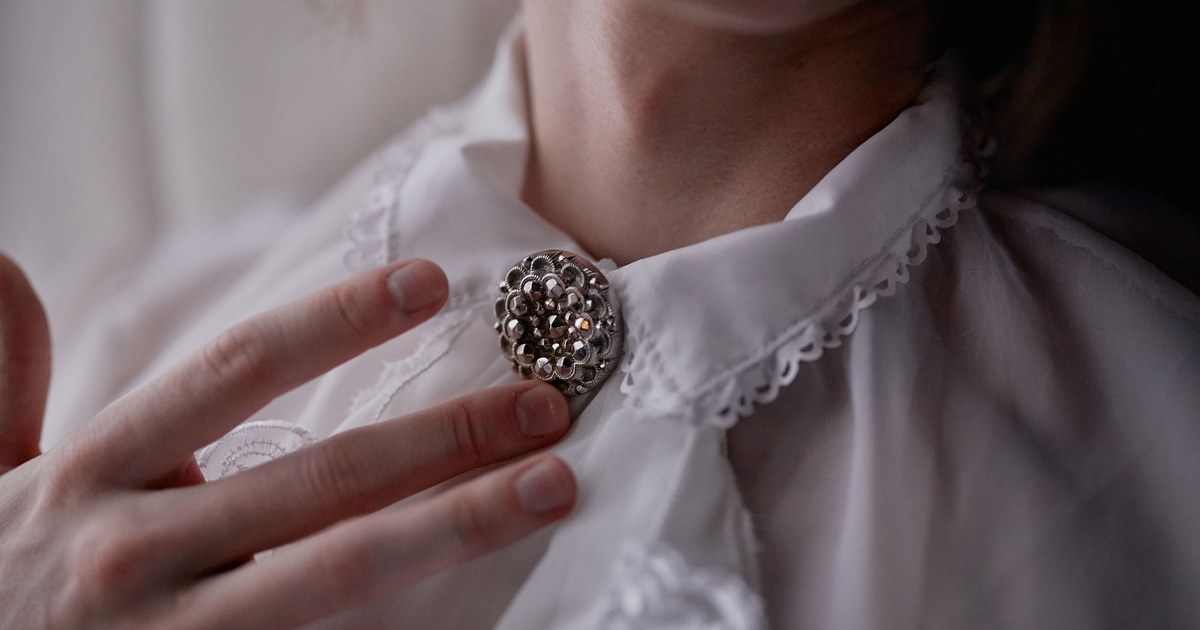
What is marcasite jewelry? It is the glittering, gunmetal-gray style of vintage jewelry where dozens of tiny faceted stones are set close together, usually in silver, to catch the light. You see it on brooches, watches, rings, and bracelets from grandmothers’ jewelry boxes.
Marcasite jewelry is set with small faceted pieces of pyrite, not true marcasite. The two minerals are both iron sulfide, but pyrite is more stable and less brittle, so jewelers use it under the traditional name. Quality pieces have each stone set in sterling silver; cheaper ones have stones glued in. Value comes from the silver, the setting work, the design, and the condition.
Knowing those few facts lets you judge a piece in a couple of minutes, which is what the rest of this guide shows.
Marcasite or pyrite: clearing up the name
The name is a long-standing trade convention. Both marcasite and pyrite are chemically iron sulfide, but they have different crystal structures, which gives them different physical properties. Pyrite is more stable and less brittle than marcasite, and that is why pyrite is used in “marcasite” jewelry.
The International Gem Society puts it plainly: much of the material in antique “marcasite” jewelry is actually pyrite. True marcasite is poorly suited to jewelry. IGS notes it is brittle, and that it can react to moisture and break down, which is the opposite of what you want on a ring worn every day.
So when you see “marcasite” on a tag, read it as “faceted pyrite.” It is a legitimate trade name, not a misrepresentation, and it does not mean the stones are fake.
A short history, and why it matters for dating
Marcasite jewelry has come in and out of fashion for centuries. It was particularly popular in the eighteenth century, in the Victorian era, and with Art Nouveau designers.
IGS notes that Victorian gem cutters faceted the material into flat-backed stones and set them in white metal settings. Marcasite jewelry set in silver is still made today.
What this means for an owner: the look alone does not date a piece. A marcasite brooch could be a century old or a few years old. The construction, the marks, and the design details do the dating, as explained in how to identify vintage jewelry.
Set or glued: the single most useful quality check
Look closely at the stones with a loupe or your phone’s zoom.
- Set stones: each tiny stone is held by small beads or grains of metal pushed over its edge. Quality marcasite jewelry is made by setting small pieces of faceted pyrite into silver.
- Glued stones: the stones sit in shallow cups or on a flat surface with no metal holding them, sometimes with a visible film of adhesive around the edges. Cheaper costume versions are made by gluing pyrite rather than setting it.
Set stones mean more labor and usually better metal, so they point to a better piece. Glued stones point to costume jewelry, which can still be attractive and collectible but is valued very differently.
Check the metal mark
Turn the piece over and look for a mark on the back, the pin, or the clasp.
- 925, STERLING, or “Sterling Silver”: the FTC’s consumer guidance explains that these terms describe products containing 92.5% silver. Most quality marcasite jewelry is in sterling.
- A British hallmark with a lion passant: the Assay Office describes the lion passant as the mark indicating the sterling standard. See what does 925 mean on jewelry for the variations.
- No mark, or a plating mark such as EPNS: base metal or plated. Plated marcasite pieces are costume jewelry; what does EPNS mean explains the plating marks.
Marcasite vs cut steel
Cut steel is the other glittering gray material in antique jewelry, and it is easy to confuse the two. Similar-looking jewelry was made from small pieces of cut steel. The practical differences:
- Cut steel studs are usually riveted onto a base plate rather than set with metal beads.
- Cut steel rusts in humid conditions, so reddish-brown spots around the studs point to steel.
- A magnet will pull on cut steel. Pyrite set in silver shows little or no pull.
What damages marcasite jewelry, and how that affects value
Pyrite is fairly hard, at about 6 to 6.5 on the Mohs scale, but the stones are small and shallow-set, so they fall out. Missing stones are the most common condition problem, and they matter to buyers.
- A few missing stones lower the value but can be replaced by a jeweler experienced with marcasite work.
- Many missing stones, bent settings, or broken pins make a piece harder to sell as jewelry.
- Avoid soaking and ultrasonic cleaners. Wipe with a soft dry cloth; moisture and harsh cleaning can loosen stones and, with glued pieces, dissolve the adhesive.
What is marcasite jewelry worth?
Keep the two kinds of value separate:
- Material value is mostly the silver. The pyrite stones have little value on their own, and a sterling piece’s metal value depends on its weight.
- Resale value depends on design, era, construction, and condition. Well-made sterling marcasite with a strong period design, well-set stones, and a maker’s mark can sell well. Glued, unmarked, or heavily damaged pieces sell as costume jewelry.
The costume-versus-fine logic is covered in is costume jewelry worth anything, and the ring guide and jewelry value guide help you take the next step toward a value range.
GemPeek can speed up the first read: scan the piece and get the likely material and stones, the style and era, the visible condition, and an estimated value range, so you know whether it is a quality sterling piece or a costume one before you decide what to do with it.
Sources
- Wikipedia: Marcasite jewellery
- International Gem Society: Marcasite Value, Price, and Jewelry Information
- Wikipedia: Pyrite (hardness and composition)
- The Assay Office (UK silver standards and the lion passant)
- FTC Consumer Advice: Buying Platinum, Gold, and Silver Jewelry
- Lang Antique Jewelry University: Cut-steel jewelry