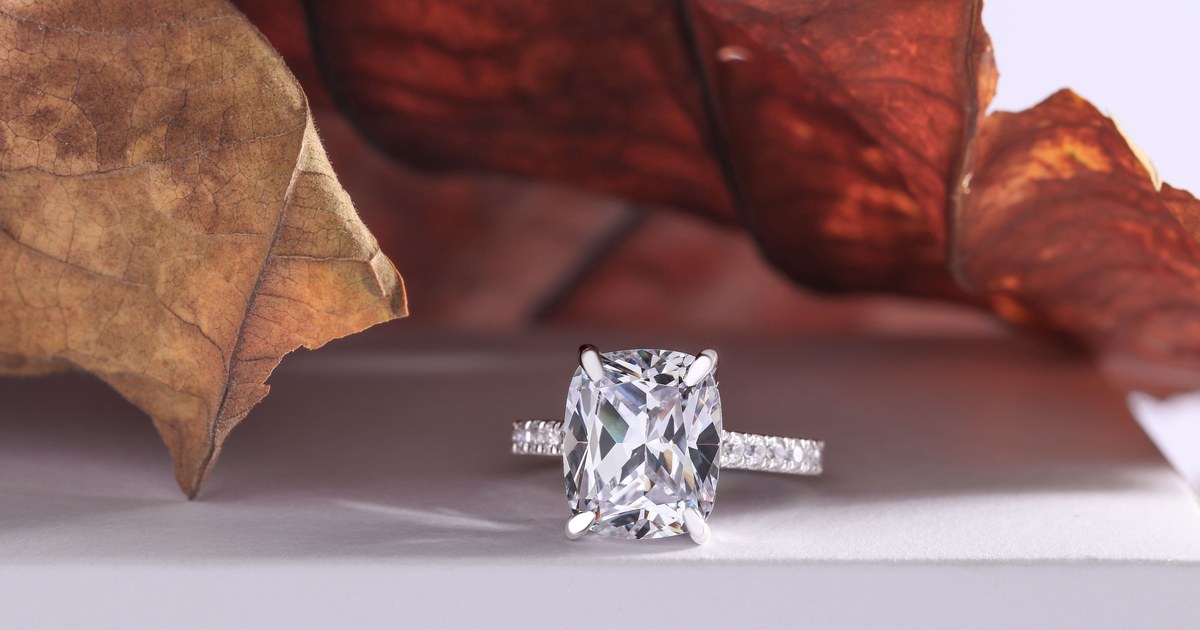
What is white sapphire? It is sapphire with no color: the same mineral as the classic blue gem, just without the trace elements that tint it. It is hard, bright, and far less expensive than diamond, which is why it turns up as a center stone in modern rings and as a diamond substitute in older ones.
White sapphire is colorless corundum, a mineral made only of aluminum and oxygen and rated 9 on the Mohs hardness scale, one step below diamond. GIA notes that colorless corundum is rare in nature, which is why lab-grown white sapphire is common in jewelry. It looks glassier and shows less rainbow fire than diamond.
If you are holding a ring and wondering whether the clear stone is diamond, white sapphire, or something else, the sections below cover what to look for and what it means for value.
What white sapphire actually is
Sapphire is the gem name for corundum. GIA explains that corundum is composed only of aluminum and oxygen, and that in its purest state it is colorless. The familiar blues come from tiny amounts of iron and titanium, and chromium produces the red of ruby. Take the trace elements away and you have white sapphire.
Two points follow from that, and both matter for owners:
- It is a real gemstone. White sapphire is not a simulant in the way glass or cubic zirconia are. It is genuine corundum, the same species as the blue sapphires covered in how to tell if a sapphire is real.
- Natural colorless corundum is uncommon. GIA says so directly, and adds that colorless sapphires were once popular diamond imitations and have come back as accent stones in recent years.
Is white sapphire natural or lab-grown?
Much of it is lab-grown, and that has been true for a long time. The Verneuil flame-fusion process, which Auguste Verneuil publicly announced in 1902, grows corundum from powdered raw material melted in a flame. It became the standard way to make synthetic ruby and sapphire, and it is cheap to run, so synthetic colorless sapphire has been widely available for more than a century.
Under the FTC Jewelry Guides, a laboratory-grown sapphire has to be disclosed with a qualifying word placed in front of the stone name, such as “laboratory-grown,” “laboratory-created,” or “[manufacturer name]-created,” when it is sold. That is a disclosure rule, not a quality judgment. A synthetic white sapphire is still sapphire, chemically and physically; it simply was not mined.
For an inherited ring, you usually cannot tell natural from synthetic white sapphire at home. Curved growth lines and gas bubbles can point to flame-fusion material under magnification, but many stones show neither, and a lab report is the only way to be sure when it matters.
White sapphire vs diamond: how to tell them apart
The two can look similar at a glance, especially in a small stone. The differences show up in how they handle light and how they wear.
Brilliance and fire
Diamond bends light more strongly than almost any other natural gem. Its refractive index is about 2.42, while sapphire’s is about 1.76 to 1.77. Diamond also splits white light into colors more strongly, which is where the flashes of rainbow fire come from. In practice:
- A diamond throws bright white sparkle and visible colored flashes, especially under spotlights.
- A white sapphire looks bright but glassier and more silvery, with much less colored fire.
Look at the stone under a single light source, such as a phone flashlight or a desk lamp, and compare it with a known diamond if you have one.
Clarity of facet edges
Diamond, at 10 on the Mohs scale, keeps crisp facet edges for decades. White sapphire, at 9, is still very durable, but on an older, well-worn ring you may see slight rounding or tiny nicks along facet junctions. Nicks alone do not identify a stone, but sharp edges on a stone that has clearly been worn every day point toward diamond.
Cleanliness
Any stone looks duller under a film of skin oil and soap. Clean the ring before you compare it with anything, or you may mistake grime for a lack of brilliance.
A diamond tester
A thermal diamond tester separates the two reliably, because diamond conducts heat far better than corundum. Many jewelers will test a stone for free or a small fee. The full list of diamond checks, including why fog and water tests are unreliable, is in how to tell if a diamond is real.
White sapphire vs other clear stones
White sapphire is one of several colorless gems and imitations you might find in older jewelry:
- Cubic zirconia: a lab-made simulant with strong fire, often more colorful than diamond. It is not related to zircon, a point cleared up in is zircon the same as cubic zirconia.
- Lab-grown diamond: a real diamond, grown rather than mined, which a basic tester cannot separate from a natural one. That question is covered in how to tell if a diamond is lab grown.
- Glass: softer, often shows bubbles and worn, rounded edges.
- Colorless topaz and quartz: lower brilliance than sapphire and softer.
What is white sapphire worth?
Label the value questions clearly, because there are two:
- The stone itself is usually modest in value, especially lab-grown material, which is inexpensive to produce. Natural colorless sapphire of good size and clarity is scarcer and can command more, but it is still priced far below diamond of similar size.
- The piece as a whole often carries more value in the metal and the design than in the stone. A well-made 14K or 18K ring holds value on its gold content alone, and a signed or period piece can have collector interest.
If the ring is a family piece and the stone was sold as a diamond, a professional identification is worth doing before you insure or sell it. The ring guide covers reading the mount and marks, and the jewelry value guide explains how to turn an identification into a realistic range.
GemPeek can give you a quick first read: scan the ring and it reports the likely stone and metal, the setting style, visible condition, and an estimated value range, which helps you decide whether the stone deserves a jeweler’s test.
Sources
- GIA: Sapphire Description
- Wikipedia: Sapphire (optical properties of corundum)
- Wikipedia: Diamond (refractive index and dispersion)
- Wikipedia: Verneuil method (flame-fusion synthesis)
- International Gem Society: Gems Ordered by Mohs Hardness
- Cornell LII: 16 CFR 23.25, Misuse of the words ruby, sapphire, emerald and similar names