Someone opens an old ring box, finds a bright colorless stone, and is told it is zircon. The word sounds so much like cubic zirconia that the natural assumption is a cheap modern fake in an old setting. So, is zircon the same as cubic zirconia? No, and the difference matters more than the similar names suggest.
Zircon is a natural mineral, zirconium silicate, mined from the ground and cut as a gemstone for centuries. Cubic zirconia is zirconium dioxide, created in a laboratory and never found in nature as a gem material. They are different substances with different chemistry, different crystal systems, and very different histories in jewelry.
Telling them apart comes down to one observation through a loupe, and an inherited zircon deserves better than being written off on the strength of its name.
Two different materials with confusingly similar names
The International Gem Society sets out the chemistry plainly. Zircon has the formula ZrSiO4, with traces of iron, uranium, thorium, and hafnium, and crystallizes in the tetragonal system. Cubic zirconia is ZrO2 in the isometric, or cubic, system, and it is lab-created.
The consequences of that difference show up everywhere:
- Origin. Zircon is mined. Zircon has been synthesized in laboratories for research, but the International Gem Society notes there is no known jewelry use for that material, and that stones advertised online as synthetic zircon are usually cubic zirconia under a confusing label. Cubic zirconia has no natural gem equivalent at all.
- Age in jewelry. Zircon has a long history as a gemstone and appears in Georgian, Victorian, Art Deco, and mid-century pieces. Cubic zirconia entered the jewelry market as a mass-produced diamond simulant in the 1970s. A colorless stone in a genuinely antique setting is far more likely to be zircon, or a diamond, than cubic zirconia.
- Optics. Zircon is doubly refractive; cubic zirconia is singly refractive. This is the most useful practical difference, as explained below.
- Intent. Zircon is a gemstone in its own right, valued especially in blue and golden colors. Cubic zirconia exists specifically to imitate diamond.
Calling zircon “fake diamond” is simply wrong. It is its own species, and unlike a simulant it has a collectible market.
The doubling test: the single most useful check
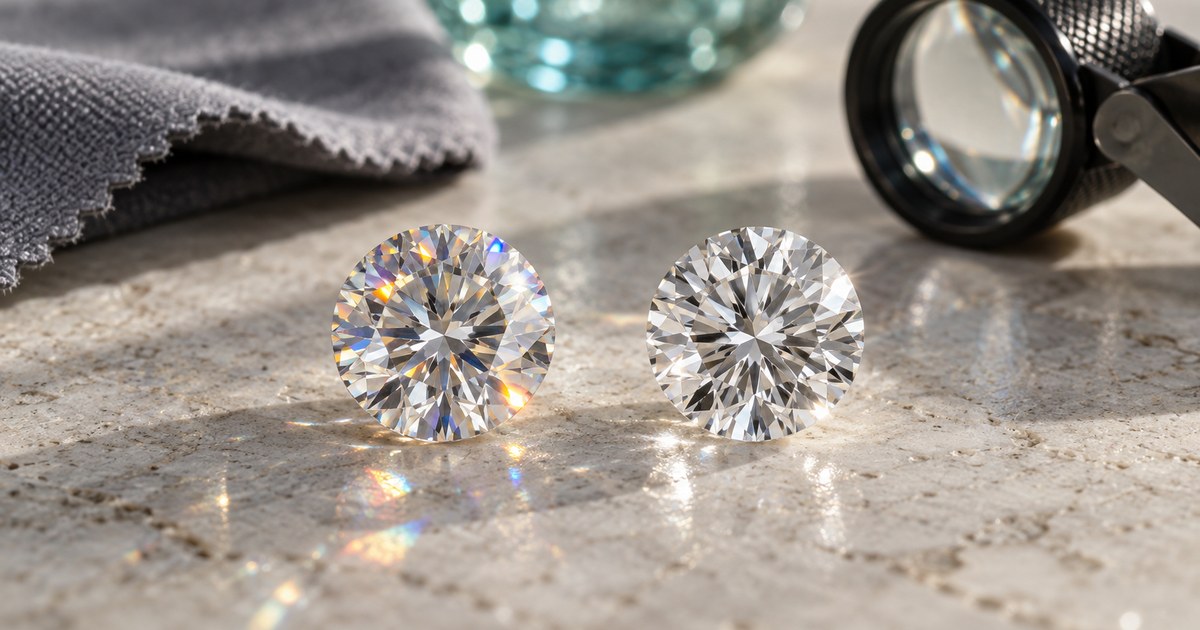
This is the tell that separates them without any equipment beyond a loupe. Because zircon is doubly refractive, light entering the stone splits into two paths, and looking down through the table at the back facets shows their edges doubled. The International Gem Society describes the effect directly: the interior may look fuzzy due to facet image doubling, which is also what distinguishes zircon from diamond.
Cubic zirconia, being isometric, is singly refractive. Its back facet edges are single and crisp no matter how you look through it.
To run the check, hold the stone under a bright light, look through the crown with a 10x loupe, and focus on the edges where the back facets meet. Well-crystallized zircon shows twinned, slightly blurred lines. Cubic zirconia does not, and heavily metamict zircon can show the effect weakly, so a clean single edge is less informative than a clear doubled one. Diamond does not either, so a clear doubling observation moves you toward zircon rather than toward either of the others. Moissanite also shows doubling, which is why colorless stone identification generally needs more than one check, a point covered in moissanite vs diamond and in how to tell if a diamond is real.
How each one ages, and what that tells you
Both stones show their years, but in different ways.
Zircon is brittle at the edges. The International Gem Society rates zircon at 6 to 7.5 on the Mohs scale and notes that its facet edges tend to chip and wear easily, recommending protective settings for rings and treating it as better suited to pendants, brooches, and earrings, or to occasional wear. So an old zircon ring often shows small chips and abrasion around the girdle and along facet junctions while the body of the stone remains bright.
Cubic zirconia scratches and dulls across its face. It is harder than zircon but far softer than diamond, so after several years of daily wear a CZ tends to develop a haze of fine surface scratches that takes the life out of it. The two wear patterns look different: chipped edges with a clear interior points toward zircon; an evenly dulled, scuffed surface points toward cubic zirconia.
Fire. Zircon has strong dispersion, which is the property that breaks white light into colored flashes, and it was historically prized as a diamond alternative for exactly that reason. Cubic zirconia also has high dispersion and can look showier than diamond. Fire alone does not separate them; wear pattern and doubling do.
The radioactivity question
This comes up whenever someone reads that zircon contains uranium and thorium, so it is worth answering plainly rather than leaving it to rumor.
Zircon’s crystal structure can incorporate trace uranium and thorium, and over geological time that radiation gradually breaks down the structure of some stones, producing what gemologists call metamict, or low-type, zircon. Most gem-quality zircon is the well-crystallized high type. The International Gem Society’s assessment is that wearing zircons typically does not pose any significant health risk, and that the radiation produced by the lower-quality metamict material usually does not exceed background radiation levels.
In other words, this is a piece of mineralogical trivia and a way to understand the different types of zircon, not a reason to be alarmed about an inherited ring.
Is zircon worth anything?
More than most people assume when they hear the name. Zircon is a genuine gemstone with an established market, particularly in blue, which is the color most often seen in mid-century jewelry, and in golden and honey tones. One thing to know about the blue: it is virtually always produced by heating brown zircon, a normal and stable treatment that the trade assumes and prices in, so a blue zircon being treated is expected rather than a mark against it. Prices are nowhere near diamond, and they vary with color, size, and cut quality, but a well-cut natural zircon in an attractive antique setting is a real piece of jewelry rather than costume material.
Cubic zirconia, by contrast, has essentially no resale value as a stone. It is inexpensive to produce in any size and quality, so a CZ piece is worth what its setting is worth, plus whatever the design or maker adds.
That difference makes the identification worth doing properly before you decide what to do with a piece. Getting it backwards means either scrapping a genuine antique gemstone or paying to insure a manufactured simulant.
What to check, in order
- Look at the setting and the era. A hand-made mount, an old cut, or a marked antique setting shifts the odds strongly. If the stones around it are old cuts, that is informative in itself, as old mine cut diamonds explains.
- Look for doubled back facet edges through the table with a loupe. This is the decisive observation.
- Read the wear pattern. Chipped facet junctions with a clear interior suggests zircon; an overall scratched, hazy surface suggests cubic zirconia.
- Weigh it if it is loose. Both are dense for their size, so this narrows the field against lighter materials such as glass and quartz rather than separating the two from each other.
- Confirm properly if it matters. Refractive index and specific gravity settle it definitively, and both are bench measurements, which is the same boundary described in how to identify a gemstone.
If a colorless or blue stone in an old setting has you guessing, scan it with GemPeek. It reads back the likely stone, the setting materials and style, the condition, and a realistic value bracket, which is what tells you whether the ring in your hand is a period gemstone or a 1980s simulant, before you pay anyone to confirm it.