
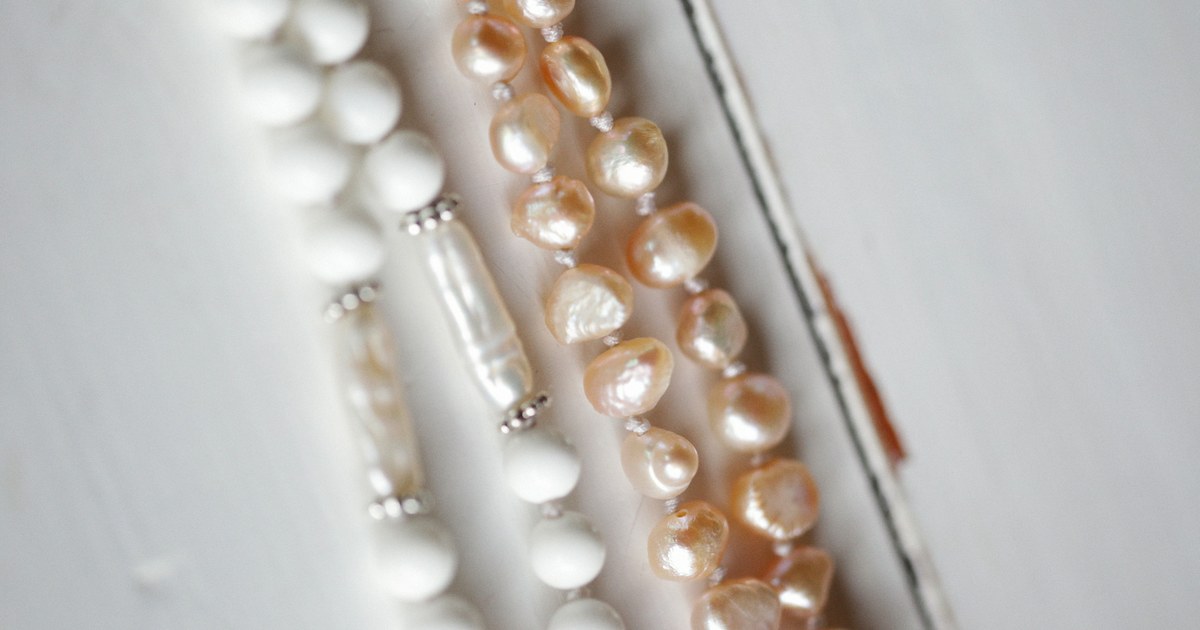
Freshwater vs saltwater pearls is the first question to settle once you know a strand is real, because it moves the value more than almost anything else. Both are genuine pearls grown by mollusks, and this guide deals with cultured pearls, the four major types GIA describes. They differ in how they are grown, how they look, and what they sell for.
Freshwater cultured pearls are grown in mussels in lakes and ponds, mostly in China, often many to a mollusk and traditionally without a bead, so they tend to be less perfectly round. Saltwater types, meaning akoya, Tahitian, and South Sea, grow in oysters around a shell bead and are usually rounder and pricier. Shape, the drill hole, luster, and color are your clues.
If you have not yet confirmed that the pearls are real rather than glass or plastic, start with how to tell if pearls are real, then come back here.
The four types, in plain English
GIA groups cultured pearls into four major types:
- Akoya (saltwater): the classic white or cream round pearl of the traditional single strand. Japan and China both produce them.
- South Sea (saltwater): grown mainly in Australia, Indonesia, and the Philippines, ranging from white to silver or golden depending on the oyster.
- Tahitian (saltwater): cultivated mainly around the islands of French Polynesia, sometimes called black pearls, with a wide color range.
- Freshwater: the most commonly produced pearls, with a wide range of sizes, shapes, and colors and generally lower price points. They are usually cultured in lakes and ponds, often many pearls to one mollusk, and China is the leading source.
How they are grown, and why it shows
The growing method explains most of the visible differences.
GIA describes the two approaches. In one, a technician inserts a shell bead along with a small piece of mantle tissue into the mollusk’s gonad, and nacre builds up in layers over the bead. In the other, several pieces of mantle tissue go into the mollusk’s mantle with no bead, and nacre forms around each piece of tissue.
Saltwater cultured pearls are bead-cultured. Freshwater pearls have traditionally been grown the tissue-only way, and GIA field research on Chinese farms found tissue nucleation to be the main method, with bead nucleation much less common. Two consequences follow:
- Tissue-grown freshwater pearls are nacre almost all the way through. There is no large bead inside, so there is no thin skin of nacre over a bead to wear away.
- Without a round bead to start from, freshwater pearls grow in more varied shapes: rice, button, oval, potato, and baroque shapes are all common, and perfectly round ones are the exception.
One modern complication: bead-cultured freshwater pearls now exist too. GIA has studied the trade-named “Edison” pearls from China, which are near-round to round freshwater bead-cultured pearls. So a large, round pearl is not automatically saltwater.
At-home tells: freshwater or saltwater?
None of these proves the type alone, but together they usually point clearly one way.
Shape
Look at the whole strand. A strand where many pearls are slightly off-round, oval, or lumpy leans freshwater. A strand of closely matched, very round pearls leans saltwater, especially akoya.
The drill hole
This is the most useful home check. With a 10x loupe, look straight into the drill hole of a pearl, ideally one at the clasp end where the hole may be slightly worn.
- A visible boundary, where a thin layer of nacre sits over a different-looking core, suggests a bead-cultured pearl.
- Nacre that looks continuous right into the hole fits a tissue-grown freshwater pearl.
GIA’s quality guidance adds a related tell: if the nucleus is visible under the nacre, or the pearl looks dull and chalky, the nacre is thin. Our guide to how to use a jeweler’s loupe covers getting a clear view at this magnification.
Luster
Luster is the sharpness of the reflections on the surface, and GIA calls it possibly the most important of the pearl value factors. High-quality akoya are known for sharp, mirror-like reflections. Many freshwater pearls show a softer glow, although top freshwater pearls can be very lustrous.
Color
- White, cream, or rose-tinted white: could be akoya or freshwater.
- Soft pastels such as peach, pink, and lavender are common in freshwater pearls.
- Dark gray, green, and peacock tones: often Tahitian, but dark freshwater pearls are frequently dyed or irradiated to imitate them.
- Deep golden: can be South Sea, or treated freshwater.
GIA notes that freshwater pearls can have a wide range of colors, either natural or produced by post-harvest treatments, with dyeing and irradiation the most common. Under the FTC Jewelry Guides, a pearl treatment has to be disclosed when it is not permanent, creates special care requirements, or significantly affects value.
Which is worth more?
As a general rule, saltwater cultured pearls sell for more than freshwater pearls of similar size and appearance, and GIA describes freshwater pearls as available at lower price points. Within each type, GIA’s value factors apply: size, shape, color, luster, surface quality, nacre quality, and, for strands, how well the pearls match.
A few points for owners:
- A fine freshwater strand is still worth having. Solid nacre wears well, and high-luster, well-matched strands have real resale interest.
- Old akoya strands are often worth restringing before you sell or wear them. Worn silk and loose knots put the pearls at risk.
- The clasp can carry value of its own, especially a marked gold clasp or a signed one.
For a strand from a family collection, how to identify vintage jewelry covers the clasp and construction clues that help date it, and if you picked it up secondhand, estate sale jewelry covers the quick checks worth doing before you pay. The necklace guide and the jewelry value guide take you from identification to a value range.
GemPeek can give you a fast first read: scan the strand and get the likely pearl type, clasp metal, style and era, condition, and an estimated value range, then confirm significant strands with a pearl specialist or a lab.
Sources
- GIA: Pearl Description (the four major cultured pearl types)
- GIA: Pearl Quality Factors
- GIA Gems & Gemology: The current status of Chinese freshwater cultured pearls (2001)
- GIA Gems & Gemology: Color treatment in Chinese freshwater Edison pearls (2021)
- Cornell LII: 16 CFR 23.23, Disclosure of treatments to pearls and cultured pearls