
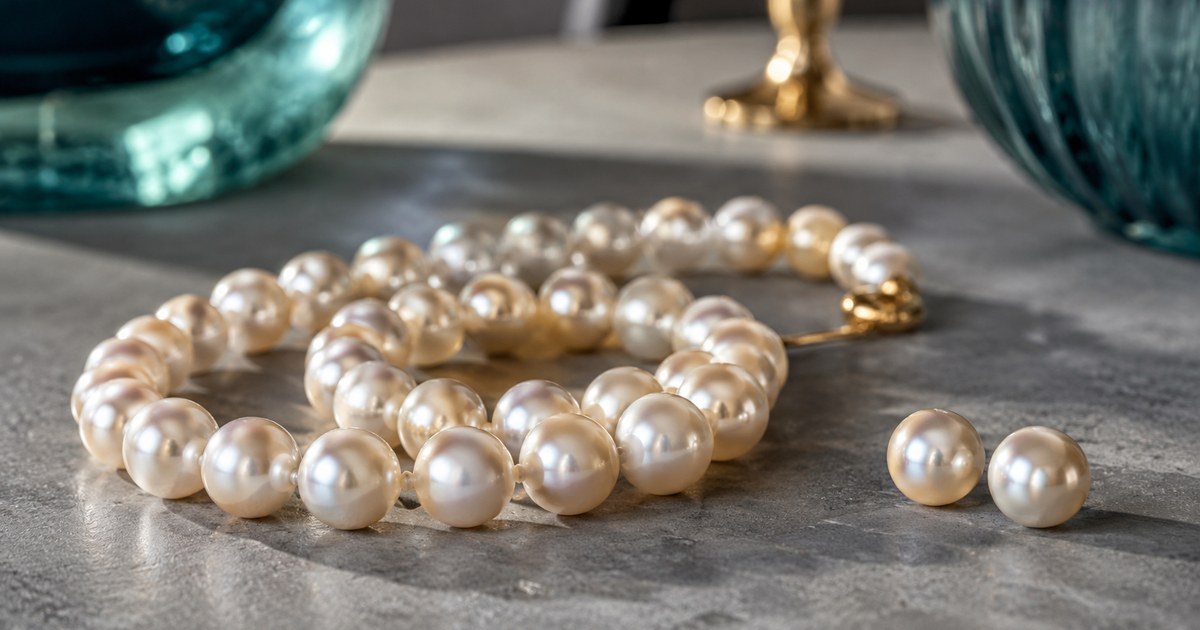
Pearl strands are the classic inheritance: they arrive in a velvet box with no paperwork, and everyone in the family has a different opinion about what they are. Before you sell, insure, or split them in an estate, it helps to know how to tell if pearls are real, and the good news is that pearls are one of the easiest gems to screen at home.
To tell if pearls are real, rub one gently against the edge of your front tooth or against another pearl: real pearls feel slightly gritty, while imitations feel glassy smooth. Then inspect the drill holes for flaking coating, check the strand for too-perfect uniformity, and remember that cultured pearls are real pearls.
Here is each check in detail, the caveats that keep them honest, and the one distinction (natural versus cultured) that no home test can make.
First, clear up what “real” means
A real pearl is one formed inside a mollusk, built up in layers of nacre, the same iridescent material that lines the shell. That definition includes two categories:
- Natural pearls form without human help. They are rare, and genuinely natural strands are mostly antique.
- Cultured pearls form when a pearl farm places a nucleus or tissue graft inside the mollusk, which then coats it in nacre exactly as it would a natural irritant. Akoya, South Sea, Tahitian, and freshwater pearls sold today are cultured.
Cultured pearls are real pearls. The mollusk does the same work either way, and the vast majority of pearls sold since the mid-20th century are cultured. When people ask “are these real,” the useful question is almost always “pearl or imitation,” not “natural or cultured.” Imitations (also sold as faux, shell pearl, or “Majorca” style) are glass, plastic, or shell beads coated to look pearly, and they are what the home tests catch.
The tooth test, with its caveats
The classic first check exploits how nacre is built. Real pearl surfaces are made of countless microscopic crystalline platelets, so when you rub a pearl lightly against the biting edge of a front tooth, it feels faintly gritty or sandy. Imitation pearls, with their smooth painted or lacquered coatings, feel slick and glassy.
If the tooth test feels unhygienic on jewelry of unknown history, rub two pearls gently against each other instead; the same friction principle applies. Real pearls drag slightly and can produce a fine pearly powder, while imitations slide.
Caveats that matter: rub gently, because aggressive rubbing can mark the nacre on a genuine pearl. And treat the result as one signal rather than a verdict, since some higher-end imitations add texture to their coatings to mimic grit. The tooth test screens well; it does not certify.
Inspect the drill holes
Drill holes are where imitations confess. Use a loupe or your phone camera zoomed in on the hole of a strung pearl:
- Real pearls show clean, sharply defined drill holes. At the rim you may see nacre in cross-section, like layers in fine plywood, and the material looks the same into the hole as on the surface.
- Imitations often show a coating problem at the hole: flaking, chipping, or peeling around the rim, ragged edges in the lacquer, or a visible boundary where a thin pearly shell gives way to a glass or plastic bead beneath. On worn fakes you can sometimes see the coating lifting like old paint.
While you are close, scan the surface around the holes and along the strand for wear patches. An imitation that has been worn for years loses its coating at contact points; a real pearl wears by dulling, not peeling.
Read the strand as a whole
Nature does not do perfect duplicates. Across a strand of real pearls, expect slight variations in size, shape, and color, and tiny surface characteristics (small pits, ridges, or growth marks) on individual pearls. That variation is normal even in fine cultured strands, and matching pearls closely is part of what makes good strands expensive.
Imitations show the opposite pattern: every “pearl” identical in size, perfectly round, identically colored, with flawless mirror-smooth surfaces. Perfect uniformity at a modest price is the single loudest imitation tell. Also look at the luster: real pearls have a depth to their glow, as light reflects from layers beneath the surface, while imitations show a bright but flat, silvery shine that sits on top.
Weight and temperature clues
Pick the strand up. Real pearls feel noticeably cool when they first touch your skin and warm up slowly as you hold them. They also have a solid, satisfying heft for their size. Plastic imitations feel light and take on skin temperature almost immediately. Solid glass imitations complicate the picture, since they are cool and heavy too, which is why temperature and weight are supporting evidence rather than a standalone test. Use them to confirm what the friction and drill-hole checks already suggest.
What no home test can tell you
Two limits to be honest about. First, natural versus cultured: separating a natural pearl from a cultured one requires laboratory X-ray examination of the pearl’s internal structure, which is why gem labs like GIA offer pearl identification reports. If there is any chance a strand is natural (antique, documented family history, unusually irregular pearls), that lab report can change the value dramatically and is worth the fee.
Second, quality grading. Whether a real strand is a modest freshwater necklace or a fine Akoya strand depends on luster, surface quality, nacre thickness, size, and matching, judgments that take experience and comparison stones. The same value logic that applies to all jewelry applies here: origin, quality, and condition drive price, as covered in what makes jewelry worth more.
How to tell if pearls are real before you sell or insure
Run the checks in order: friction, drill holes, uniformity, weight and temperature. Photograph as you go, including close-ups of drill holes and the clasp, using the techniques in our guide to photographing jewelry for identification; the clasp metal is evidence too, since fine strands tend to be finished with gold or well-made silver clasps. From those photos, GemPeek can give you a likely identification of the strand, its visible condition, and an estimated value range, which is a solid first answer to confirm with a professional appraiser when insurance or a significant sale is on the line.
Pearl earrings deserve the same treatment as strands, with extra attention to the mounting: real pearls are usually drilled and glued to a post on a small cup, and the setting quality tends to match the pearl quality. Our earring identification guide covers reading those mountings, and the necklace identification guide walks through clasps, knotting, and stringing, all of which carry clues about what a strand is.
If a colored stone turns up in the same box, the “real but is it treated” question runs the same way: how to tell if a ruby is real and how to tell if jade is real cover the equivalent checks, plus the grading a home test can never settle.
One last encouragement: knotted silk between pearls, a quality clasp, and slight natural variation are all signs someone invested in the strand. Pearls that pass the checks above are strong candidates for real pearls, whatever their price tier. Treat that as a confident starting point rather than a verdict, and turn a velvet-box mystery into a decision you can actually make.