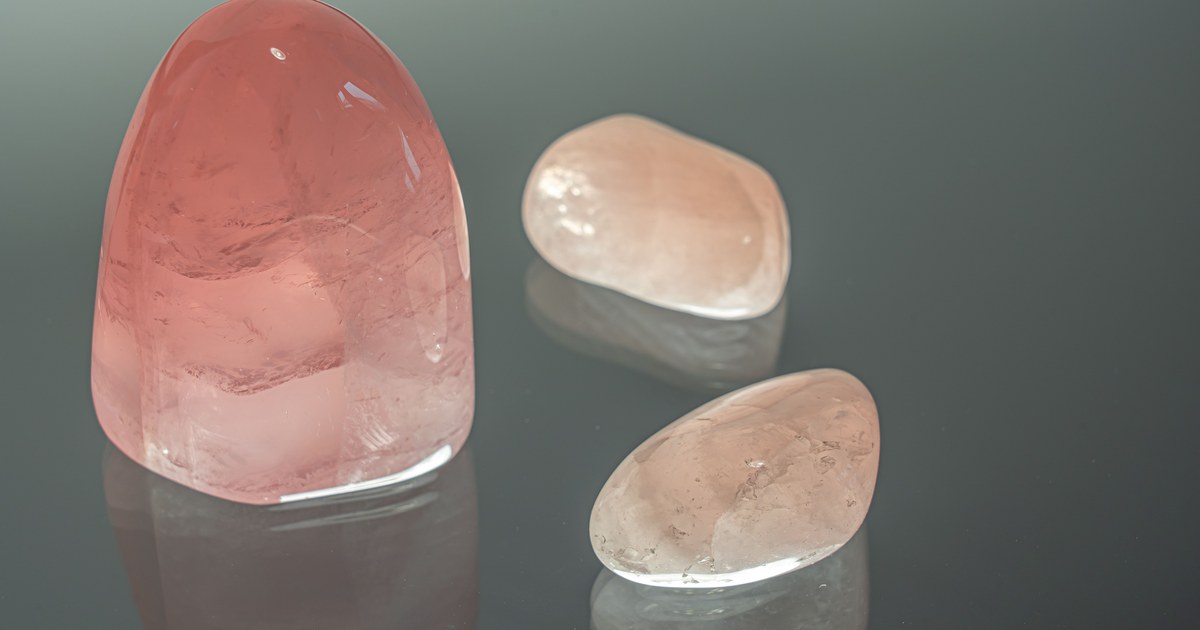
Most people asking how to tell if rose quartz is real are holding something too perfect. A bright, clear, candy-pink stone looks like the ideal rose quartz, and that is exactly the problem. That look is atypical for natural rose quartz.
Real rose quartz is a pale to medium pink and usually cloudy or milky, because its color comes from microscopic mineral inclusions that also scatter light. GIA describes its typical look as a cloudy translucence. A stone that is perfectly transparent and vividly pink, especially one with round bubbles inside, is far more likely to be glass.
That single idea, cloudy is normal and clear is suspicious, settles most rose quartz questions. The checks below cover the rest.
What real rose quartz looks like
Rose quartz is a pink variety of quartz, the same mineral as amethyst and citrine, and it rates 7 on the Mohs hardness scale. GIA describes its color range as very light pink, almost white, to medium-dark pink, and notes that the most appealing color typically occurs in larger sizes, with small stones tending to show lighter shades.
The color has an unusual cause. Most colored quartz gets its color from trace elements or radiation in the crystal. Rose quartz is colored by microscopic inclusions of a fibrous silicate mineral related to dumortierite. Those same inclusions make the stone hazy, which is why GIA attributes rose quartz’s cloudy translucence to microscopic mineral inclusions.
A few consequences are worth knowing:
- Most rose quartz is translucent, not transparent. GIA notes that translucent material is usually cut as cabochons or carved, while transparent material is faceted.
- It usually comes in massive form. Rose quartz is generally found as masses rather than well-shaped crystals, and GIA notes well-shaped crystals are highly prized.
- Some stones show a star. When the inclusions are well oriented, rose quartz can show asterism, a six-rayed star, in cabochons and spheres.
The tells that point to glass
Glass is the most common rose quartz imitation, and it gives itself away in a few ways. Check with a 10x loupe or your phone’s zoom in good light.
- Round gas bubbles. Molten glass traps air as it cools. Spherical bubbles, alone or in clusters, are the clearest sign you are not looking at quartz.
- Swirl lines. Faint curved flow lines through the stone come from molten glass, not grown crystal.
- Perfect transparency with strong color. Natural rose quartz is rarely both clear and deeply colored.
- Mold marks. A seam around the edge of a bead or cabochon, or soft, rounded facet edges, suggests a molded piece rather than a cut one.
- Worn surfaces. Quartz at hardness 7 resists scratches well, so a stone with a heavily scuffed surface after modest wear may be something softer.
Some glass imitations are sold under names that sound like gems. If a label describes the material in vague terms, or the price is well below what quartz of that size would cost, treat it as glass until tested.
Dyed quartz: real quartz, fake color
The other imitation is real quartz with artificial color. Colorless or pale quartz can be crackled with heat and then dyed pink, or coated. GIA’s overview of gem treatments explains that treatments are used to alter color and apparent clarity, and that disclosure matters because they affect value.
Signs of dyed quartz:
- Color concentrated in cracks. Under magnification, the pink sits in lines and fractures while the quartz between them is paler.
- A network of fine fractures, especially in a stone that otherwise looks glassy.
- Color that rubs off on a cotton swab with a little acetone, on an inconspicuous spot. Only try this on a loose stone or a place where a mark would not matter.
Dyed quartz is still quartz, but it is not natural rose quartz and should be priced accordingly.
Pink quartz that fades
One natural complication: there is a distinct transparent, well-crystallized pink quartz, sometimes called pink quartz, which forms as crystals rather than masses. Unlike massive rose quartz, it is photosensitive and can fade. So a very clear pink quartz crystal is not automatically fake, but it is a different material from the cloudy rose quartz in most jewelry, and it needs protecting from strong light.
Tests to skip
- Scratch tests. Scratching a stone to prove its hardness risks damaging it and still would not separate natural rose quartz from dyed quartz, since both are quartz. It is the same restraint recommended in how to tell if amethyst is real.
- Temperature by touch. Quartz does tend to stay cool longer than glass, but judging it by hand is unreliable without a known stone to compare against.
- Price alone. Rose quartz is an affordable gem, so a low price is not a red flag in itself.
What this means for value
Rose quartz is widely available and generally inexpensive, so the value question is usually less about the stone than about the piece.
- Color and size drive stone value: GIA notes large stones generally show the most intense pinks.
- Star rose quartz and fine carvings can command more than plain cabochons.
- The setting often carries more value than the stone, especially a marked gold or sterling mount or a signed piece.
The quartz family shares many of these patterns. How to tell if citrine is real covers the heat-treatment side of quartz, and how to identify a gemstone lays out the general identification process. If you are working with magnification for the first time, how to use a jeweler’s loupe shows how to see bubbles and dye lines clearly.
For a pendant, ring, or bracelet you cannot place, GemPeek will scan it and give you the likely stone and metal, style, condition, and an estimated value range. The necklace guide and jewelry value guide cover the next steps.