
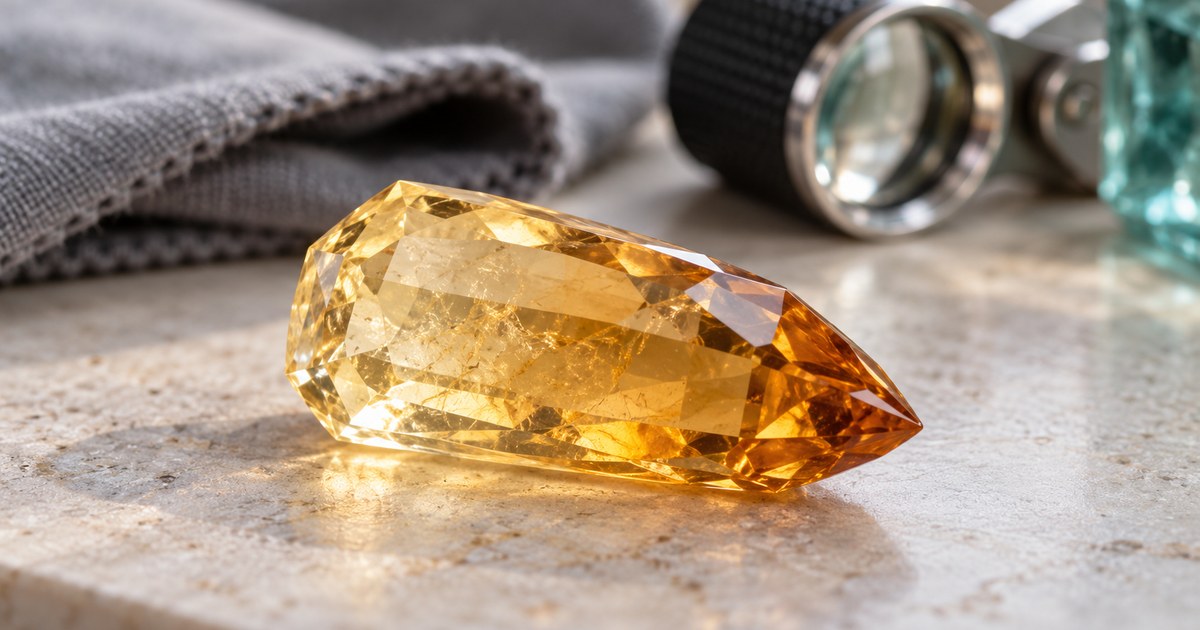
Most guides on how to tell if citrine is real are answering the wrong question. They walk you through spotting glass, which is the least likely problem you have. The actual issue in the citrine market is that most of the stones sold as citrine started life as a different purple stone, and that fact changes what a fair price looks like.
GIA is direct about it: most of the citrine on the market is the result of heat treatment, because natural citrine is rare. Heating amethyst at relatively low temperatures turns it yellow to orange, and that treatment is stable and effectively undetectable, in a laboratory as much as at home, which is why a seller’s written statement is the only real recourse you have. So the practical question is not “is this quartz,” it is “am I paying a natural-citrine price for treated quartz.”
Read the stone for the patterns below, then let the answer change what you expect to pay rather than whether you trust the seller.
What citrine actually is
Citrine is the yellow to orange variety of quartz, sitting at 7 on the Mohs scale, and it is the same mineral as amethyst with different color chemistry. GIA describes the finest material as a saturated yellow to reddish orange free of brownish tints, with the broader market running from pale yellow through orangy yellow to reddish orange.
The relationship with amethyst is not a scandal, it is basic mineralogy. The International Gem Society explains that amethysts heated to yellow or red-orange are, by trade definition, citrines. Green is a different story: only amethyst from a small number of deposits turns green on heating, and that material is sold as prasiolite, so green quartz is a question of where the rough came from rather than simply how hot it got. GIA notes that low-temperature heat treatment turns amethyst into orangy citrine, and that the original hue of the amethyst determines how rich the result is.
Two consequences follow, and they are the whole point of this article:
- A heat-treated stone is still genuine citrine. It is quartz, colored by a stable process, and it will not fade or change back with normal wear. It is not glass, not a synthetic, and not a fake.
- Natural and treated citrine are not worth the same. Natural citrine is genuinely scarce, and collectors pay accordingly. Treated material is abundant, which is precisely why citrine is one of the more affordable yellow gemstones.
The honest failure mode in this market is therefore mispricing and misdescription, not counterfeiting.
The color tells that point to heat treatment
You cannot prove treatment at home, and anyone selling you a test that does is overselling. What you can do is read the color for the patterns that heat-treated amethyst tends to leave.
- Deep reddish orange and burnt-orange tones are the signature of heated material. Natural citrine leans toward pale yellow, honey, and warm champagne tones more often than it does toward saturated orange-red.
- Color concentrated at the point or tip of the stone, fading toward the base, follows the shape of the original amethyst crystal and its color zoning. Even, gentle color throughout is more typical of natural material.
- A cloudy or milky zone near the base or girdle is common in stones cut from geode material that was heated in quantity.
- Uniform, intense color across a large parcel of matched stones at a low price points to bulk treatment. Naturally colored citrine does not turn up in quantity looking identical.
None of these are proof, and there are exceptions in both directions. Use them the way a jeweler would: as the reason to ask a seller a direct question rather than as a verdict you deliver.
Ask the seller plainly whether the stone is heat treated. GIA’s guidance on gem treatments is stronger than trade courtesy: it describes disclosure of a treatment as necessary and legally required of anyone selling a gem, whether or not the buyer thinks to ask. A seller who cannot or will not answer is the actual warning sign, not the orange color.
When the label on an old piece says something odd
Two labels cause needless worry on inherited jewelry.
“Smoky citrine” or a tag mixing citrine and smoky quartz. Smoky quartz and citrine are close relatives in the same mineral family, and older trade language was loose about where one ended and the other began. A vintage tag using both words is usually imprecision from an era with different conventions, not evidence that someone set out to defraud your grandmother.
“Madeira” and similar color names. These are trade descriptions of a color range, not species names or guarantees of natural origin. They tell you what the stone looks like and nothing about how it got that way.
There is also ametrine, a naturally occurring quartz that shows purple and yellow zones in the same stone. It is a real material and a genuine curiosity, and it is a useful reminder that amethyst and citrine are two expressions of one mineral.
Ruling out the things that are not quartz at all
Glass and plastic do turn up, mostly in costume pieces and in tourist jewelry, and they are easy to catch with a magnifier and side lighting:
- Spherical bubbles, or faint frozen swirls in the body of the stone. Both belong to molten glass, not to grown crystal.
- A seam running around the girdle, or facet junctions that feel soft under a fingernail, meaning the stone was molded rather than cut.
- Surface scuffing on a stone that should be a hard 7, which suggests something softer has been sitting in the setting.
Skip the scratch test, though. Quartz at 7 is hard enough that testing it means dragging something harder across a mounted stone, and a pass would still not separate natural from treated quartz, since both are quartz. Those glass tells and that restraint apply across the whole quartz family, and they are worked through in more detail in how to tell if amethyst is real.
What this means for the piece in your hand
Work through it in this order:
- Rule out glass with a magnifier: bubbles, swirls, soft facet edges.
- Read the color pattern for tip concentration, burnt orange saturation, and milky zones near the base.
- Look at the setting. A marked gold mount with well-formed prongs says the stone was worth setting properly, whatever its origin.
- Set your expectations by the market, not by hope. Citrine is an affordable stone, and most of it is treated. A modest valuation is the normal outcome and not a sign you were cheated.
- Ask for disclosure if you are buying, and get any natural-origin claim in writing when it is being used to justify the price.
For inherited pieces, the setting, the era, and the maker very often carry more of the value than the citrine does, which is the recurring lesson across colored-stone identification and the framework used in how to identify a gemstone. It is also the same relationship between treatment and authenticity found in how to tell if turquoise is real, where a treated stone is still a real one, and the same disclosure question that shapes value in how to tell if aquamarine is real.
For a stone you cannot place, GemPeek will read back the likely material, the setting style and marks, the condition, and the value range a comparable piece sits in, which is usually enough to tell an ordinary treated citrine from something that deserves a specialist’s attention.