
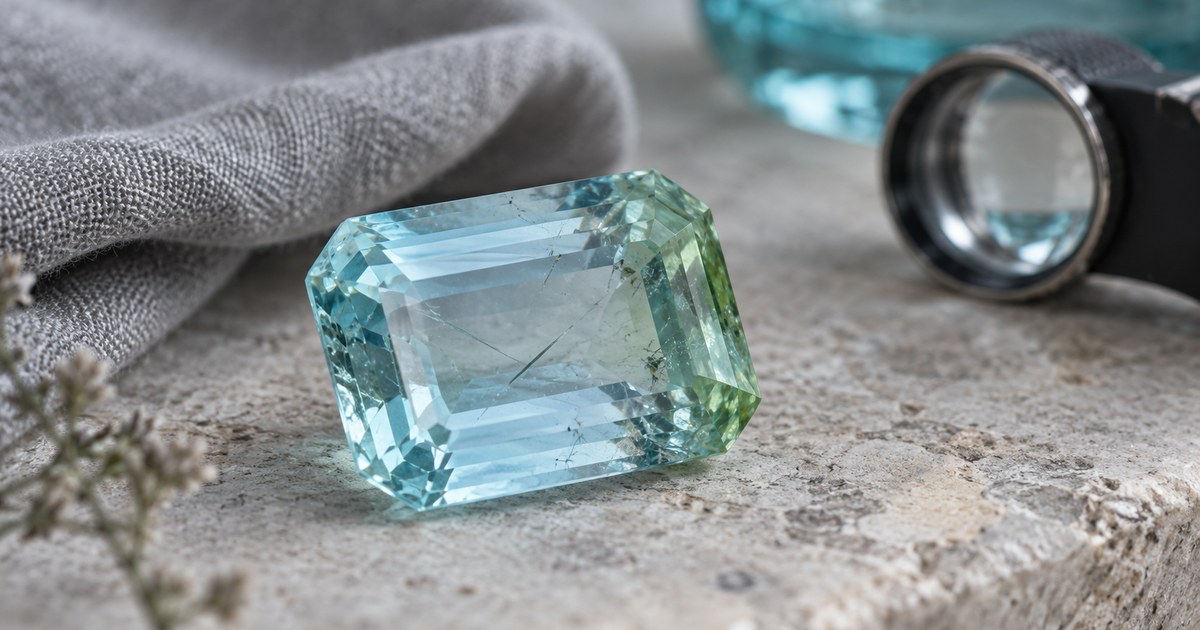
The usual advice on how to tell if aquamarine is real is to check that the blue looks natural, which is not advice at all, since nobody knows what someone else’s idea of a natural blue looks like. Aquamarine has two properties that are far more useful, and both are visible without a laboratory: the way its color splits when you turn the stone, and the tiny hollow tubes that grow inside it.
Aquamarine is a beryl that shows distinct blue and colorless dichroism, meaning the color visibly shifts between a blue and a near-colorless view as you rotate it. It rates 7.5 to 8 on the Mohs scale, and it often contains long hollow tubes. A stone that stays exactly the same blue from every angle, with no inclusions at all, is more likely glass, a treated substitute, or a synthetic.
Both checks are described below, along with the reason the most common substitution in this market is not glass at all.
The dichroism check, and how to do it
Dichroism means the stone absorbs light differently along different crystal directions, so it presents two colors depending on the viewing angle. The International Gem Society describes aquamarine as showing distinct blue and colorless dichroism, and that is a property of the material rather than of how it was cut.
To see it, hold the stone under a steady, bright, neutral light and rotate it slowly through its axes, looking down through the table and then through the sides. What you are watching for is not a rainbow flash off the facets, which every faceted stone does, but a shift in the body color itself: strong blue from one direction, noticeably paler or nearly colorless from another.
Two useful readings come out of this:
- A visible blue-to-colorless shift is a genuine positive signal. Glass and synthetic spinel are singly refractive and do not show it. Neither does the historical Maxixe material, a treated beryl that reached the market in the 1970s and which the International Gem Society notes appears blue from all angles rather than showing pleochroism, with an unstable color that fades.
- Absence of a clear shift is not a verdict. In a pale or small stone the effect can be genuinely subtle, and a deep setting or a poorly oriented cut will mute it further. Failing this check means keep looking, not “it is fake.”
Inclusions: the tubes are the fingerprint
Natural beryl grows with characteristic internal features, and aquamarine’s signature is a set of long, hollow tubes running parallel through the stone, sometimes fine enough to look like scratches suspended in the interior. The International Gem Society also lists metallic inclusions such as hematite, pyrite, and rutile, plus irregular liquid droplet formations sometimes described as snow-stars.
Look through the crown with a magnifier and a light source off to one side:
- Fine parallel tubes or needles support a natural beryl.
- Round bubbles point to glass. Bubbles are spheres; tubes are elongated channels. Once you have seen both you will not confuse them.
- Curved swirl lines point to glass as well, since they record molten flow rather than crystal growth.
- Total, absolute cleanliness in a large, inexpensive stone is a flag rather than a triumph. Perfect clarity is cheaper to manufacture than to mine.
Aquamarine is also a stone where good material is genuinely clean, so eye-clean alone proves nothing. It is the combination that matters: clean plus perfectly uniform color plus a low price plus no dichroism is a very different picture from clean with visible tubes and a color that shifts.
The real mix-up is blue topaz, not glass
Most people worry about glass. In practice the far more common substitution in modern jewelry is treated blue topaz, sold either honestly as topaz or loosely described as aquamarine by sellers who should know better. Nearly all blue topaz on the market began as colorless or pale topaz and was treated to produce that blue.
Three things separate them without instruments:
- Weight for size. Topaz is markedly denser than beryl. Two stones cut to the same dimensions, one aquamarine and one topaz, will not feel the same in the hand, and the topaz is the heavier one. On loose stones this is the most reliable home check available.
- Color character. Treated blue topaz tends toward a strong, even, slightly electric blue. Aquamarine is usually gentler and often carries a hint of green, especially in untreated material.
- Facet edges and chips. Topaz has perfect cleavage in one direction, so older topaz jewelry often shows small flat chips along facet junctions and around the girdle. Aquamarine’s cleavage is only indistinct, so it fractures unevenly rather than splitting off flat plates.
Heat treatment is worth understanding on the aquamarine side too, because it is completely normal. The International Gem Society explains that most aquamarine comes out of the ground with a greenish tint that disappears with heating, leaving a pure blue, and that the treatment is undetectable, so pure blue stones are usually described as probably heat treated. GIA’s overview of gem treatments makes the same general point across colored stones: treatment is common, stable, and expected, and disclosure rather than absence is the standard. A heated aquamarine is a real aquamarine.
What the classic home tests are worth here
Scratch testing is a bad idea on a mounted stone, as it is with every gem. Aquamarine at 7.5 to 8 is harder than most things you would test it against, and a positive result still does not separate natural beryl from synthetic beryl.
The temperature test is the same weak signal it is for every stone, and it is discussed in how to tell if amethyst is real. It is worth a moment and never worth a decision.
A UV torch is not particularly informative for aquamarine, which is generally inert. It is a more useful tool for other stones, which is one reason the check order changes from gem to gem. That variation is exactly why how to identify a gemstone treats each material on its own terms rather than offering one universal test.
Read the setting as evidence too
A pale blue stone in a marked gold mount with fitted prongs was worth mounting properly, which shifts the odds toward real aquamarine. A large, vividly blue stone glued into an unmarked base-metal mount is telling you something before you have looked at the stone at all. Antique settings add another wrinkle: a genuine aquamarine may sit in a piece where the metal, the era, and the design carry more of the value than the stone does, which is a pattern worth expecting rather than resenting.
The same “judge the whole piece, not just the stone” habit runs through how to tell if a sapphire is real, where treatment and synthetics dominate the conversation, and through how to tell if turquoise is real, where a treated stone is still a genuine one. Aquamarine also shares an approach with quartz identification, where uneven natural color is a positive signal rather than a defect, as in how to tell if amethyst is real.
A working order for your stone
- Rotate it under a bright light and look for a blue to near-colorless shift.
- Look through the crown with a magnifier for parallel tubes, needles, and metallic flecks.
- Rule out bubbles and swirls, which mean glass.
- If the stone is loose, compare its weight against its size, since a heavy stone points to topaz.
- Look for flat chips at the facet edges, another topaz signal.
- Read the setting and the marks, then decide whether the piece is worth a gemologist’s time.
What none of this settles is natural against synthetic beryl, which is a laboratory question, and origin, which is a laboratory question with a specialist report attached. For most inherited aquamarine, neither answer changes the decision in front of you.
Scanning the piece with GemPeek gives you a written starting point rather than an impression: the likely stone, the setting materials and style, the condition, and the value range a comparable piece sits in. Take a promising result to a jeweler; take a disappointing one as a reason not to.