
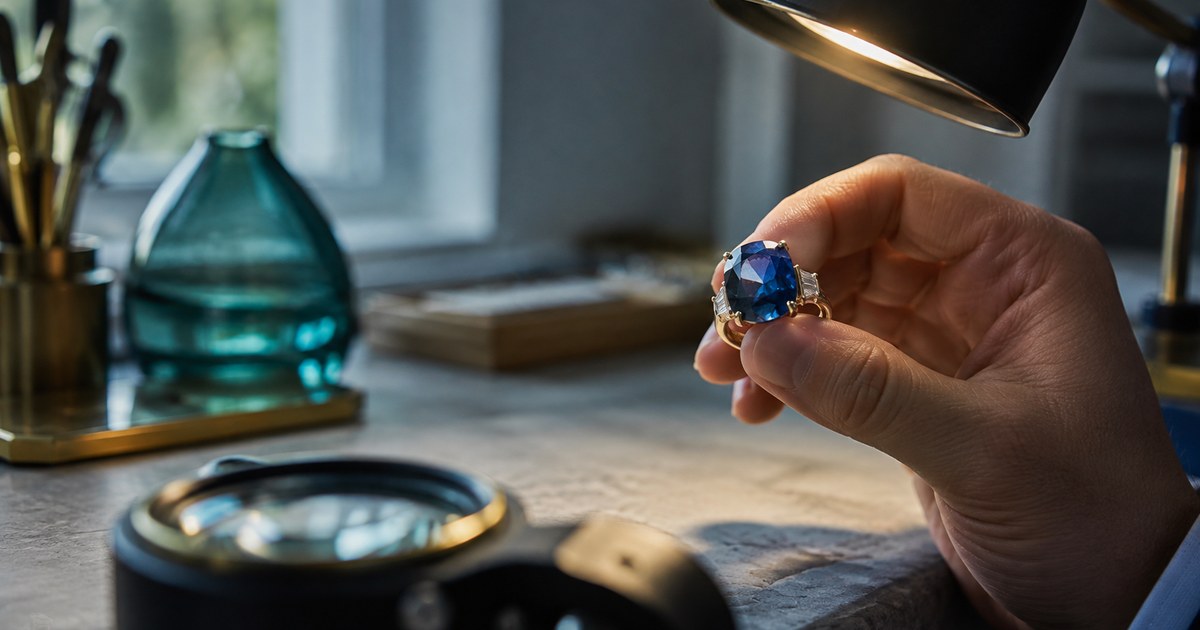
Someone tells you the blue stone in your grandmother’s ring was “probably heated,” and it lands like bad news. It usually is not. Most owners asking how to tell if a sapphire is real are actually asking three different questions at once, and untangling them is the difference between a calm evaluation and a needless panic about a perfectly genuine gem.
A real sapphire is natural corundum, colored any shade except red. Heat treatment is routine, accepted, and does not make a sapphire fake, only disclosable. What changes the answer is a synthetic origin, an aggressive treatment such as diffusion or glass filling, or a look-alike stone that is not corundum at all.
Here is how to separate those three questions, and which ones you can make progress on at home.
How to tell if a sapphire is real: three questions, in order
“Real” gets used for three separate things, and merging them is what causes most of the confusion.
- Is it corundum? Sapphire is the gem variety of corundum, an aluminum oxide, in every color except red. Red corundum gets its own name, ruby. Blue is the famous one, but sapphire also occurs in pink, yellow, green, orange, purple, and colorless, and the trade uses padparadscha for a light-to-medium pinkish-orange to orange-pink stone, a color range gemologists themselves describe as hard to pin down precisely. If the stone is not corundum, it is not a sapphire at any price.
- Did it grow in the earth or in a factory? Synthetic corundum is chemically the same material and just as hard, but it is manufactured, inexpensive, and worth a small fraction of a natural stone of similar appearance.
- What has been done to it since? Treatment sits on a scale. Routine heating is normal and expected. Lattice diffusion and glass filling are far more invasive and change what the stone is worth.
Answer them in that order. Ruling out a non-corundum look-alike is the easiest step, the natural versus synthetic call is the hardest, and the treatment question is the one most often misunderstood.
Why heat treatment does not make a sapphire fake
Heating corundum to improve its color and clarity is an old, established, and widely accepted practice in the gem trade. The stone that comes out is still natural sapphire: same mineral, same hardness, same origin in the ground. What heating does is deepen or even out the blue and dissolve some of the fine internal silk that clouds it. GIA’s guidance on gem treatments frames this as standard practice for corundum rather than an exception, and under the FTC Jewelry Guides a seller is expected to disclose treatments that affect a stone’s value.
Two practical consequences follow. First, if you inherited a sapphire and someone mentions heating, nothing has gone wrong. The overwhelming majority of blue sapphires on the market have been heated, and they are priced accordingly. Second, the reverse claim carries real money. An unheated stone of fine quality commands a premium precisely because it is uncommon, which means “unheated” is a claim you should never accept on a verbal say-so. Nobody can confirm it by eye. It takes a gemological laboratory report, and a fine sapphire sold as unheated without one is being sold on trust alone.
The treatments that genuinely change what you own
Beyond heating, two categories deserve their own line on any disclosure, because they alter the stone far more aggressively and materially reduce its value.
Lattice diffusion, sometimes called bulk diffusion, drives an element such as titanium or beryllium into the corundum at high temperature to create or change color. Depending on the process, the color may be concentrated in a shallow surface layer or driven deeper through the stone. Either way, a significant part of what you are looking at was added rather than grown, and a diffused sapphire is worth far less than an equivalent stone whose color is its own.
Fracture filling takes a stone with surface-reaching cracks and fills them with glass or a similar substance so the breaks become less visible and the gem looks cleaner. Lead-glass filling is the version most people have heard of, largely from the corundum’s red sibling, and the same logic applies here: you are buying a compromised stone plus filler, and the filler is vulnerable to heat, ultrasonic cleaning, and household chemicals. The same trap in red corundum is covered in how to tell if a ruby is real, and fracture filling in a very different mineral shows up again in how to tell if an emerald is real.
Both of these require disclosure. Neither is something you can reliably diagnose across a counter, which is one of the honest limits of any at-home look.
Natural or synthetic: reading the inclusions
Flame-fusion synthetic corundum, also called Verneuil, has been produced industrially for over a century, so lab-grown blue stones turn up routinely in older jewelry that was never meant to deceive anyone. It is cheap to make and, in a small stone, convincing to the naked eye. The differences live inside the gem, under 10x magnification.
- Curved growth striae. Flame-fusion material typically shows faint curved bands following the shape of the boule it grew from. Natural corundum instead shows straight, angular color banding that follows the crystal’s flat growth faces. Curved is the single most useful tell.
- Round gas bubbles. Spherical or teardrop bubbles, sometimes in trails, point to a melt-grown synthetic. Natural sapphires carry crystals, fine needles known as silk, healed fractures with a fingerprint-like pattern, and other irregular, angular features.
- The harder cases. Flux-grown and hydrothermal synthetics are a different problem. They grow slowly and can develop inclusions that resemble natural fingerprints and veils closely enough that separating them is laboratory work, not loupe work.
Color zoning is worth a second look on its own. Straight, angular bands of stronger and weaker blue, sometimes visible when you view the stone through the side rather than the top, are a natural growth signature. Smooth curves are not. The same flame-fusion history explains why the colorless stones in older diamond-look rings are so often lab-made corundum; what white sapphire is covers that case.
Blue look-alikes that are not corundum at all
Before worrying about synthetics, make sure you are holding corundum. Several stones sit in the same color range and behave differently:
- Blue spinel is a genuine gem in its own right, slightly softer than sapphire and singly refractive, so it lacks corundum’s optical doubling.
- Tanzanite is strongly trichroic, showing noticeably different colors (typically blue, violet, and a brownish or burgundy tone) as you rotate it, and it is much softer, which is why tanzanite in a daily-wear ring often shows wear that sapphire would not.
- Iolite also shows strong color change with viewing direction and is considerably softer.
- Blue topaz is common, inexpensive in its treated form, and cleaves, which sapphire does not.
- Blue glass gives itself away with round gas bubbles, internal swirls, conchoidal chips at the girdle, and a tendency to warm slowly in the hand rather than staying cool.
- Blue cubic zirconia is far more dispersive, throwing noticeably more rainbow fire than a sapphire of the same size.
Doublets and composite stones exist too, where a thin slice of one material sits on a base of another. Viewing the stone from the side, out of its setting where possible, is what reveals the join.
Hardness gives you one more observation. Corundum is a 9 on the Mohs scale, behind only diamond and lab-grown moissanite among gems you are likely to encounter, so a genuine sapphire shrugs off nearly everything it meets in daily life. Heavy surface scratching, rounded facet junctions, and a dulled table on a stone sold as sapphire are a reason to look harder at the identification. Treat that as something you notice, not something you test for: deliberately scratching a stone risks damaging a gem that may be exactly what it claims to be. The International Gem Society’s ordering of gems by Mohs hardness puts the common blue candidates in useful perspective.
When a lab report earns its cost
Here is the one honest boundary. The natural-versus-synthetic call and the identification of treatment are gem-laboratory work. They rely on magnification, spectroscopy, and reference data that no home check replaces, and the trickier synthetics defeat the loupe entirely. A laboratory report is worth paying for once the stone is worth materially more than the report costs, and it becomes close to essential whenever a price depends on a specific claim: unheated, no diffusion, a named origin, or a particular variety such as padparadscha.
Practical sequencing helps. Photograph the stone in daylight from the top and from the side, note the setting and any metal marks (our ring identifier guide covers what mounts and stamps tend to indicate about the stone they hold), and work through the general process in how to identify a gemstone before you commit to a report. That gives a lab, an appraiser, or a buyer something concrete to work from.
The practical takeaway
Do not let the word “treated” derail you. Heating is the norm for sapphire, it keeps the stone natural, and it needs only disclosure. Diffusion and glass filling are the treatments that move value, and both require disclosure of their own. Synthetic corundum is a separate question again, usually betrayed by curved growth striae and round gas bubbles where a natural stone would show angular color banding, silk, and crystals. Rule out the softer blue look-alikes first, since that is the step you can make real progress on at home, then send anything valuable or ambiguous to a laboratory. And be clear which value you are chasing: insurance replacement, realistic resale, and what a dealer will actually hand you are three different numbers for the same gem.
For a first read on a blue stone you cannot place, scan the piece with GemPeek: it flags the likely stone and setting type, visible marks and materials, condition, and an estimated value range, so you walk into a gemologist’s office with a structured starting point instead of a guess.