
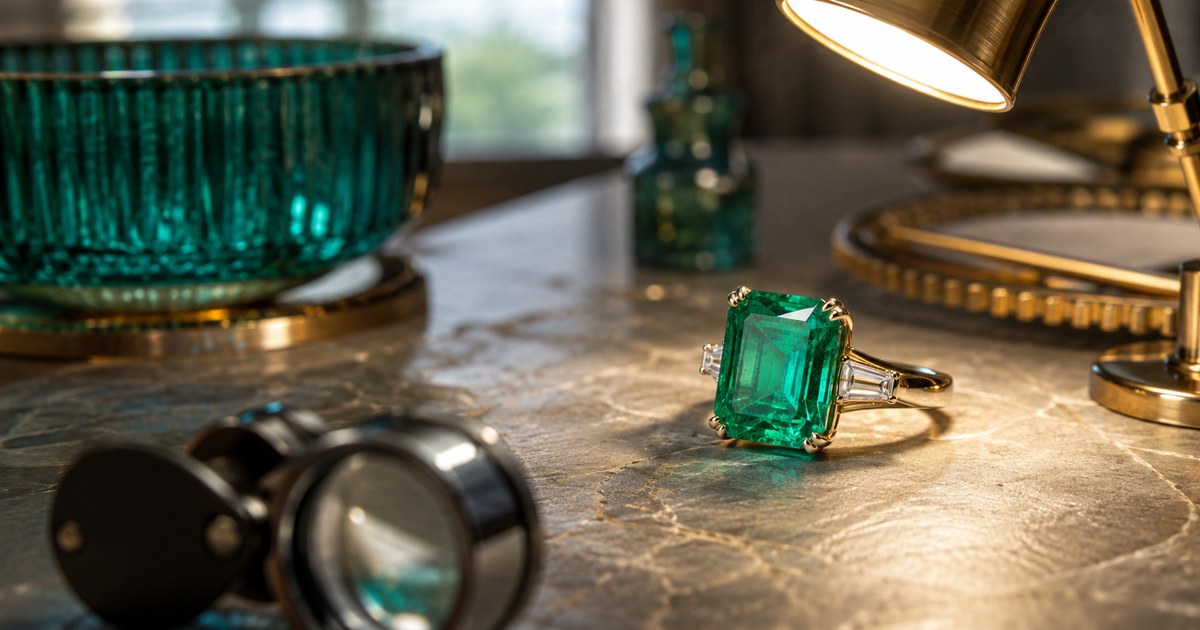
A green stone in an inherited ring invites a simple question with a complicated answer. Most guides on how to tell if an emerald is real stop at “check for inclusions” and never mention the thing that actually decides what the stone is worth and how you are allowed to clean it: nearly every emerald in circulation has had its fractures filled with oil or resin.
To tell if an emerald is real, look for a jardin of natural inclusions, expect fracture filling with oil or resin because almost every commercial emerald has it, and rule out green look-alikes such as peridot, tsavorite garnet, and glass. Lab-created emerald is chemically real emerald but worth far less.
Here is what each of those means in practice, starting with the treatment that gets left out.
Why fracture filling is the first thing to understand
Emerald is the green variety of beryl, and it grows in a geological environment that leaves it riddled with fine surface-reaching fractures. Those fractures scatter light and make a stone look cloudy or veiny. For a very long time the trade’s answer has been clarity enhancement: soaking the cut stone in cedarwood oil, or in a modern polymer resin, so that the filler’s optical properties come close enough to beryl’s that the fractures largely disappear. The stone looks cleaner and greener the moment it comes out of the bath.
This is not a scam, and it is not the same thing as a fake. It is a standard, accepted, and disclosable treatment, described in GIA’s guide to gem treatments alongside the other enhancements that are normal in the colored-stone trade. The FTC Jewelry Guides require sellers to disclose treatments that affect a gem’s value or that impose special care requirements, and emerald filling does both.
What matters to you as an owner is the degree. Labs describe clarity enhancement in broad steps, from none through minor, moderate, and significant, and that grade is one of the largest single levers on an emerald’s price. Two stones that look identical across a counter can sit far apart in value if one needed almost nothing and the other needed a lot of filler to get there. So the useful question is rarely “is it treated,” because the honest default assumption is yes. The useful question is how much, and only a gemological lab can answer that.
How to tell if an emerald is real by reading the jardin
Gem dealers call an emerald’s internal landscape the jardin, French for garden, because the inclusions look like foliage suspended in the stone. Natural emerald almost always has them: fine feathers, wisps, tiny mineral crystals, and irregular growth features that are visible with a 10x loupe and often to the naked eye. In emerald, unlike in most gems, a visible jardin is not a defect to be embarrassed about. It is the ordinary condition of the material, and it is one of your best signs the stone grew in the ground.
Turn that around and you get the most useful red flag an owner can apply at home. A large, perfectly transparent, eye-clean stone in a deeply saturated green, offered at a price that feels like a win, is far more likely to be glass, a synthetic, or a heavily filled stone than a natural bargain. Fine, clean natural emeralds exist, but they are among the more expensive colored stones on earth, and they do not turn up cheaply.
A few specific things to look for under magnification:
- Irregular, angular inclusions and feathers that look organic and randomly placed. These fit natural growth.
- Round gas bubbles, swirls, or a syrupy internal texture, which point to glass rather than beryl.
- A colored flash along a fracture when you tilt the stone, sometimes bluish or orange, which indicates a resin or oil filler sitting in that break.
- Facet edges that read slightly soft or rounded, which suggest a softer imitation that has worn, since beryl holds a crisp edge better than glass does.
Lab-created emerald is real emerald
This is where the word “fake” does more harm than good. Hydrothermal and flux-grown emeralds are produced in laboratories, and they are the same beryl colored by chromium or vanadium as a mined stone, essentially the same material rather than an identical one down to every trace detail a lab can measure. Calling them fake is inaccurate. They are lab-created emerald, and a jeweler who sells one is selling emerald.
The difference is value, not authenticity. Lab-created stones can be produced in sizes and clarities that nature rarely delivers, so they command a small fraction of the price of comparable natural material, and any honest seller discloses their origin. Under the loupe, flux-grown stones can show wispy veil-like inclusions or traces of residual flux, and hydrothermal stones can show subtle chevron or growth-pattern features, but these overlap enough with natural inclusions that the separation is genuinely difficult by eye.
That is the one boundary worth stating plainly: a definitive natural-versus-lab-created call, and a real grade for how much filler a stone carries, are lab jobs. A gemologist with a microscope and a spectrometer settles both in an afternoon. Everything above tells you whether the stone deserves that step, which is exactly what our note on what a jewelry appraisal costs is meant to help you decide.
Ruling out the green look-alikes
Plenty of green stones in old jewelry were never emerald in the first place. The common substitutions each have a tell:
- Peridot is a yellower, more olive green and has strong double refraction, so at 10x you can often see the back facet edges appear clearly doubled. Emerald’s doubling is weak and does not show that way.
- Tsavorite and demantoid garnet are genuine, valuable gems in their own right, usually cleaner than emerald and singly refractive, so they show no doubling at all.
- Green glass warms quickly in your hand rather than staying cool, often holds round bubbles or swirl lines, and chips in curved, shell-like flakes at the girdle.
- Green cubic zirconia is far more brilliant and fiery than emerald ever looks and feels noticeably heavy for its size.
- Doublets and triplets pair a thin slice of beryl or quartz over a backing, with a green cement layer between. View the stone from the side, out of its setting if possible, and look for a color line running parallel to the girdle.
Beryl sits at roughly 7.5 to 8 on the Mohs hardness scale, which is hard enough to resist casual scratching. Toughness is a separate property, and emerald’s is poor precisely because of those fractures, so it chips and cleaves more readily than its hardness number suggests. If a green stone in a daily-wear ring is still crisp-edged after decades of knocks, that is mild evidence for a tougher material than emerald. The broader method for reading any unknown stone is laid out in how to identify a gemstone, and the parallel checks for a red stone in the same jewelry box are in how to tell if a ruby is real.
The cleaning rule that follows from all of this
Because the filler is doing visible work, anything that removes it changes the stone in front of you. Ultrasonic cleaners and steam cleaners are the classic way people ruin an inherited emerald: the vibration or heat drives oil and resin out of the fractures, and a stone that looked fine going in comes out with a web of breaks suddenly visible. Solvents, acetone, alcohol, harsh jewelry dips, and prolonged heat do the same job more slowly. The damage is not always reversible, and re-oiling is a treatment in itself.
Clean an emerald with lukewarm water, a small amount of mild soap, and a soft brush, then rinse and pat dry. Take it off before swimming, cleaning, or gardening. Tell any jeweler that the green stone is an emerald before they put the piece anywhere near a machine, because a routine cleaning intended to be helpful is the most common way these stones get hurt.
The practical takeaway
Assume the emerald is treated, because almost all of them are, and treat that as normal rather than alarming. Look for a jardin: irregular natural inclusions support a mined stone, while flawless clarity at a friendly price is a warning rather than a bargain. Separate the impostors by color, doubling, warmth in the hand, and a side-on look for a doublet’s cement line. Remember that lab-created emerald is genuine emerald that simply costs far less, and that both the origin call and the degree of clarity enhancement need a lab. Then keep it out of the ultrasonic. When you are weighing what a piece is actually worth, be clear whether you want insurance replacement, realistic resale, or an auction estimate, since those are three different numbers. Reading the mount itself helps too, and our ring identification guide covers what the setting, prongs, and metal marks add to the picture.
For a fast first read on a green stone you cannot place, scan the piece with GemPeek: it flags the likely jewelry type, the visible stones and materials, the style and condition, and an estimated value range, so you walk into a gemologist’s office with a structured starting point rather than a guess.