
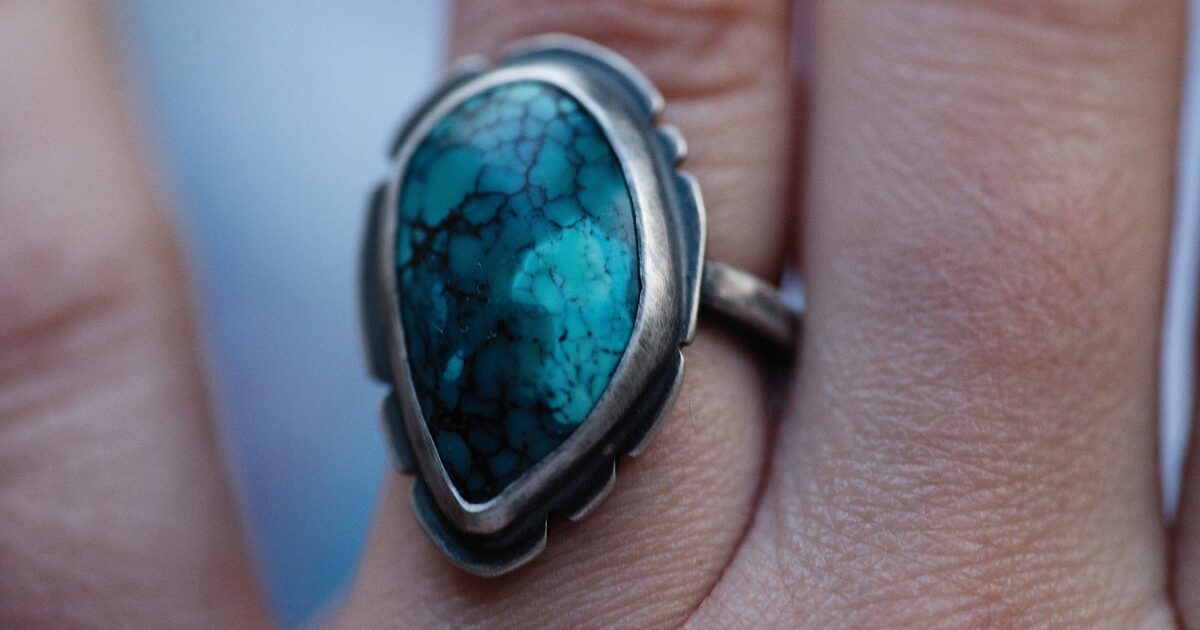
Most “is my turquoise fake” guides get one thing badly wrong: they treat any sign of treatment as proof of a fake. In reality the turquoise market runs on a spectrum, and the stone in your inherited squash-blossom necklace can be genuine turquoise that has simply been hardened. Knowing how to tell if turquoise is real means separating four different things, not two.
Turquoise comes in four broad grades: natural, stabilized, reconstituted, and outright imitation. Natural and stabilized are both real turquoise, the second just impregnated with resin to harden a porous stone. Reconstituted is powdered real turquoise bonded into a block, while true fakes such as dyed howlite, dyed magnesite, and plastic contain no turquoise at all. The test that matters is telling that last group from the first three.
Here is what each grade is, how to read the matrix, and the one safe home test worth doing.
What turquoise actually is
Turquoise is a hydrated copper aluminum phosphate that forms in arid, copper-rich rock. According to GIA, its color ranges from sky blue to blue-green to green, and it is often threaded with matrix, the veins of brown, black, or tan host rock that run through the stone. It is a relatively soft, porous gem, rating about 5 to 6 on the Mohs hardness scale per the International Gem Society, softer than quartz and easily scratched.
That softness and porosity explain the entire treatment story. Only a small share of mined turquoise is naturally hard enough to cut and wear without help. The rest is chalky and would crumble, fade, or soak up skin oils and turn green over time, so the trade stabilizes it. Understanding that reframes the whole “real or fake” question.
The four grades, from most to least genuine
Natural turquoise is dug, cut, and polished with no treatment beyond shaping. It is the least common and the most valuable, and top natural material from historic mines commands high prices. Because it is untreated, its color can shift slightly with age and wear.
Stabilized turquoise is genuine natural turquoise that has been impregnated with a clear resin or polymer to harden the porous stone and lock in its color. As GIA notes on gem treatments, impregnating porous material with polymers or resin is a recognized, disclosed enhancement. This is the crucial point owners miss: stabilized turquoise is still real turquoise. It is the majority of what sells today, it is not a fake, and it wears more reliably than fragile natural stone. It is worth less than fine natural turquoise of the same look, but it is a real gem.
Reconstituted turquoise, sometimes called reconstructed, is made by grinding up small fragments and powder of real turquoise and bonding them with resin into a block that is then cut. It contains real turquoise but is essentially a composite, so it sits well below natural and stabilized in value. Very even color with no natural depth is a common sign.
Imitation is not turquoise at all. The usual stand-ins are dyed howlite and dyed magnesite, both naturally white, porous minerals that take blue dye easily and can even show gray or black veining that mimics matrix. Plastic, resin, and dyed glass round out the group. These have no turquoise content and no gem value.
So the honest hierarchy is that natural beats stabilized beats reconstituted, and all three are real turquoise, while dyed howlite and plastic are the true fakes to catch.
Reading the matrix
Matrix is the veining, and it is one of the better visual clues. In natural and stabilized turquoise the matrix is part of the host rock, so it tends to look integrated, varying in width and depth and sometimes sitting slightly recessed because the surrounding rock is harder or softer than the blue. Prized spiderweb turquoise shows a fine, even net of matrix, but even that has an organic irregularity.
Imitations often get the matrix wrong. Dyed howlite can show veining that looks too uniform, too black, or sits on the surface rather than running through the stone, and dye tends to pool darker in the cracks. Plastic and reconstituted block can repeat a pattern from piece to piece, show tiny trapped bubbles, or carry a suspiciously perfect, poreless blue. A row of “turquoise” beads that are all identical in color and marking is a warning sign, since natural material varies bead to bead.
The one safe home test, and the one to skip
The useful, low-risk test is the acetone swab. Dampen a cotton swab with pure acetone and rub it gently on an inconspicuous spot, such as the back of a cabochon or a drill hole:
- If blue or green color transfers onto the swab, the piece is dyed, which points to dyed howlite, dyed magnesite, or dyed low-grade material, not genuine turquoise color.
- If no color comes off, that is consistent with real turquoise, natural or stabilized. It does not distinguish natural from stabilized, and it will not lift the clear resin used in stabilization, which is exactly why it is a fake-catcher rather than a treatment detector.
Two cautions. Acetone can affect some resin finishes, so keep it to a small hidden area and a light touch. And skip the hot-needle test entirely. Touching a heated needle to the stone to smell for melting plastic is destructive: it can scorch, pit, or melt the piece, the smell is easy to misread, and you can permanently damage a genuine stone to learn something the acetone swab and a loupe usually settle. A soft stone like turquoise is not worth burning.
Beyond those, feel and temperature give rough hints, since stone stays cool to the touch while plastic warms quickly in the hand, but treat that as a nudge, not proof.
Turning the grade into a value question
Once you know which of the four grades you are holding, value follows the usual levers of quality, origin, workmanship, and demand, explained in what makes jewelry worth more. Fine natural turquoise in a well-made silver setting is a different object from a dyed-howlite bead strand, even when they look alike at arm’s length. Because turquoise so often turns up in cuffs and bangles, the bracelet identification guide shows where maker marks and construction clues hide. The same “confirm before you assume” discipline that applies to a suspected diamond in how to tell if a diamond is real applies here, and when a piece looks genuinely fine, weigh the modest cost in how much a jewelry appraisal costs against selling it blind. Turquoise is not the only stone where a treated original still counts as real rather than fake; the same grading-not-faking logic runs through how to tell if opal is real.
For a fast first read, scan the piece with GemPeek: it flags the likely jewelry type, the visible stones and materials, the style and condition, and an estimated value range, giving you a structured starting point to confirm with a gemologist before you insure or sell turquoise that might be fine natural material.