Almost every guide to how to tell if amethyst is real opens with “check the color,” then describes the color of good amethyst and leaves you comparing your stone to a photograph. That advice has the logic backwards. With amethyst, the useful signal is not how pretty the purple is. It is how evenly it is distributed.
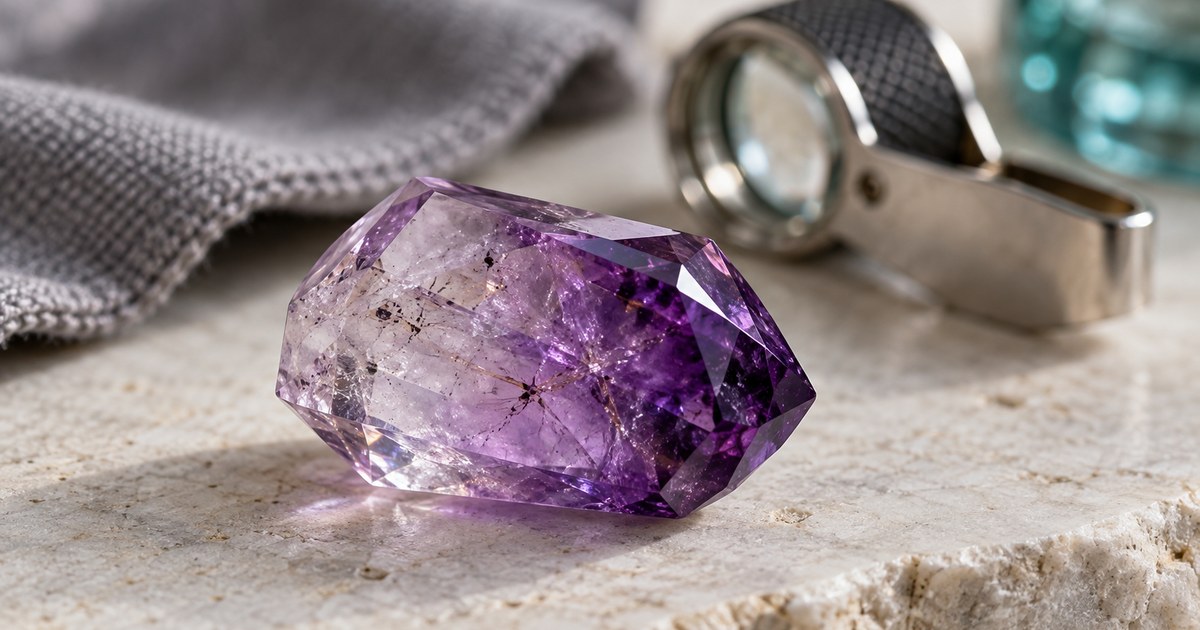
Natural amethyst is quartz colored by trace iron, and that color almost never arrives perfectly even. Look for uneven color zoning, faint banding, and small natural inclusions. A stone that is flawlessly clear with a single saturated purple running edge to edge, especially a large cheap one, is more likely glass or lab-grown material than a natural find. Pink quartz follows a different rule, since natural rose quartz is cloudy rather than clear, which is covered in how to tell if rose quartz is real.
The checks below run in the order that narrows things down fastest, starting with the ones that catch an imitation outright and ending with the ones that only shift the odds.
What amethyst is, and what it is usually confused with
Amethyst is the purple variety of quartz, with a Mohs hardness of 7, which the International Gem Society notes is durable enough for any jewelry setting including rings. Its color runs from pale lilac to deep reddish purple.
Four different things turn up in jewelry described as amethyst, and they are not equally worrying:
- Natural amethyst. Mined quartz, abundant and generally inexpensive relative to the rarer colored stones. This is what most amethyst in older jewelry is.
- Synthetic amethyst. Real quartz, grown in a lab rather than the ground. It has the same chemistry and physical properties as the natural stone, which is why the International Gem Society is candid that separating it takes laboratory work, not a home test.
- Treated quartz. Heat treatment is common across the quartz family and is stable, and no home test will reveal it. Heated to yellow or red-orange, amethyst becomes citrine by trade definition. Amethyst from a small number of deposits turns green on heating instead, and that material is sold as prasiolite.
- Imitations. Glass and purple plastic, plus assembled or dyed material. These are the ones you can actually catch at home.
That order matters, because it sets a realistic goal: catching glass is easy, and catching a lab-grown quartz is a laboratory job.
The color zoning tell
This is the check most competitor guides skip. Natural amethyst commonly shows uneven color: the purple pools more strongly in some parts of the crystal than others, and cutters orient the rough to hide it as best they can. The International Gem Society notes that Brazilian material often shows uneven color despite cutters’ best efforts, while stones from other sources tend to be smaller but more richly colored.
Tilt your stone slowly under a bright, neutral light and watch how the purple moves:
- Patchy or banded color that shifts as you rotate the stone is a natural characteristic. It is not damage and it is not a flaw to be alarmed about.
- Color that is absolutely uniform from every angle, in a bright, almost neon purple, deserves a second look. Perfectly even saturation is easier to manufacture than to find.
- Color that sits only in the surface layer, concentrated in scratches, chips, or around the girdle where the stone meets the setting, suggests dyed or coated material rather than colored-through stone.
Plenty of natural amethyst is beautifully even, and some synthetics are grown with deliberate zoning, so use color distribution to decide how hard to look at everything else rather than as a verdict on its own.
The glass tells you can check at home
Glass is the imitation most likely to be sitting in an inherited box, and it gives itself away in several ways at once. Take the piece to a window or a bright lamp and look closely, ideally with a magnifier:
- Round bubbles. Trapped spherical bubbles are a glass signature. Natural quartz has inclusions, but they are crystals, fine feathers, and liquid veils, not neat round spheres.
- Swirls and flow lines. Faint curved striations inside the body of the stone, like a stirred liquid frozen in place, mean molten material, not a crystal.
- Mold seams and rounded facet edges. Run a fingernail across the facet junctions. Cut stone has crisp, sharp edges where facets meet. Molded glass has soft, slightly rounded ones, and sometimes a faint seam running around the stone.
- Surface wear in the wrong places. Quartz at Mohs 7 resists everyday scratching reasonably well. Glass sits lower on the hardness scale, so an old glass stone tends to show scuffs and abraded facet edges that a genuine amethyst of the same age would not.
The touch test is worth knowing but not overtrusting: quartz conducts heat away from your skin better than glass does, so a real stone tends to feel cool for a moment longer when you first press it to your cheek or lip. Warm rooms, warm hands, and a metal setting all interfere with this, so treat it as one soft signal among several rather than proof.
Why you should skip the scratch test
Scratch testing gets recommended constantly and it is close to the worst idea in home gem identification. Amethyst sits at Mohs 7, so proving hardness means dragging something harder across a stone that is already mounted in a setting you would have to pay someone to repair. You risk chipping the girdle, scratching the metal, or loosening a prong, and a positive result still does not separate natural from synthetic quartz, since both have the same hardness.
If you feel you must test hardness, do it on an unmounted stone, on the girdle rather than the table, and only after you have exhausted the visual checks. The same restraint applies with softer, more fragile stones, which is why turquoise identification and jade identification both lean on appearance and structure rather than destructive tests.
Putting the checks in order
Work through the piece in this sequence, spending the most time on the earliest steps:
- Read the setting and the marks first. A stone set in a marked gold or silver mount was worth mounting properly, which shifts the odds toward a genuine stone. A purple stone glued into an unmarked base-metal mount is a different proposition.
- Look for bubbles, swirls, and soft facet edges. These separate glass from crystal faster than anything else.
- Study the color distribution. Zoning and gentle unevenness point natural. Flawless neon uniformity in a large, cheap stone points to lab-grown or imitation.
- Look at the inclusions. Fine feathers, veils, and tiny crystals are natural fingerprints. Total flawlessness at a low price is a flag.
- Accept the limit. If the stone passes every check, you have established that it is quartz and probably amethyst. Natural versus lab-grown is a laboratory call, and for a stone in this price range that call is usually only worth paying for when the piece itself is valuable.
That last point is not a hedge, it is the honest economics. Amethyst is a stone where the setting, the maker, and the era often carry more of the piece’s value than the stone does, which is exactly the pattern described in how to identify a gemstone. It is the reverse of the situation with a colorless stone, where the material question dominates, as in moissanite vs diamond.
What a photo can settle
A good, well-lit photo can show a lot here: bubbles, swirl lines, facet-edge crispness, surface wear, how color is distributed through the stone, and the marks on the mount. It cannot show hardness, refractive index, or the growth structures a gemologist uses to separate natural quartz from lab-grown quartz. Knowing which questions a photograph can answer is what keeps a first read useful rather than misleading.
If the stone is still ambiguous after all of that, scan the piece with GemPeek. It reads back the likely stone, the setting style and materials, the condition, and a value range to expect, which is the context that tells you whether a jeweler’s opinion is worth paying for.