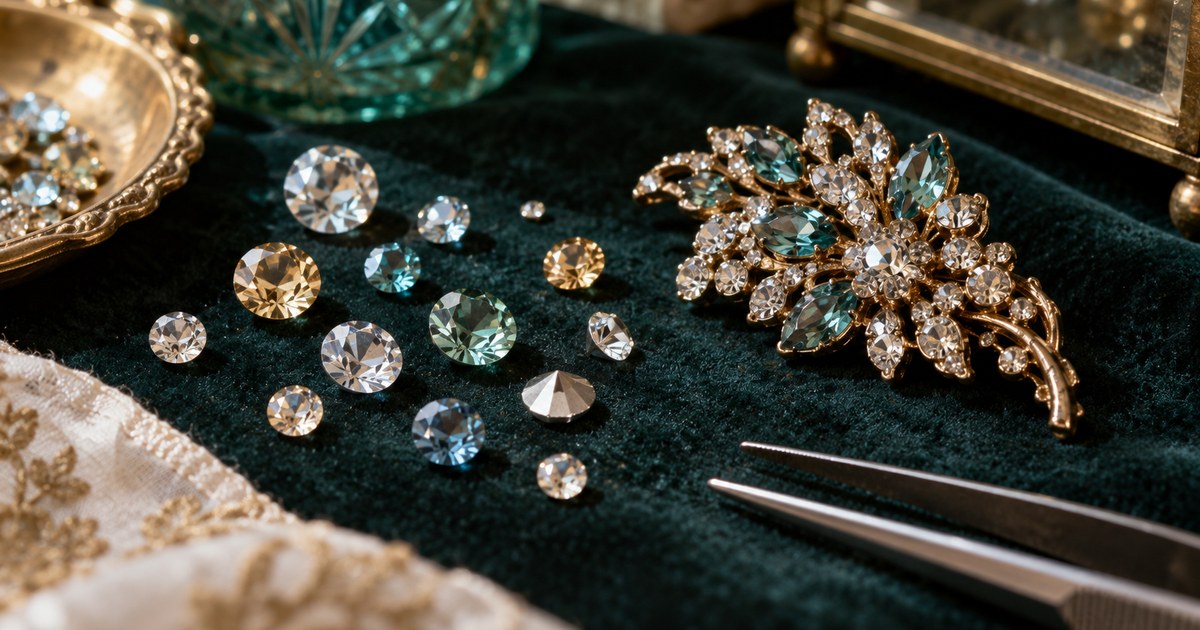
What are rhinestones? They are the sparkling clear and colored stones on costume brooches, evening bags, belt buckles, and stage costumes, and they are the most common “gem” in any inherited jewelry box. Knowing what they are made of tells you straight away what a piece can and cannot be worth.
Rhinestones are imitation gemstones made of faceted glass, usually lead (crystal) glass, and often coated or foil-backed on the underside to throw more light. The name comes from rock crystal once gathered along the river Rhine. They imitate diamonds and colored gems, but they are glass: attractive and collectible in signed costume jewelry, with no gem value of their own.
The rest of this guide covers how they are made, how to recognize them in a setting, and when rhinestone jewelry is worth more than the stones suggest.
Where the name comes from
Britannica explains that the name originally meant gemstones cut from rock crystal (clear quartz) taken from the Rhine in Germany, and that it was later applied to faceted rock crystal generally. Over time the word moved from natural quartz to man-made glass. Wikipedia’s entry notes that rhinestones have been made from crystal glass or polymers such as acrylic since the nineteenth century, and that today the name applies to varieties of lead glass known as crystal glass.
Two names travel with rhinestones in older pieces:
- Paste is the older term for glass gems in antique jewelry. Wikipedia describes paste as glass made by grinding lead glass, packing it into a mold, and firing it.
- Strass comes from Georg Friedrich Strass, the eighteenth-century jeweler credited with imitation diamonds made by coating the underside of lead glass with metal.
Rhinestone vs crystal: are they the same thing?
Mostly, yes. In jewelry, “crystal” usually means high-quality lead glass, and that is the same material modern rhinestones are made of. Wikipedia notes that crystal rhinestones are produced mainly in Austria, by Swarovski. The word crystal here describes the glass, not natural quartz crystal and not a gemstone. Plastic (acrylic) rhinestones also exist and are the cheapest version.
How rhinestones are made to sparkle
Glass bends light far less than diamond does, so on its own a faceted glass stone looks fairly flat. Rhinestone makers solve that with a reflective layer on the pointed back of the stone. Wikipedia notes that classic rhinestones carried a metal coating on the bottom side only, the technique associated with Strass. The coating acts like a mirror, bouncing light back up through the top.
That backing is also why rhinestones are almost always set in closed-back cups or glued into place. The foil has to stay dry and intact to keep working.
Some rhinestones carry an iridescent “aurora borealis” coating, a thin rainbow film applied evenly over the stone by metal deposition, which Wikipedia dates to Swarovski in the mid-1950s. Seeing it is a useful hint that a piece is mid-century or later.
How to tell rhinestones from real gems
Work through these at home with a loupe or your phone’s zoom. The jeweler’s loupe guide shows how to hold one and what to focus on.
- Look at the back. A silvery, mirror-like or foil-colored back, sometimes showing through a scratch or chip, points to a rhinestone. Modern fine gems are rarely foiled, though Georgian-era jewelers often set real gems over foil in closed-back settings, as the International Gem Society’s guide to Georgian jewelry explains, so on an antique piece a foiled back is a clue, not proof.
- Check for darkening. When moisture gets behind the foil, a rhinestone goes cloudy, grey, or black. Collectors call these “dead” stones. Modern open-set gems do not darken this way.
- Study the facet edges. Glass sits at about 5.5 on the Mohs scale, per Wikipedia’s Mohs hardness table, so rhinestones show rounded, scuffed facet edges and small chips with age. A diamond, at 10, keeps sharp edges for generations.
- Look for molded facets. Cheaper rhinestones are pressed in molds, which leaves slightly rounded facets and soft corners instead of crisp, flat planes.
- Look inside. Round gas bubbles and swirl marks are typical of glass.
- Check how the stones are held. Glued stones sitting in shallow cups, or on a flat surface with no metal over their edges, are a costume jewelry signature. Prong-set rhinestones exist, so prongs alone prove nothing.
If a clear stone passes these checks and you think it might be a diamond, move to how to tell if a diamond is real, which covers the tests that actually separate diamond from its imitators.
Rhinestone, cubic zirconia, or diamond?
These three get confused constantly, and they are very different:
- Rhinestone: glass, usually foil-backed, soft enough to scratch and chip with wear.
- Cubic zirconia: a synthetic crystal, much harder than glass at about 8 to 8.5 on the Mohs scale, per Wikipedia’s cubic zirconia entry, and not foil-backed. Its dispersion is higher than diamond’s, so it throws strong rainbow fire. Its name also gets mixed up with zircon, a natural gem, which is zircon the same as cubic zirconia clears up.
- Diamond: a natural or lab-grown gem, 10 on the Mohs scale, set open-backed in fine metal far more often than not.
The metal is a strong supporting clue. Rhinestones mostly sit in plated base metal or white metal settings, while a diamond is usually set in marked gold or platinum.
Are rhinestones worth anything?
The stones themselves have little value. Rhinestone jewelry can be another story. Signed costume pieces from well-known makers, strong period designs, and complete matching sets are actively collected, and for those the design and the maker’s mark carry the value, not the glass. That logic is laid out in is costume jewelry worth anything.
Condition matters a lot. Dead or missing stones, worn plating, and broken clasps all pull a rhinestone piece down, though a jeweler who works with costume pieces can often replace individual stones. Before you sell or donate a tray of glittering costume pieces, turn each one over and look for a signature on the back or the clasp.
GemPeek can give you a quick first sort: scan a brooch or necklace for the likely stones, metal, style, era, condition, and an estimated value range, so you can tell a signed collectible from an everyday piece before you decide what to keep.