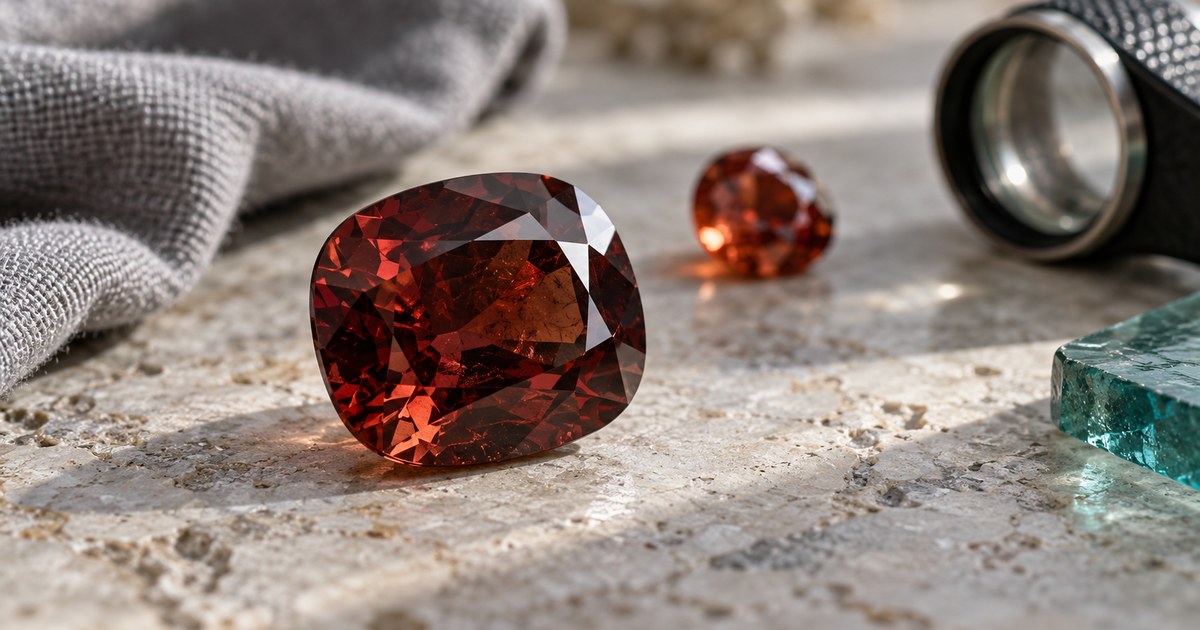
Most guides on how to tell if a garnet is real start from a false premise: that garnet means a dark red stone. Garnet is not one mineral, it is a family of related species that occur in nearly every color, and starting from “red” makes you misidentify the green one in a Victorian brooch and mistake the red one for a ruby.
Garnet is a family of related species that the International Gem Society groups into seven, with a hardness of about 6.5 to 7.5 and refractive indices spanning roughly 1.72 to 1.95 across the group. Most garnets are singly refractive and inert under ultraviolet light, which is the useful contrast with ruby: ruby is a corundum that commonly fluoresces red under UV. Glass imitations give themselves away with bubbles and swirls instead.
Work through a red or unusually colored stone in the order below and you can get a long way without a lab.
Garnet is a family, not a color
The International Gem Society lists seven major garnet species, and their colors overlap almost everything a jewelry box contains. Other references count the family slightly differently, since some members are treated as varieties rather than species, but the practical point survives any of those groupings:
- Almandine: deep red, brownish red, violet red. The classic Victorian garnet.
- Pyrope: purplish red, pinkish red, orangey red, dark red. Very dark pyrope is the one most often mistaken for ruby.
- Spessartite: red, orange, yellow-brown, blackish brown. The bright orange garnets belong here.
- Grossular: nearly every color except blue, including colorless, yellow, green, pink, and brown. Green grossular is sold as tsavorite.
- Andradite: yellow-green, green, brown, black. Green andradite is demantoid, the most prized garnet of all.
- Uvarovite: dark green.
- Hydrogrossular: bluish green, sometimes pink, white, or grey. Often opaque, and frequently mistaken for jade.
The practical consequence is worth sitting with. A green stone in an old ring can be a garnet. So can an orange one, a colorless one, and an opaque jade-looking one. If you have been assuming your inherited “garnet” is red and your green stone is emerald, both assumptions deserve a second look.
Two garnet types, demantoid and tsavorite, are genuinely valuable stones rather than the inexpensive red material most people picture, which is a good reason not to dismiss a garnet identification as a disappointment.
The ruby question, and the UV check that helps
Dark red pyrope and a real ruby look similar enough in a closed setting that this mix-up drives a lot of inherited-jewelry disappointment in both directions. Three signals separate them.
Fluorescence. GIA notes that chromium causes fluorescence in ruby, adding to the intensity of its red, and that marble-hosted rubies typically fluoresce red under ultraviolet light, even under the ultraviolet in sunlight. Garnets, by contrast, are generally inert under UV, with grossular the exception that can show some fluorescence. So a red stone that glows visibly red under a UV lamp in a dark room is pointing toward ruby, while one that stays flat is pointing toward garnet. Neither result settles it alone, and a small inexpensive UV torch is the only equipment involved.
Tone. The International Gem Society notes that ruby-like pyropes tend to have a very dark tone that distinguishes them. Garnet red often reads slightly brownish or purplish in daylight where fine ruby reads pure or slightly pinkish red. Compare the stone against a white background under daylight rather than shop lighting.
Doubling. Garnets are singly refractive, so looking through the table at the back facets shows single, crisp facet edges. Ruby is doubly refractive and can show a faint doubling of those edges under magnification. Corundum’s birefringence is modest, so this is often invisible in a mounted stone, and seeing nothing proves nothing. When you do see clear doubling, though, it is a real property of the material rather than an impression.
If your stone leans toward the ruby answer, the traps particular to that market, especially lead-glass composites, are covered in how to tell if a ruby is real.
Catching glass and synthetic imitations
Red glass has been used in jewelry for centuries and is the most common garnet imitation in inherited pieces. It reveals itself the same way glass always does, and a magnifier is all you need:
- Round bubbles or curved swirl lines in the body of the stone. Natural garnets contain crystals, needles, and feathers, never neat spheres or frozen flow lines.
- Soft facet edges and mold seams. Cut stone has crisp facet junctions. Molded glass rounds them, and may carry a faint seam.
- Scuffed surfaces. Glass is softer than garnet’s 6.5 to 7.5 hardness, so an old glass stone shows abrasion on the table and facet edges that a garnet of the same age would not.
Synthetic red spinel is the other frequent stand-in, particularly in mid-century and mass-market pieces. It is clean, bright, and consistent, and separating it from garnet reliably is a refractive-index measurement rather than a home observation. A useful heuristic: a flawless, evenly colored red stone in an inexpensive setting is more likely synthetic spinel or glass than a natural garnet, because natural garnet almost always shows some inclusions.
The same “too perfect is a flag” logic runs through how to tell if amethyst is real, and it is the most transferable instinct in home gem identification.
Do the classic home tests work here?
Mostly not, and two are worth actively avoiding.
Scratch tests put a garnet at 6.5 to 7.5 on the Mohs scale in contact with something harder while it sits in a setting you would have to pay to repair. The information gained is small and the risk is real.
The magnet test is the one genuine oddity in garnet identification. Most gemstones ignore a magnet entirely, but garnets carry enough iron or manganese to respond, and with a strong neodymium magnet the response can be clear enough to pick up an unmounted stone of some species outright, while others need a floatation setup to measure. Gemologists use calibrated magnetic-response testing to help sort garnet species for exactly this reason. It needs a loose stone, a proper suspended-magnet rig, and reference data to interpret, so waving a fridge magnet at a mounted ring will tell you nothing useful.
Density and refractive index do separate garnets cleanly, and both are bench measurements on an unmounted stone. That is exactly the boundary described in how to identify a gemstone: appearance, inclusions, and setting narrow the field at home, and instruments finish the job.
What to do with what you find
Work in this order. Note the color honestly, including whether it reads brownish or purplish. Look for bubbles and swirls under magnification. Check for inclusions, since their presence supports a natural stone. Try a UV torch in a dark room and note whether the stone glows red. Look for doubled facet edges through the table. Then judge the setting: an old, well-made mount in marked gold or silver suggests the stone was worth mounting properly.
None of this certifies the stone, and it does not need to. What it does is tell you whether you are holding an inexpensive red garnet in a nice Victorian setting, a possible ruby that deserves a gemologist, or a piece of glass. Those three outcomes call for three different next steps, and knowing which one you are in is most of the value.
The same “narrow it visually, confirm it properly” approach applies when the stone is colorless rather than red, which is the whole basis of moissanite vs diamond.
A scan with GemPeek will give you a structured version of the same first read: the likely stone, the setting materials and style, the condition, and the range a piece like it tends to be worth. Use it to decide which of the three outcomes above you are in, then let a gemologist settle the ones that matter.